P0300: Random Multiple Misfire — When Your Engine Decides to Do Jazz
P0300 is the code that lands when your engine has stopped committing to any particular cylinder and has instead decided to misfire at random — a rolling chaos rather than one bad actor. Unlike P0301–P0308, which politely point a finger at a specific cylinder, P0300 means the misfire is jumping around, which tells you something systemic is wrong: fuel, air, timing, or spark on a scale that affects multiple pots at once. It's often accompanied by shaking that vibrates through the seat, a flashing Engine Management Light, and the distinct sensation that your engine is trying to run on vibes alone. SOSCarFix diagnoses it on your driveway — live data, methodical testing, no guessing, no parts-cannon approach.
See our upfront pricingP0300 is the engine's way of telling you it's misfiring everywhere at once — not your coil, your whole setup. We diagnose it on your driveway. Get a quote.
How it actually works
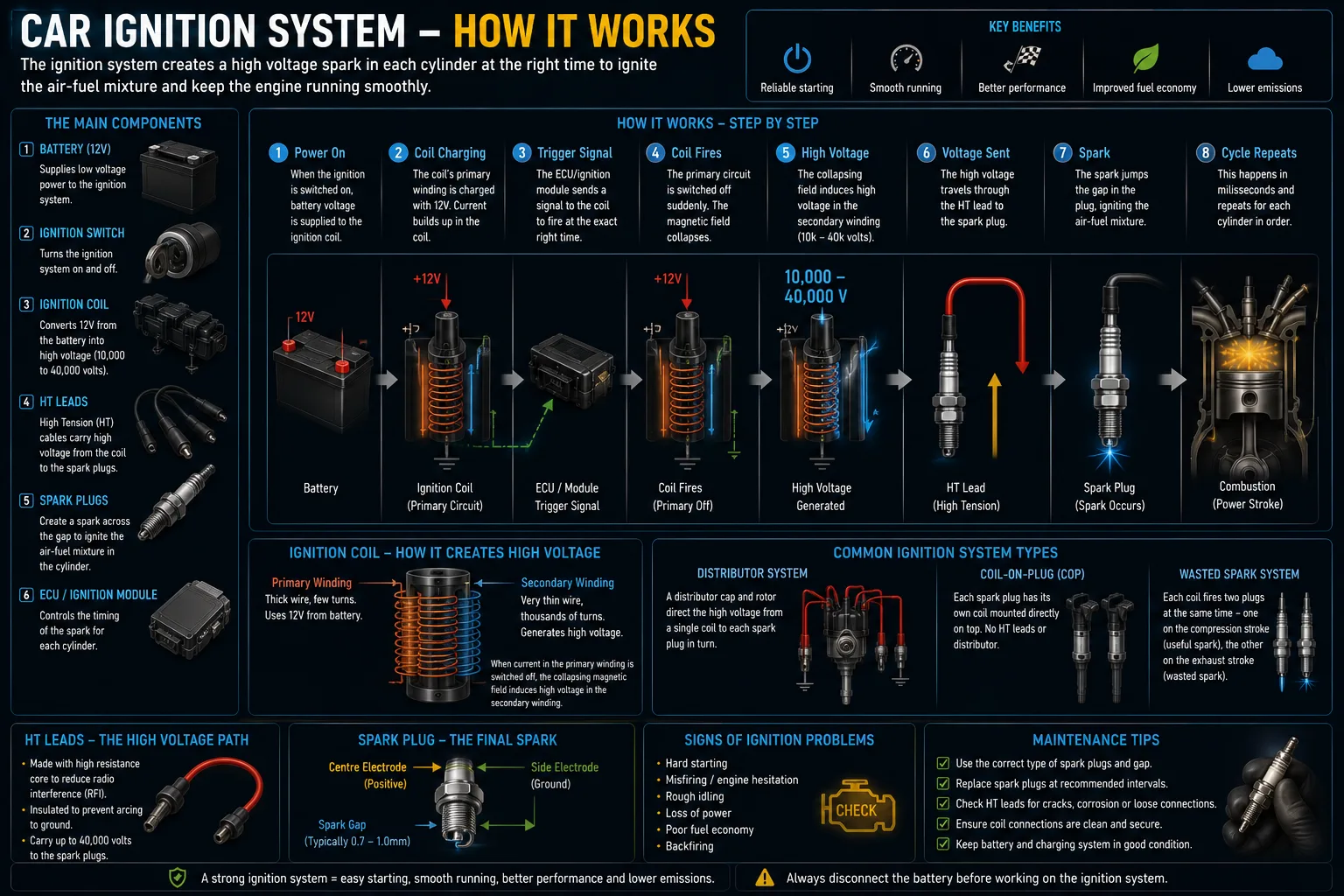
Your engine runs on a precisely timed four-stroke cycle: intake, compression, ignition, exhaust. In each cylinder, a spark plug fires at exactly the right moment, igniting the fuel-air mixture and pushing the piston down. The ECU monitors how smoothly the crankshaft rotates — when a cylinder misfires, the crank slows fractionally at that point in the cycle. The ECU logs that as a misfire event for that cylinder. If the misfire is consistently in cylinder 3, you get P0303. If it's jumping between cylinders — cylinder 2 one second, cylinder 4 the next, then cylinder 1 — the ECU can't pin it on one pot, so it logs P0300: random/multiple misfire detected. That randomness is the diagnostic clue. A single bad coil causes a cylinder-specific code. P0300 tells you something shared is struggling — fuel pressure that's marginal, a MAF reading that's skewed, a vacuum leak starving several cylinders, a cam timing that's slightly out, or old plugs wearing uniformly across the lot. The ECU isn't diagnosing the cause for you; it's flagging that the problem is too widespread to point at one place. The misfire count matters too: a small number logged over many miles is different from a high rate right now, and live data tells us which.
“SOSCarFix diagnoses it on your driveway — live data, methodical testing, no guessing, no parts-cannon approach.”
Sound familiar?
So what's behind it?
What we do — at your door
We come to you — driveway, car park, office forecourt — with a professional diagnostic setup, not just a code reader from a motorway services shop. We pull the full fault code history to see whether P0300 is travelling with any cylinder-specific codes (P0301–P0308) or supporting codes like P0171 (lean fuel trim) or P0101 (MAF), which narrows the field immediately. Then we go into live data: misfire counters per cylinder in real time, fuel trim values, MAF readings, fuel pressure where we can test it, and ignition timing. A fault code is the starting point of a diagnosis, not the diagnosis itself — we don't replace parts because a code exists; we test to confirm which part is the actual cause before quoting for any work. Once the root cause is confirmed we carry out the repair on-site: plug changes, coil swaps, cleaning the MAF, tracing vacuum leaks with smoke or carb cleaner, and clearing codes with a road test check to confirm the misfire count drops to zero.
What affects the price
Cost depends entirely on what's causing it. A full set of spark plugs is one of the cheaper fixes — parts cost varies by make (standard copper plugs are inexpensive; OEM iridium plugs on a six-cylinder German car less so) and labour is straightforward on most engines, though some require inlet manifold removal (e.g. certain VW/Audi transverse engines with rear-bank plugs). MAF sensor cleaning is sometimes free — a careful clean with MAF cleaner can restore a dirty sensor without replacing it; a replacement MAF varies considerably by make. A fuel pump is a bigger job, cost-wise, with parts ranging from modest on a common hatchback to significant on a prestige car. Vacuum leak tracing and repair is usually labour-heavy relative to parts cost. Cam timing work (chain and tensioner) is more involved and should be quoted separately once confirmed. We charge a diagnostic fee for our time and equipment — that fee is transparent upfront, and applies against any repair work we carry out on the same visit.
Random knowledge you didn't ask for
Questions you're probably asking
What's the difference between P0300 and P0301, P0302, P0303 etc.?
P0301–P0308 identify a misfire in a specific cylinder (number after the zero = cylinder number). P0300 means the ECU detected misfires but couldn't consistently blame one cylinder — they're random or spread across multiple cylinders. You can get P0300 alongside cylinder-specific codes, which still helps narrow the search. But P0300 alone is a signal that the fault is systemic, not a single component in one place.
Can I keep driving with a P0300?
Depends on the EML. Steady light and the car drives reasonably normally: get it booked in within days, not weeks — misfires stress the catalyst and waste fuel, but you're not in immediate danger. Flashing EML: reduce speed, avoid high engine loads, and get it looked at the same day. Sustained misfiring at high fuel flow can overheat and destroy the catalytic converter, which is an expensive problem layered on top of whatever you already have.
Is P0300 always an ignition problem?
No, and this is exactly why parts-shotgunning is a bad idea. Plugs and coils are common causes, but so is low fuel pressure, a dirty MAF, a vacuum leak, or cam timing. Fitting a full set of coils when the real problem is a split vacuum hose is a frustrating waste of money. Live data diagnosis — fuel trims, misfire counters per cylinder, sensor readings under load — points at the actual cause before anything gets replaced.
My car shakes at idle but smooths out when revving — is that a misfire?
Very likely, yes. Misfires are often worst at idle because fuel and ignition timing are at their most marginal — any weakness in the system shows up first at low revs. When you rev up, fuel pressure rises and dwell time increases, which can temporarily mask a weak component. It doesn't mean it's fixed; it means the fault is lurking. A misfire count check in live data will confirm it even if the car feels better when moving.
Could a P0300 be caused by bad fuel?
Yes, occasionally. Contaminated fuel — water in the tank, diesel misfuelling in a petrol car, or a genuinely poor batch — can cause random misfiring. If the fault appeared immediately after a fill-up and the car had no prior issues, that's worth flagging. However, bad fuel causing P0300 is far less common than worn plugs, weak fuel pressure or a vacuum leak — so we test rather than assume.
P0300 — sorted at your door
Stop procrastinating. Get a transparent quote and we'll come to you.