P0171: System Too Lean Bank 1 — the code that sends people down an expensive rabbit hole
P0171 — System Too Lean Bank 1 — is one of the most common fault codes on UK roads, and also one of the most misdiagnosed. Every internet forum will tell you to replace the oxygen sensor. That is, very often, completely wrong. The code means the ECU is trying to add extra fuel to compensate for what it thinks is too much air (or too little fuel), and it's lost the battle. Why? Could be a vacuum leak letting unmetered air in. Could be a dirty MAF sensor lying about how much air is there. Could be a weak fuel pump or partially-clogged injectors. The O2 sensor might just be faithfully reporting a problem it didn't cause. SOSCarFix comes to you, reads the live data, smoke-tests the intake system, and finds the actual cause — so you fix the right thing once.
See our upfront pricingP0171 doesn't mean "replace the O2 sensor" — it means your engine's running lean and needs proper diagnosis. We come to you, smoke-test and sort it.
How it actually works
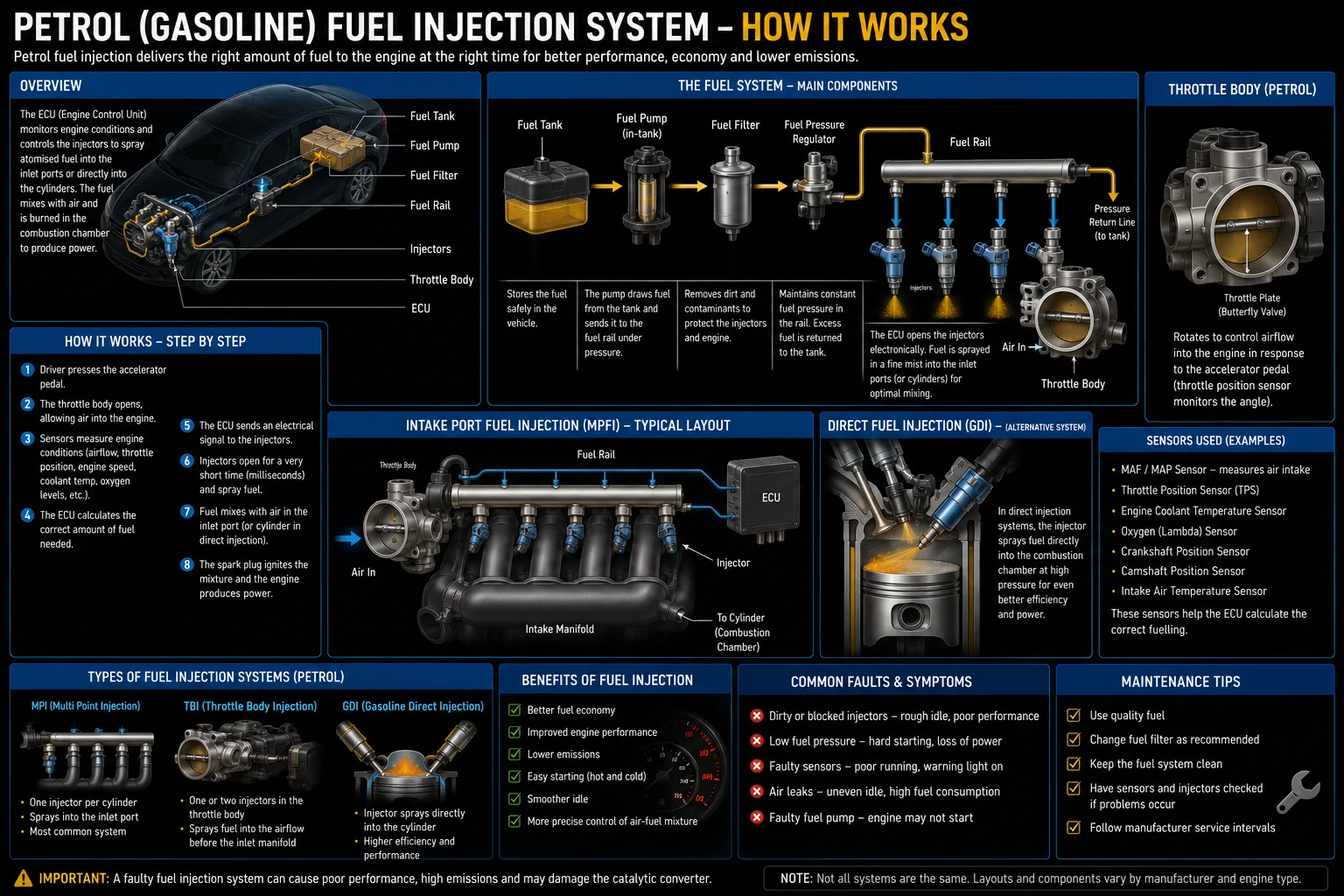
Your engine runs on a very precise air-to-fuel ratio — roughly 14.7 parts air to 1 part fuel (the stoichiometric ratio, since you asked). The MAF (Mass Air Flow) sensor measures the air going in; the ECU uses that figure to calculate how much fuel to inject. Lambda (oxygen) sensors in the exhaust then check the result: too much oxygen in the exhaust means the mixture was too lean — not enough fuel for the air. When the ECU has to keep adding more fuel than expected to compensate, and it's still not correcting the mixture to within spec, it throws P0171 (Bank 1 — the side of the engine with cylinder 1) and sometimes P0174 (Bank 2, on V-engines with two cylinder banks). The code is the ECU waving a flag and saying "something is wrong with this equation" — it is emphatically not telling you which component broke. The cause could be upstream (more air getting in than the MAF thinks) or downstream (less fuel than it should be). Good diagnosis uses live fuel trim data — Short Term Fuel Trim and Long Term Fuel Trim — to narrow it down before anything is touched.
“P0171 — System Too Lean Bank 1 — is one of the most common fault codes on UK roads, and also one of the most misdiagnosed.”
Sound familiar?
So what's behind it?
What we do — at your door
We come to you — driveway, car park, or wherever the car is sitting with its sad little engine light — and start with a full diagnostic scan across all modules, not just the engine. We pull the P0171 detail and the fuel trim data: if Short Term and Long Term Fuel Trim are both strongly positive at idle but come back towards zero at higher revs, that's a classic vacuum-leak signature. If the fuel trims are high across the rev range, we're looking harder at the fuel system. We'll inspect the MAF live-data readings against air temperature and engine speed to check it's behaving, and physically inspect the intake system — all the hoses, the manifold, the PCV connections — for cracks and splits. Where the inspection warrants it, we use a smoke machine to pressurise the intake and find leaks you'd never spot by eye. We test fuel pressure if the fuel system is suspect. We diagnose before we quote for parts — because throwing an O2 sensor at P0171 is how you spend money and still have the same code three weeks later.
What affects the price
Cost varies enormously depending on the actual cause. A split vacuum hose or a dirty MAF cleaned in situ is far cheaper than a new fuel pump or a manifold reseal. The diagnostic visit (which comes to you) establishes which you're dealing with before any parts are ordered. Parts pricing varies by make and model: a MAF sensor ranges from budget pattern parts upwards, genuine OEM sensors costing considerably more on German or Japanese cars. A fuel pump on a common hatchback is a different job to one on a vehicle requiring tank removal. We quote clearly, per item, once the cause is confirmed — no "it might be this so let's fit it and see."
Random knowledge you didn't ask for
Questions you're probably asking
Does P0171 always mean I need a new oxygen sensor?
Almost never. The lambda sensor is usually reporting accurately — it's telling you the mixture actually is lean. The fault is upstream: air getting in that wasn't measured (vacuum leak, intake split, dodgy PCV) or fuel that's not getting delivered (pump, injectors, dirty MAF). Fitting a new O2 sensor when the mixture itself is lean will cost you money and leave P0171 exactly where it is. We test the actual cause with live data first.
Can I drive with P0171 stored?
Usually yes, short-term — a steady engine light with P0171 and no other obvious driveability symptoms is not an immediate danger. However, running lean long-term causes the ECU to compensate in ways that can hurt fuel economy and, in extreme cases, risk running the engine hotter than it should. It's a 'get it diagnosed soon' code, not a 'pull over now' one. If you're also misfiring or the light is flashing, that changes things — stop and call us.
What's the difference between P0171 and P0174?
P0171 is 'System Too Lean — Bank 1' (the side of the engine containing cylinder 1). P0174 is the same fault on Bank 2 — only relevant on engines with two cylinder banks, like a V6 or V8. If you get both codes together, the fault is almost certainly somewhere they share — the intake manifold, a plenum gasket, a shared PCV hose. A fault isolated to one bank narrows the hunt to that bank's MAF, injectors or lambda sensor.
Will clearing the code fix it?
No — it'll turn the light off for however long it takes the ECU to run its readiness monitors again, then the light comes back. Clearing also wipes the freeze-frame data (the snapshot of conditions when the fault stored), which is one of the useful diagnostic clues. We find the fault first, then clear the code once it's actually fixed.
My car had a service recently — could that have caused P0171?
Possibly, yes. A disturbed air filter housing, a misrouted or kinked intake hose, or a vacuum pipe not clicked back in after poking around the engine bay can all introduce a leak. It's worth mentioning the recent service when you call — we'll look at those disturbed areas first and potentially save diagnostic time.
P0171 — sorted at your door
Stop procrastinating. Get a transparent quote and we'll come to you.