P0420: The Code That Sells a Lot of Unnecessary Catalytic Converters
Your engine management light is on. You've plugged in a code reader, or a mate has, or a parts shop has done it for free in the car park while quietly hoping you'll buy something expensive. It says P0420. The internet says catalytic converter. Someone on a forum says catalytic converter. Your local garage, freshly rubbing their hands together, says catalytic converter. Here's the inconvenient truth: roughly 30% of the time, it isn't the catalytic converter at all. It's a lazy downstream lambda sensor, or an exhaust leak making the system read incorrectly, or a handful of other causes that cost a fraction of a new cat. P0420 is the start of a diagnostic conversation — not the end of one. SOSCarFix comes to you, plugs into your car's live data, and actually works out what's broken before anything gets condemned.
See our upfront pricingP0420 doesn't always mean a new cat. Get it properly diagnosed first — we come to you, read live data, and save you from a £600 mistake. Book SOSCarFix.
How it actually works
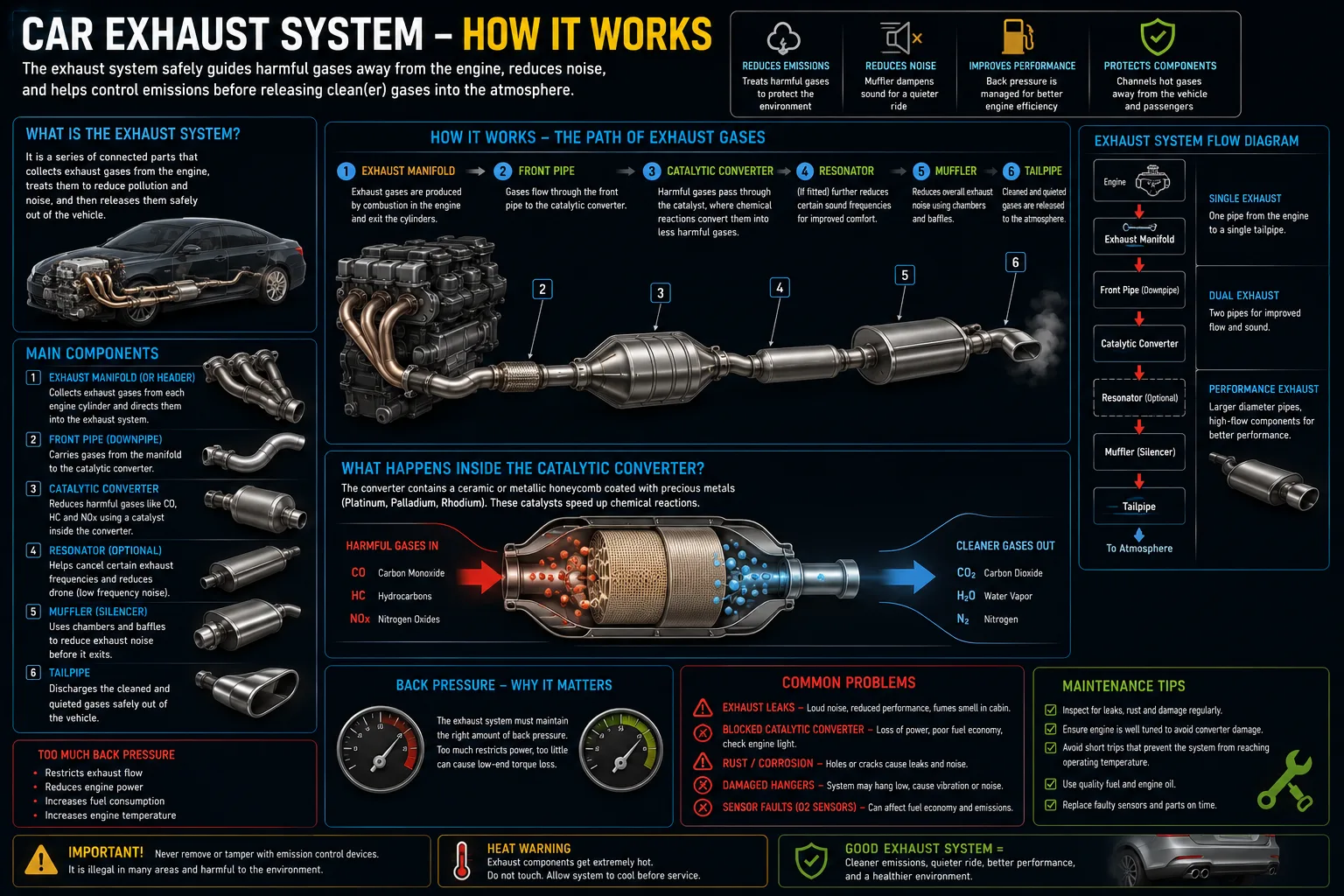
Your exhaust system runs two lambda (oxygen) sensors per bank on most cars — one upstream of the catalytic converter, one downstream. The upstream sensor measures oxygen in the raw exhaust leaving the engine and helps the ECU trim fuelling. The downstream sensor, positioned after the cat, should show a steady, relatively flat signal because a functioning catalyst is converting harmful gases — hydrocarbons, carbon monoxide, nitrogen oxides — into less offensive CO₂, water, and nitrogen. The ECU continuously compares those two sensor signals. On a healthy cat, the downstream reading is calm and stable; the upstream one hunts and cycles busily. When P0420 triggers, the ECU has decided the downstream sensor's signal looks too similar to the upstream one — meaning the cat isn't doing enough converting. "Catalyst efficiency below threshold, bank 1" is the formal translation. Bank 1 is the side of the engine containing cylinder number one — relevant on V6 and V8 engines, but most UK four-cylinder cars have only one bank, so bank 1 is the whole lot. The threshold the ECU uses is calibrated to ensure your car passes emissions standards. Fail to meet it long enough, and the light stays on — and come MOT time, that's a conversation you don't want to have.
“SOSCarFix comes to you, plugs into your car's live data, and actually works out what's broken before anything gets condemned.”
Sound familiar?
So what's behind it?
What we do — at your door
SOSCarFix is a mobile mechanic service — no garage, no waiting room with three-week-old magazines, no upselling while your car sits on their ramp. We come to your driveway, workplace, or wherever the car happens to be. For a P0420, we connect a professional-grade diagnostic tool that reads live sensor data in real time — not just the stored fault code, but the actual upstream and downstream lambda waveforms while the engine is running at operating temperature. We watch how those sensors behave across different load and rev conditions. A dead downstream sensor has a characteristic flat, unresponsive trace. A genuine cat failure looks entirely different. We also physically inspect the exhaust system for leaks — joints, gaskets, flexible sections — because a gap you can barely see can corrupt the entire reading. If the downstream lambda is the culprit, we can often replace it on-site. If the cat genuinely needs replacement, we tell you honestly, quote fairly, and source a quality part — not a no-name unit that'll throw the same code inside 18 months.
What affects the price
Downstream lambda sensor replacement is the cheapest outcome and often sorts the fault entirely — sensor cost varies by vehicle make and whether it's a universal or direct-fit unit, plus the labour to replace it and clear and recheck codes. Exhaust leak repair depends on whether it's a gasket, a flexi-pipe, or a rusted section — a new gasket is cheap; a section of downpipe on a corroded older car can escalate quickly. A genuine catalytic converter replacement is the expensive scenario — aftermarket cats for common UK cars are considerably cheaper than OEM dealer parts, though on some Euro 5/6 vehicles the OEM route may be the only option that satisfies the ECU's calibration thresholds. On older pre-Euro 5 cars a quality aftermarket cat is usually acceptable. Labour time varies significantly: some cats unbolt in twenty minutes; others are buried under heatshields and require half a day of careful persuasion. If the root cause is oil burning or a failed head gasket, that repair must be costed separately and addressed first — no point pricing just the cat in isolation.
Random knowledge you didn't ask for
Questions you're probably asking
Will P0420 cause my car to fail its MOT?
Potentially, yes — on two fronts. The engine management light being illuminated is itself a minor MOT fault (an advisory on older tests, a fail on post-May 2018 standards depending on category). More critically, if the cat genuinely isn't converting efficiently, tailpipe emissions at the test will likely exceed legal limits for HC and CO, which is a hard fail regardless of the light. Get it diagnosed and sorted before booking your MOT.
Can I drive with a P0420 code stored?
In most cases the car is still driveable short-term — P0420 on its own rarely causes an immediate driveability emergency. The risk is what's underneath it: if an undiagnosed misfire or oil-burning issue caused the code and you keep driving, you may be turning a sensor or gasket job into a full engine rebuild. Don't ignore it indefinitely; get it read properly.
Why does my garage want to replace the cat without doing much diagnosis?
Partly because it's the most common root cause if you just look at the code in isolation, and partly because it's a significant job that pays well. That's not cynicism — it's just economics. The problem is that 'P0420 usually means cat' and 'this specific car's P0420 means cat' are different statements. Live data from the lambda sensors takes minutes to read and can save you hundreds of pounds. Always ask whether they've checked the downstream sensor waveform before agreeing to a cat replacement.
Will a cheap aftermarket catalytic converter fix my P0420 properly?
Sometimes, and sometimes it'll throw the code again within six to twelve months. Very cheap unbranded cats often don't have sufficient precious-metal loading to bring efficiency back above the ECU's threshold, particularly on newer Euro 5 and Euro 6 vehicles with tighter calibration. A mid-range quality aftermarket part from a reputable supplier is usually fine for older cars; on modern vehicles the OEM or OEM-equivalent route is often the safer long-term spend.
My car has a P0420 and P0300 (misfire) stored at the same time — which do I fix first?
The misfire, without question. Misfires send unburnt fuel into the exhaust, which superheats the catalytic converter substrate and destroys it. If you replace the cat without sorting the misfire, the new cat will be damaged by the same problem. Fix the misfire first, clear all codes, and then recheck whether P0420 returns — you may find the cat was stressed but recovers once the misfire is gone.
P0420 — sorted at your door
Stop procrastinating. Get a transparent quote and we'll come to you.