P0299 Turbo Underboost: Don't Buy a New Turbo Before You Read This
P0299 is the code for "turbocharger/supercharger — underboost condition." In plain English: the engine asked for boost, the boost sensor reported back less than expected, and the car sulked into limp mode. It's extremely common on diesel-engined cars — your VW, Ford, Vauxhall, Peugeot, Citroën, BMW or Jaguar Land Rover — and it is almost never actually caused by a dead turbo. The real culprit is usually something far cheaper: a sticky variable-vane mechanism, a split hose, a weeping actuator or a choked DPF quietly strangling airflow. SOSCarFix comes to you, connects the diagnostic tools, reads the live boost data and tests methodically — so you know exactly what's wrong before anyone starts quoting you a new turbocharger.
See our upfront pricingP0299 turbo underboost: stuck VNT vanes, split boost hose or blocked DPF? We diagnose before you buy a turbo. Mobile mechanic comes to you. Get a quote.
How it actually works
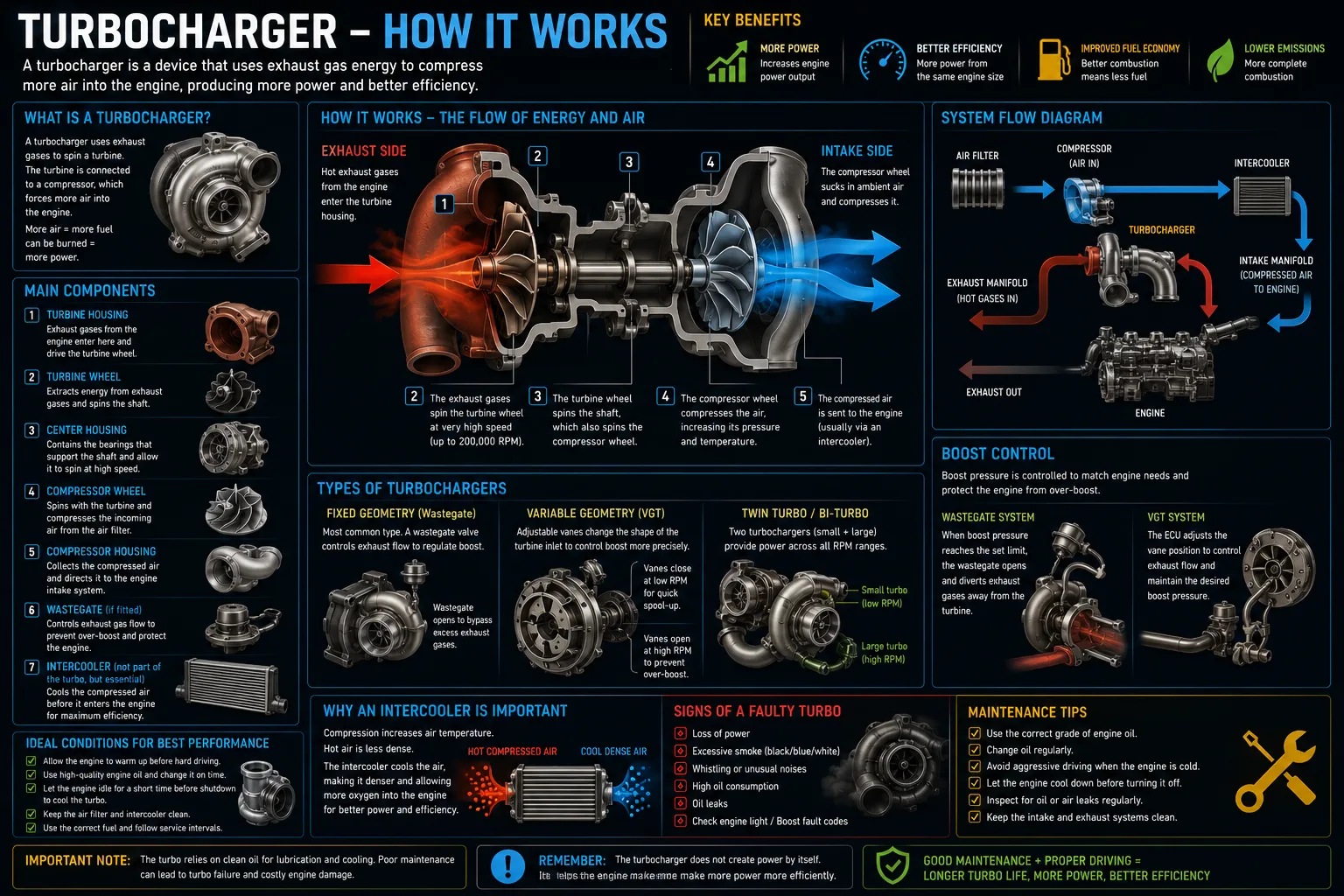
Most modern diesel engines (and quite a few petrols) use a Variable Nozzle Turbocharger — also called a Variable Geometry Turbo (VGT) or VNT. Instead of a fixed turbine wheel, it has a ring of moveable vanes around the turbine that pivot to control how fast exhaust gas spins the wheel. At low revs the vanes narrow the passage to speed up the gas and generate boost sooner; at high revs they open up to avoid overboost. A small actuator (either a vacuum-operated diaphragm or an electric servo motor, depending on age and make) moves those vanes on command from the engine management ECU. The ECU monitors actual boost pressure via a MAP (manifold absolute pressure) or boost pressure sensor, compares it to the boost it requested, and throws P0299 when actual boost falls too far short of target — a set percentage below the expected value for too many seconds. On some platforms this happens almost immediately; on others the car has to fail the check several times across a drive cycle. The moment the code sets, the ECU drops power (limp mode) to protect the engine from running lean or over-fuelling. That protective logic is sensible — but the fault itself is almost always upstream of the turbo core.
“P0299 is the code for "turbocharger/supercharger — underboost condition.”
Sound familiar?
So what's behind it?
What we do — at your door
We come to you — home, workplace, supermarket car park, wherever the car has given up — with manufacturer-grade diagnostic equipment, not a £30 dongle from Amazon. We read all modules, not just the engine, because DPF status, EGR faults and boost sensor readings across multiple ECUs all tell part of the story. Then we pull up the live data: requested boost versus actual boost, VNT actuator position, DPF differential pressure, EGR duty cycle and MAF readings in real time as the engine runs through its load range. That live comparison is what tells us whether the turbo itself is underperforming or whether something cheaper — a hose, an actuator, a coked-up vane mechanism — is responsible. We physically inspect the boost pipework, the intercooler connections and the actuator, and where appropriate we test actuator travel. You get a clear, plain-English explanation of the actual cause and an honest quote to fix it before we touch anything. No guesswork, no "it might be the turbo."
What affects the price
Cost varies enormously depending on the real cause — which is precisely why you diagnose first. A split boost hose or a perished joiner is a modest parts-and-labour job. Freeing off sticky VNT vanes with a specialist cleaner (in-situ or with the turbo off, depending on severity) costs significantly more in labour but is still a fraction of a turbo replacement. An actuator replacement sits somewhere in between. A DPF that needs a forced regeneration or professional clean is its own job. A turbo replacement — when it genuinely is needed — is the most expensive outcome, but it's also the least common diagnosis when the work is done properly. We charge for the diagnostic visit; if we go ahead with the repair on the same visit, the diagnostic fee is absorbed into the job.
Random knowledge you didn't ask for
Questions you're probably asking
P0299 came up — does that mean my turbo is dead?
Almost certainly not, and you should not buy a replacement turbo based on the code alone. P0299 means the boost system underperformed; it doesn't say why. The turbo core itself is usually fine. The most common causes — sticky VNT vanes, a split boost hose, a failing actuator or a choked DPF — are all cheaper fixes that a proper live-data diagnosis will identify before you spend anything on parts.
Can I keep driving with P0299?
The car will probably stay in limp mode, which limits power but does at least prevent you from making things worse by thrashing a low-boost engine. Short essential journeys are generally survivable; longer trips in limp mode are unpleasant and risk overheating the turbo if oil circulation is compromised. Get it diagnosed soon — especially if you also have a DPF warning light, because a clogged DPF left too long becomes a much more expensive problem.
The fault cleared itself after I restarted — is it fixed?
No. P0299 is notorious for clearing on a cold restart and coming back under load once the engine is warm and in the boost range. The underlying fault is still there; the ECU just hasn't hit its confirmation threshold again yet. It will return. Diagnosing it while the fault is active (or reproducible under load) is far easier than chasing an intermittent.
What is the VNT/VGT mechanism and why does it stick?
Variable nozzle turbos have a ring of small pivoting vanes that control exhaust flow speed through the turbine. Diesel combustion is inherently sooty, and EGR systems recirculate some exhaust gas back into the intake — that soot finds its way onto the vane pivot pins and bakes hard over tens of thousands of miles. The vanes gradually lose travel until they stick at one position. A specialist clean — sometimes in-situ with a carbon-dissolving treatment, sometimes with the turbo removed — can restore full movement without replacing the unit.
Could the boost sensor just be faulty rather than the turbo or vanes?
Yes, and it's worth ruling out. A MAP or boost pressure sensor that's reading low will produce exactly the same P0299 code even if the turbo is functioning normally. Live data gives it away — a faulty sensor tends to show suspiciously flat or implausibly low boost readings across the rev range, or readings that don't track smoothly with throttle demand. We test the sensor as part of the diagnostic, so a cheap sensor replacement isn't missed in favour of an expensive turbo job.
P0299 Turbo Underboost — sorted at your door
Stop procrastinating. Get a transparent quote and we'll come to you.