P0016: Your Engine's Timing Is Out of Sync — and Guessing the Fix Will Cost You a Fortune
P0016 is your ECU politely informing you that the camshaft and crankshaft are no longer dancing in step. In practice, that usually means one of two things: your timing chain has stretched beyond acceptable limits, or your variable valve timing (VVT) system is sluggish because the oil is too old, too thin, or arriving too slowly. Either way, the code is the beginning of the investigation — not the end of it. Swapping parts based on a code alone is how people spend £400 on a sensor that was perfectly fine all along. SOSCarFix comes to you, hooks in properly, reads the live data, and finds out which of those two (very different) problems you've actually got.
See our upfront pricingP0016 on your dashboard? It's not a sensor swap — it's a diagnosis. We come to you, read live data, and find the real cause. Get a quote.
How it actually works
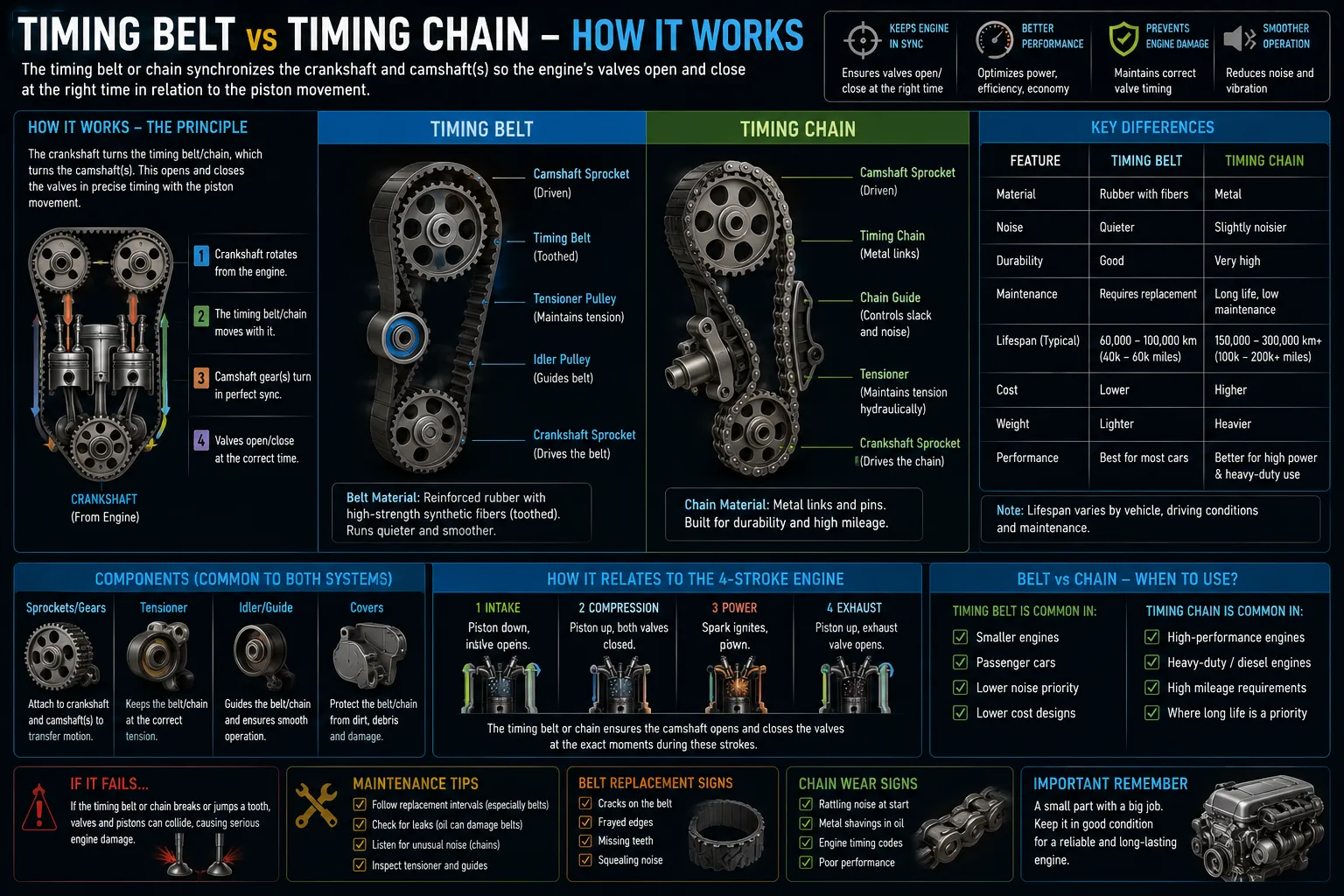
Your engine relies on extraordinarily precise timing. The crankshaft drives the pistons; the camshaft(s) open the valves. For combustion to happen correctly, they must be synchronised to within a few degrees of rotation — the ECU monitors both using a crankshaft position sensor (CKP) and one or more camshaft position sensors (CMP), cross-referencing the two signals constantly. Modern engines also use variable valve timing (VVT) — a system where oil pressure is used to advance or retard the camshaft position on the fly, improving power low down and efficiency at cruise. The VVT actuator (often called a phaser or cam phaser) is a hydraulically-controlled unit that shifts the cam's angular position relative to the crank based on ECU commands. P0016 fires when the ECU sees a discrepancy between where it expects the Bank 1 inlet camshaft to be and where the CMP sensor says it actually is. "Bank 1" on a four-cylinder means there's only one bank — it's the whole engine. On a V6 or V8, Bank 1 is the side containing cylinder number one. The two root causes are mechanically distinct. A stretched timing chain physically relocates the cam relative to the crank, because there's slack. A lazy VVT phaser means the cam is slow to move to its commanded position — the chain is fine, but the hydraulic system shifting the cam isn't responding fast enough. Both throw P0016. Without live data and proper testing, you cannot tell which one it is from the code alone — and the repair cost difference is enormous.
“Swapping parts based on a code alone is how people spend £400 on a sensor that was perfectly fine all along.”
Sound familiar?
So what's behind it?
What we do — at your door
We come to you — driveway, car park, work — with a proper professional scan tool, not a £30 Bluetooth dongle from Amazon. We read all stored fault codes across every module, then pull the live data stream: actual versus commanded cam timing position in real time, VVT solenoid duty cycle, oil temperature and engine load. That live data tells us whether the camshaft is trying to move and can't (phaser/solenoid/oil issue) or whether it's sitting in a position that's structurally wrong at rest (chain). We check the engine oil level, condition and correct specification — because if the oil is wrong or overdue, that gets fixed first and we retest. If the cold-start rattle is present, we listen and assess timing chain noise properly. We'll tell you plainly: this is an oil-change job, this is a solenoid, this needs a chain kit, or this needs a bigger conversation. No guesswork, no parts-cannon, no "could be a number of things" while charging you for three sensors you don't need.
What affects the price
Cost varies enormously with the actual cause — which is exactly why diagnosis first matters. Correct-spec oil and filter service: modest, well within routine service territory, and fixes a significant proportion of P0016s on maintained VVT engines. VVT solenoid (oil control valve): the part itself is generally inexpensive; labour is usually straightforward. Cam phaser replacement: more involved — often requires cam cover removal; part and labour costs depend heavily on make and model. Timing chain kit (chain, tensioner, guides): a major job on most engines — requires significant strip-down, and on some engines access is at the rear of the block, making it a multi-hour job. Labour time is the dominant cost here. A small number of P0016s on high-mileage engines with severe timing chain wear also bring an associated risk of engine damage if the chain jumps a tooth and bends valves — which is why ignoring a rattle plus an EML is never a sensible strategy. We'll give you an itemised quote once we know what you're actually dealing with.
Random knowledge you didn't ask for
Questions you're probably asking
My local garage just read 'P0016' and said I need a new camshaft sensor — is that right?
Possibly, but statistically unlikely to be the primary cause. P0016 means the cam and crank signals are out of sync; it does not mean the sensor itself is broken. Replacing the cam sensor fixes P0016 only if the sensor is actually faulty — which you can confirm with live data. Most P0016s on VVT engines trace back to oil condition, a solenoid or a timing chain. Replacing a sensor on guesswork is a common and expensive mistake.
Can I drive on a P0016 fault code?
Briefly, carefully, and with urgency to get it diagnosed — yes. Indefinitely — no. If you have a cold-start rattle alongside the P0016, that rattle is the timing chain slapping about with insufficient tension; keep driving and you risk the chain jumping a tooth, bending valves and turning a few hundred pounds of repair into a potential engine replacement. The light on its own with no rattle is less immediately alarming, but cam timing being wrong harms performance, economy and emissions.
I just changed the oil and the P0016 is still there — what now?
Good start, but the fault code won't vanish by itself once the oil is right — it needs to be cleared with a scan tool and the engine retested. If the code returns immediately after clearing, the oil change hasn't resolved it and the phaser, solenoid or chain needs proper investigation. If it clears and stays clear after a few cold starts, the oil was the culprit.
What's the difference between P0016 and P0011?
P0011 means the Bank 1 camshaft is over-advanced — it's moved further than commanded, often because a VVT phaser is stuck in the advanced position. P0016 means the camshaft position doesn't correlate with the crankshaft reference at all — a broader sync error that can mean a stretched chain or a slow/stuck phaser. They often appear together, and the causes overlap substantially. P0016 is the timing reference fault; P0011 is the position error.
How do I know if it's the timing chain or the VVT system without stripping the engine?
Live data is the first step: if the ECU is commanding cam advance and the cam position is responding but slowly, the chain is likely in the right place and the phaser or solenoid is the suspect. If cam position is statically wrong relative to crank at idle with no VVT command active, a stretched chain is more likely. A cold-start rattle that clears once oil pressure builds points strongly to chain or tensioner. A rattle that's persistent regardless of oil pressure is different again. This is exactly what we map out before recommending anything.
P0016 — sorted at your door
Stop procrastinating. Get a transparent quote and we'll come to you.