Red Fluid Leaking Under Your Car: The Rainbow of Doom That Means Your Automatic Gearbox is Quietly Begging for Help
Brake fluid is clear-ish. Engine oil is brown-black. Coolant is green, pink, or orange depending on which decade your car was born in. But that vivid red or cherry-brown puddle forming under the front or middle of your car? That's automatic transmission fluid — ATF — and it is not supposed to be on your driveway. It is supposed to be inside a sealed, pressurised system doing the very important job of lubricating, cooling, and hydraulically actuating your automatic gearbox. When it leaves that system, the gearbox notices. At first it complains quietly — a slight hesitation, a firmer shift. Then it complains loudly. Then it complains expensively. SOSCarFix comes to you, identifies where the fluid is coming from, and sorts it before the gearbox decides the whole situation has become untenable.
See our upfront pricingRed or brown puddle under your car? ATF or power steering fluid is escaping. We diagnose on your driveway before the gearbox gets expensive. Get a quote.
How it actually works
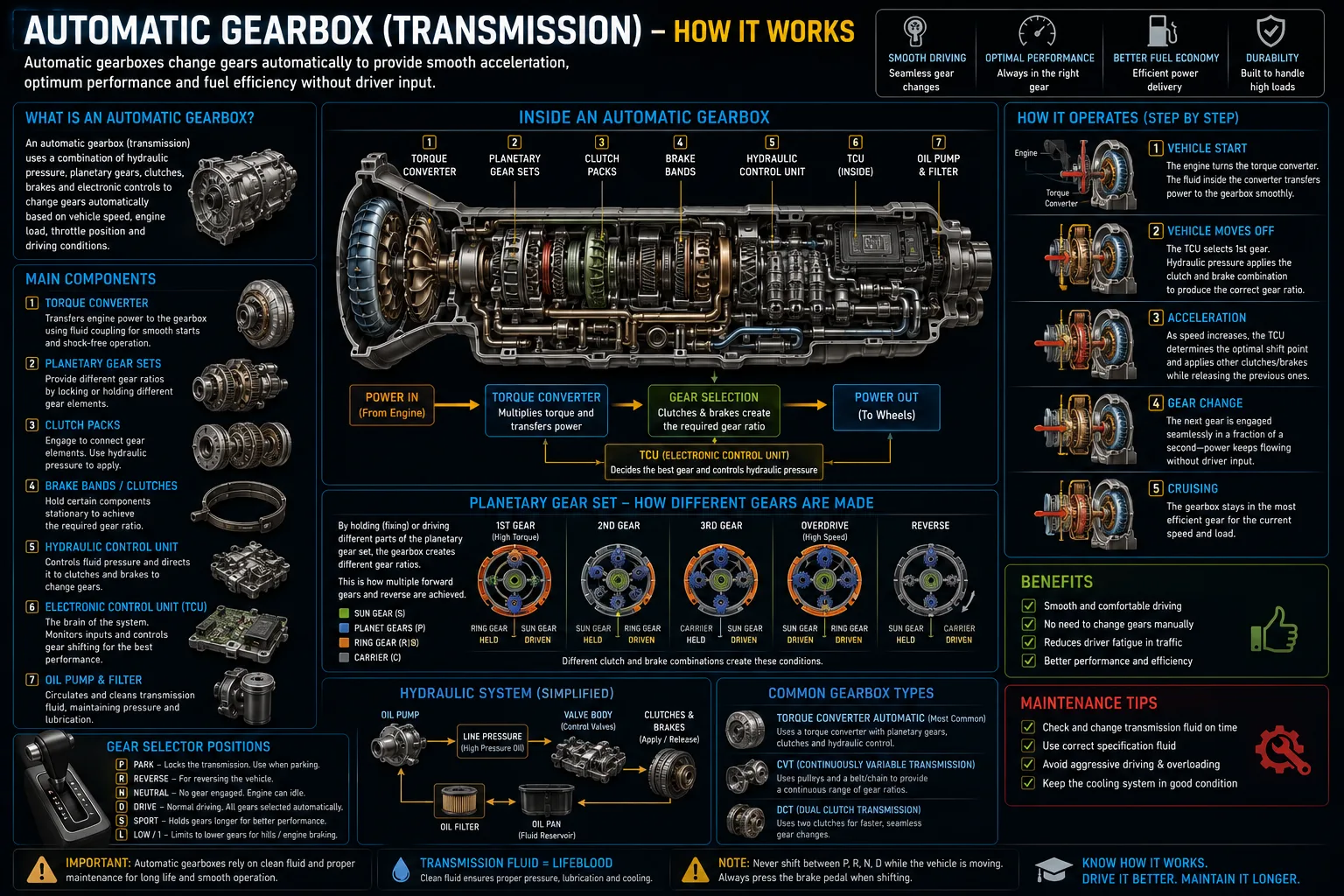
Your automatic gearbox is a hydraulic wonder that contains dozens of clutch packs, servos, solenoids, and passages carrying ATF at pressures up to around 150 PSI. The fluid does three jobs simultaneously: it lubricates rotating components, it cools the internal clutch packs and bands (via a cooler that typically lives inside or beside the radiator), and it provides the hydraulic pressure that physically selects gears by engaging and releasing those clutch packs. Low fluid means compromised lubrication, insufficient cooling, and inadequate hydraulic pressure — a trio that produces every symptom from slipping shifts and harsh changes right through to full transmission failure if you let it run dry. ATF starts life as a bright red, slightly sweet-smelling oil. As it ages and heats — and automatic gearboxes run hot, often exceeding 90°C at the fluid cooler — it darkens toward brown and eventually black, picking up clutch material, metal particles, and oxidation byproducts along the way. The colour of your puddle tells you something: bright red means fresh fluid (possibly from a seal that's only recently started leaking); dark red-brown means aged fluid that's been working hard; black and burned-smelling means the fluid has been overheated, which is a separate problem on top of the leak. Power steering fluid is frequently mistaken for ATF — both are often red or pink, both are hydraulic fluids, and both live in the front of the car. The distinction matters because they come from entirely different systems. A power steering leak is located forward near the rack, pump, or high-pressure hose; it affects steering weight but leaves the gearbox unaffected. We identify which system has sprung a leak before anything else happens, because the fix for each is completely different.
“That's automatic transmission fluid — ATF — and it is not supposed to be on your driveway.”
Sound familiar?
So what's behind it?
What we do — at your door
SOSCarFix comes to your address — driveway, car park, or the layby where you've been sat refreshing the transmission fluid Wikipedia page — with the means to actually diagnose the leak rather than glance at a puddle and start quoting for a full gearbox overhaul. We begin by correctly identifying the fluid: colour, smell, and location narrow it from 'red fluid somewhere under the car' to 'ATF from the sump pan gasket' or 'power steering fluid from the high-pressure rack hose' in fairly short order. We'll clean the suspected areas if necessary and use an inspection light to trace the leak to its exact origin point, because the fluid runs and pools and if you just look at where the puddle is you'll spend your afternoon replacing the wrong seal. We check ATF level and condition — because low level combined with a leak tells you the leak has been progressing for a while, and dark, burned ATF alongside a leak tells you cooling has been compromised; both affect what we recommend next. On vehicles where the ATF spec is available, we'll check whether what's in the box is actually the correct fluid, since mixing ATF types causes seal swelling, deposit formation, and shift quality issues that look like gearbox wear but trace back to a fluid mistake. If the leak origin is accessible on-site — a pan gasket, a cooler line, an output seal on most common vehicles — we can often complete the repair at the same visit. We'll be straight with you if the fault is something that needs specialist transmission work, and we won't start replacing things until we've confirmed what we're replacing and why.
What affects the price
The cost of fixing an ATF or power steering fluid leak varies considerably depending on which component is actually leaking and on which car. A transmission sump pan gasket service is typically modest in parts cost — the gasket, filter, and replacement ATF are the main consumables — but the labour involves dropping the pan, cleaning both mating faces carefully, and refilling to the correct level using the manufacturer's hot-check procedure; on many vehicles this is a couple of hours' work. A cooler line replacement depends on whether rubber sections are available or whether the whole hard-line assembly needs sourcing. A front pump or output shaft seal requires driveshaft or propshaft removal, which adds time. A power steering rack seal repair varies enormously by vehicle — some racks are repairable with a seal kit, others need a replacement rack, and pricing for the rack unit itself ranges from sensible (reconditioned unit for a common Ford or Vauxhall) to eye-watering (OEM rack on a prestige German car). A failed internal transmission cooler in the radiator can mean a new radiator plus a full transmission fluid flush if contamination has occurred, which is the most significant cost scenario in this fault category. We will always diagnose before quoting, and we'll give you an honest picture of what the options are and what happens if you leave each one.
Random knowledge you didn't ask for
Questions you're probably asking
How do I tell if the red fluid is ATF or power steering fluid?
Both are commonly red or pink and both are hydraulic fluids, so colour alone doesn't separate them. Location is the key: automatic transmission fluid leaks typically appear under the centre or rear-centre of the engine bay, beneath where the gearbox sits, while power steering leaks typically appear beneath the steering rack (driver's side, low down) or beneath the power steering pump at the front of the engine. If your steering feels heavy or you hear a whine on full lock, it's almost certainly power steering fluid. If shifts feel harsh or slipping, it's almost certainly ATF. We confirm visually with a torch once we're under the car.
Can I just top up the ATF and keep driving?
Topping up buys time only if the leak is slow and the underlying cause is addressed promptly. ATF level directly controls the hydraulic pressure that selects gears — run it low and the gearbox slips, overheats, and burns clutch material into the fluid, which accelerates wear further. Running an automatic gearbox on repeatedly topped-up ATF while ignoring the leak is how a modest pan gasket job becomes a transmission replacement conversation. Top up if you must to get somewhere safely, but treat it as emergency management, not a solution.
My automatic gearbox is slipping — could it just be low fluid rather than a gearbox problem?
Yes, and this is exactly why you check the fluid level and condition before assuming the worst. Slipping shifts, delayed engagement, and harsh changes are textbook low-ATF symptoms, and if they're caused by fluid loss from a leaking seal rather than worn clutch packs, fixing the leak and restoring the correct fluid level can completely resolve the shift quality issue. The distinction matters enormously for repair cost — a sump pan gasket and refill is a very different afternoon to a transmission overhaul. We check the fluid before recommending anything else.
What colour should my ATF be, and is dark fluid a problem?
Fresh ATF is bright red and slightly translucent. With age and heat it darkens through brown to almost black, picking up clutch material and oxidation products along the way. Dark brown ATF that smells burned has been overheated — either because the cooler isn't working, the fluid hasn't been changed in a very long time (many manufacturers now recommend ATF changes at 40,000–60,000 mile intervals, though some still claim 'lifetime fill' which is optimistic), or the gearbox has been running low on fluid. Burned ATF loses its friction modifier balance, which affects shift quality and accelerates clutch wear. If your fluid is black and smells burnt, it needs changing regardless of whether there's an active leak.
Is an ATF leak an MOT failure?
An active fluid leak that is 'excessive' can be flagged as an MOT failure — the tester checks for leaks as part of the underside inspection, and a dripping ATF sump pan or a weeping cooler line may well generate an advisory or a failure depending on severity. More relevantly, a leak that has caused ATF to contaminate the rear brake components or exhaust can cause additional failures. In practice, a slow seep may only get an advisory while an obvious active drip is more likely to fail — but neither is something to ignore, and both get worse over time.
Red Fluid Leaking Under Your Car — sorted at your door
Stop procrastinating. Get a transparent quote and we'll come to you.