Your Gearbox Is Whining: the Fix Starts With Knowing Why
A gearbox should be felt, not heard. If yours has developed a persistent whine, hum, or bearing drone — one that climbs and falls with road speed, changes pitch in certain gears, or disappears the moment you dip the clutch — your transmission is trying to tell you something. It might be as simple as old, degraded oil that costs next to nothing to fix. It might be an input or output shaft bearing beginning its long, grinding farewell. It might be a diff bearing, a layshaft, or a worn synchro hub. The only way to know is to actually diagnose it — not guess, not throw parts at it, and definitely not hope the noise goes away. SOSCarFix comes to you, listens to your gearbox properly, and tells you exactly what you're dealing with before any money changes hands.
See our upfront pricingYour gearbox is singing and not in a good way. SOSCarFix diagnoses gearbox whine and bearing noise at your door. Get a quote before it gets expensive.
How it actually works
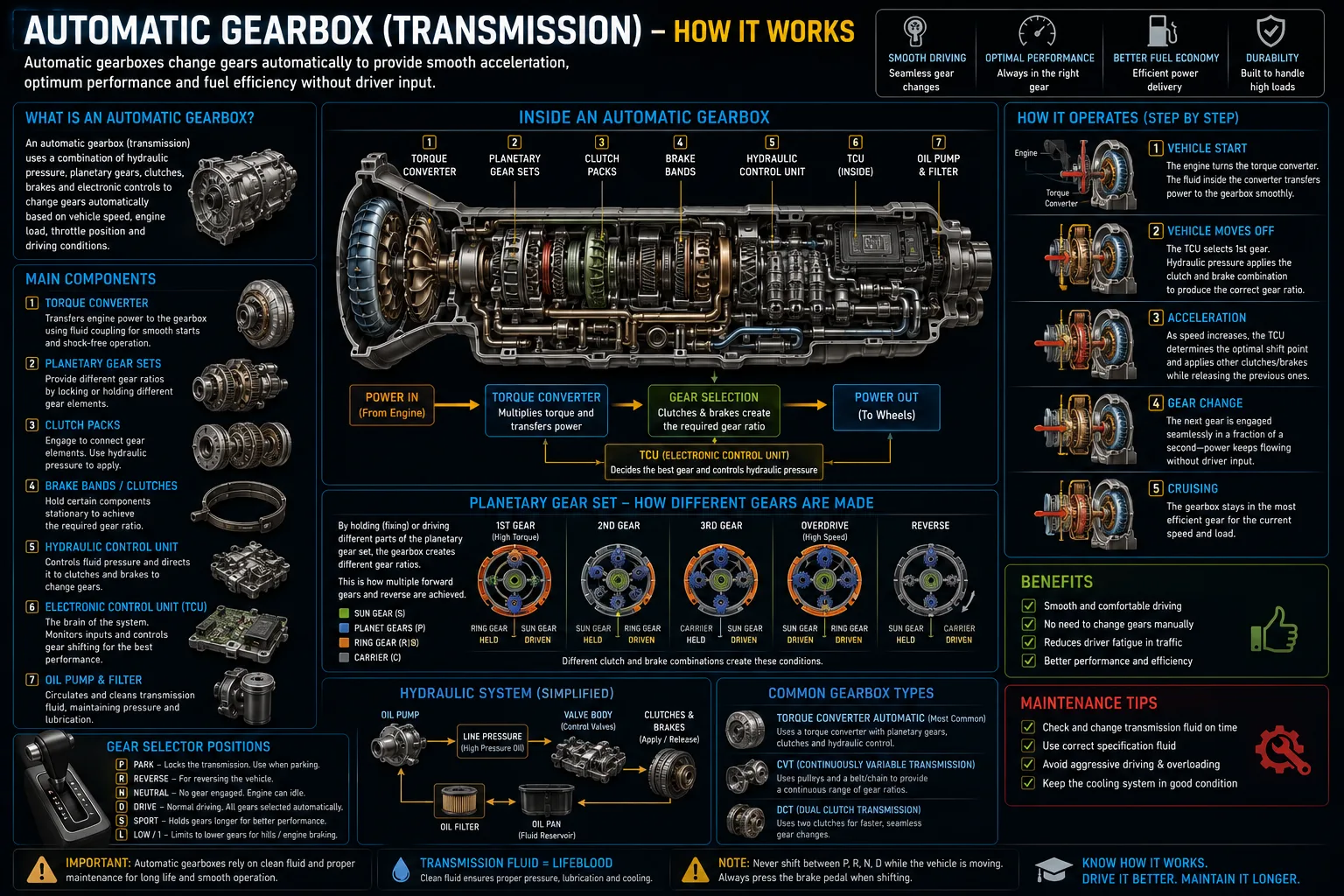
A manual gearbox is a remarkably elegant device full of things that can go wrong. Engine torque enters via the input shaft (spinning at engine speed), passes through the layshaft (a parallel shaft with its own gear set), engages your selected ratio, and exits on the output shaft to the propshaft or driveshafts. Every shaft runs on bearings — usually ball or tapered roller bearings at each end — and all those gears run in an oil bath. That oil is the lifeblood of the box: it lubricates the bearings, cushions the gear mesh, and carries heat away. When it degrades, gets contaminated, or simply runs low (gearbox seals don't last forever), metal runs on metal and the bearings and gear teeth start to suffer. Automatic gearboxes are more complex — planetary gear sets, a torque converter, a valve body full of hydraulic logic — but the bearings and lubrication principles are identical. Differentials (either integral to the gearbox in FWD cars or separate on RWDs) use the same hypoid gear oil and have their own bearings that whine when they're unhappy. Noise diagnosis is about isolating which shaft or component is the source, then confirming with a road test, a scan tool reading, and — where needed — a careful inspection of the oil for metal debris.
“The only way to know is to actually diagnose it — not guess, not throw parts at it, and definitely not hope the noise goes away.”
Sound familiar?
So what's behind it?
What we do — at your door
We come to you — driveway, work car park, or wherever the car lives — with a full toolkit and a diagnostic mindset. We start by road-testing the car to characterise the noise: does it change with speed or engine revs? Does it shift with load? Does the clutch dip kill it? From there we connect our scan tools to pull any transmission fault codes (automatic gearboxes store fluid temperature and slip data that tells a story), and on manual boxes we check the oil level and condition — colour, smell, and whether there's metal suspended in it. Where it's safe and practical on-site, we'll drop a small oil sample. We give you a clear diagnosis — "this is the input shaft bearing and here is what that means for the gearbox long-term" — before quoting anything. Some bearing replacements require gearbox removal and are bench jobs; we'll tell you honestly if that's the case and what your options are, including whether an oil change alone buys you meaningful extra life.
What affects the price
Gearbox oil changes are the cheapest intervention — usually modest cost, just a drain-and-fill with the correct spec fluid. The labour is relatively quick on most cars. Bearing replacement is a different matter: most gearbox bearings require the box to come out of the car and be partially stripped, which is significant labour time. Cost varies enormously by vehicle (a small hatchback vs a large SUV or van), by which bearing has failed (input shaft is more accessible than layshaft or output), and by whether any gear or shaft damage has occurred alongside it. Differential bearing work on integral FWD boxes similarly requires gearbox removal. Automatic gearbox bearing work is typically more involved still, and fluid flushes for autos must use exactly the correct OEM-specified fluid — there is no universal substitute. We never quote blind; diagnosis first, then honest pricing based on what we actually find.
Random knowledge you didn't ask for
Questions you're probably asking
Can I keep driving with a gearbox whine?
Depends entirely on what's causing it. If it's early-stage bearing wear and the oil is in reasonable condition, you may have some time — but 'some time' is not a warranty. A bearing that's whining is already failing; the question is how fast. Metal in the oil means the timeline collapses quickly, because debris accelerates wear on everything else in the box. Get it diagnosed before you commit to more miles.
Could it just be a wheel bearing and not the gearbox at all?
Absolutely — wheel bearing noise is one of the most commonly misidentified gearbox complaints. Both produce a road-speed-linked drone or hum. The difference: a wheel bearing usually shifts pitch when you swerve gently left or right at motorway speed, as the load transfers between wheels. A gearbox bearing typically doesn't. A proper road test and clutch dip check distinguishes the two fairly reliably, and we can confirm with a scan for ABS sensor drop-outs which often accompany a failing wheel bearing.
What gearbox oil should I use?
It varies significantly by manufacturer and box type. Many manual gearboxes specify a 75W-80 or 75W-90 GL-4 gear oil; some VW/Audi units require a specific MTF specification; some Mercedes boxes want ATF rather than traditional gear oil. Using the wrong spec is genuinely damaging — the additive package in GL-5 oil, for instance, can attack the yellow-metal synchro rings in boxes designed for GL-4. We always use the correct specification for your vehicle.
Is gearbox whine always a bearing — or could it be the gears themselves?
Both are possible. Gear tooth noise tends to be more prominent in a specific gear ratio and often has a slightly harder, more rhythmic quality than the smooth hum of a failing bearing. Bearing noise is usually more of a consistent drone across a speed range. In practice, by the time gear teeth are noisy, there's usually been significant wear — often accelerated by low or degraded oil. A proper diagnosis with oil inspection tells you which is more likely before anyone starts quoting for parts.
Can a gearbox oil change fix the whine?
If the noise is caused purely by degraded or low oil — which is more common than people think — then yes, a fresh fill with the correct spec fluid can reduce or even eliminate the whine if the underlying components haven't yet sustained significant wear. If a bearing is already damaged, fresh oil slows the deterioration but won't reverse it. That's why we check the oil condition and the noise character together: it tells us whether you're at the 'prevention' stage or the 'repair' stage.
Your Gearbox Is Whining — sorted at your door
Stop procrastinating. Get a transparent quote and we'll come to you.