DSG Mechatronic Unit Faults: When Your Clever Gearbox Decides to Have a Breakdown
The DSG — Volkswagen Group's Direct Shift Gearbox — was sold as the pinnacle of clever engineering: two gearboxes in one, pre-selecting the next gear before you've even finished using the current one, seamlessly quick, supremely efficient. And it mostly is, right up until the mechatronic unit — the combined hydraulic valve body and control unit that makes every single gear decision — starts throwing a tantrum. Then you get shuddering shifts, a PRND display blinking at you like a desperate distress signal, random lurches into neutral, and, finally, limp mode. Which is the car's polite way of saying "I give up, drive to a mechanic at 30mph". SOSCarFix comes to you, plugs in, reads the live data, and tells you exactly what's going on before anyone starts quoting scary numbers.
See our upfront pricingJerky DSG shifts, PRND flashing, limp mode or neutral hunting? We diagnose mechatronic unit faults on your driveway. Get a quote today.
How it actually works
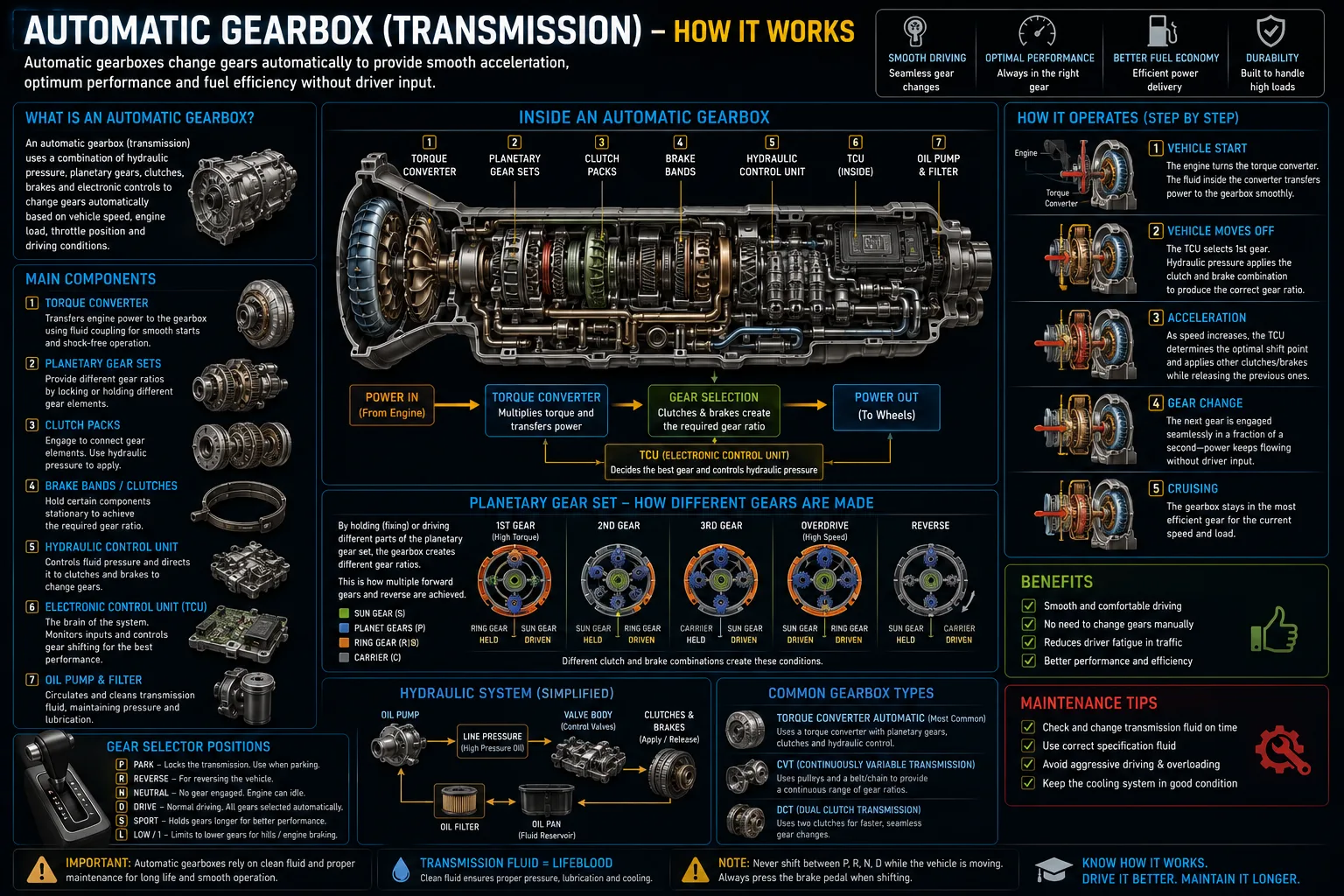
The DSG is actually two separate gearboxes sharing the same housing — one handles odd gears (1, 3, 5, 7), the other handles even gears (2, 4, 6, R). While you're in third, the transmission is already pre-loading fourth on the other shaft. This is how VW Group achieves gear changes in under 200 milliseconds — faster than a human blink, and considerably faster than you could manage with your hand and foot. The brains and hydraulics of the whole operation live inside the mechatronic unit: a single assembly that bolts inside the gearbox casing, combines the TCU (Transmission Control Unit — the computer) with the hydraulic valve body (a maze of solenoid-operated passages that direct pressurised ATF fluid to the right clutch packs and forks). When the mechatronic works, it's seamless wizardry. When it fails — whether a solenoid sticks, a pressure sensor drifts, the TCU develops a fault, or the fluid degrades and blocks the fine passages — the whole intricate system starts improvising badly. DSG fluid (specifically approved ATF like G 052 182 A2 or G 055 025 A2, depending on variant) is also not "fill for life" whatever the handbook may claim. Degraded fluid is the single biggest contributing factor to premature mechatronic death.
“Which is the car's polite way of saying "I give up, drive to a mechanic at 30mph".”
Sound familiar?
So what's behind it?
What we do — at your door
We come to your address — driveway, workplace car park, or supermarket car park where you've been stranded in neutral for the past forty minutes — connect a professional-grade diagnostic tool that speaks DSG-native (not an ELM327 dongle off eBay; the actual OBD/proprietary protocol the Volkswagen Group uses) and pull every fault code stored, including freeze-frame data that shows what was happening at the moment of failure. From there we go into live data: actual solenoid duty cycles, hydraulic pressures, temperature readings, adaptation values, clutch slip rates. This is how you tell a failed solenoid from a TCU software fault from a fluid issue from a worn clutch — you look at the numbers, not guess. Once we know what we're dealing with, we give you a clear, honest quote: fluid and filter service if the fluid is the culprit, mechatronic replacement (new or remanufactured unit) if the hardware has failed, or a software update if the fix is electronic. No component-cannon approach, no replacing everything in the hope something works.
What affects the price
The cost of a DSG mechatronic repair varies enormously depending on what the diagnosis actually reveals. A DSG fluid and filter service — the thing that prevents most of these faults and should be done every 40,000 miles regardless — is a fraction of the cost of a mechatronic replacement and should always be the first port of call if it's overdue. An actual mechatronic unit replacement involves the cost of the unit (new OEM units are expensive; quality remanufactured units from specialist rebuilders cost considerably less and carry a warranty), plus labour time to drop the sump, remove and refit the unit, and correctly adapt the gearbox with specialist software afterwards — because a raw swap without the adaptation procedure will shift as badly as the unit you took out. The gearbox variant matters too: the DSG6 DQ250 (wet clutch, found in higher-torque applications like 2.0 TDI) and the DSG7 DQ200 (dry clutch, found in most 1.4/1.8 TSI and 2.0 TDI from around 2008 onwards) use different units, different fluid specifications and different adaptation procedures. On higher-mileage cars, clutch pack condition is always worth checking before committing to a mechatronic — fitting a new control unit into a box with worn clutches solves exactly nothing.
Random knowledge you didn't ask for
Questions you're probably asking
My PRND display is flashing and the car won't go into drive. Is it the mechatronic unit?
A flashing PRND is the DSG's way of logging a serious transmission fault — it can indicate a mechatronic issue, but it can also be a failed selector position sensor, a wiring fault, low or degraded fluid, or a TCU software fault. It needs to be read with a proper diagnostic tool that can see the actual fault codes and live data before anyone starts quoting replacement parts. Replacing the mechatronic speculatively is an expensive guess.
Can I still drive with DSG limp mode?
Technically yes — limp mode is designed so the car can drive slowly to safety or a workshop. In practice, limp mode on a DSG usually means the gearbox is locked in third gear, which makes junctions and any speed below 20mph deeply unpleasant. It is not a 'run it for a week and see if it clears' situation. The fault is logged, the car has limited itself for a reason, and continuing to drive it risks making a repairable fault into something more expensive.
How often should DSG fluid be changed on a VW or Audi?
For the DSG7 DQ200 (dry clutch, common in 1.4 TSI, 1.8 TSI and many 2.0 TDI models), VW now states 40,000 miles. For the DSG6 DQ250 (wet clutch), the interval is longer but still finite. If you bought the car used and have no history of a fluid change, it needs doing regardless of mileage — degraded DSG fluid is the leading cause of solenoid wear and mechatronic failure, and a fluid service is dramatically cheaper than the alternative.
My DSG shudders when moving off from rest — is that the mechatronic unit?
Low-speed shudder on pull-away is actually one of the most common complaints on the DSG7 DQ200, and it is often not the mechatronic at all. The dry clutch design is sensitive to clutch pack wear and contamination, and a shudder on pull-away is frequently a clutch adaptation issue or worn clutch packs rather than a valve body fault. A diagnostic with live data showing the clutch slip rates and adaptation values will tell you which it is — getting that wrong and fitting a mechatronic into a box with worn clutches is a costly mistake.
Do you work on DSG gearboxes across all VW Group brands?
Yes — the DSG family is used across Volkswagen, Audi, Skoda and Seat, and the same mechatronic variants appear in cars as different as a Polo GTI and an Audi A4. The diagnostic and repair process is the same across all four brands; what varies is the specific calibration and adaptation software needed for each variant, which we carry.
DSG Mechatronic Unit Faults — sorted at your door
Stop procrastinating. Get a transparent quote and we'll come to you.