Grinding When You Change Gear: Your Gearbox Is Trying to Tell You Something — And It's Not Happy
That crunch when you slot into second gear is your gearbox's version of a polite cough: "Excuse me, something isn't right." Ignore it long enough and the polite cough becomes a grinding snarl, and the snarl becomes an expensive rebuild. The maddening thing is that a gearbox crunch can mean half a dozen different things — worn synchromesh rings, a clutch that isn't fully disengaging, low or ancient gearbox oil, or a sloppy gear linkage — and each one has a different fix with a very different price tag. The good news: on a manual gearbox, the pattern tells the story. Which gear it happens in, at what point in the shift, and whether it's worse when cold — all of that is diagnostic information. SOSCarFix comes to you, listens carefully, and works out what's actually happening before quoting you anything.
See our upfront pricingCrunching through the gears? We come to you, diagnose the actual fault — synchros, clutch, gearbox oil — and tell you what it'll cost. No garage faff.
How it actually works
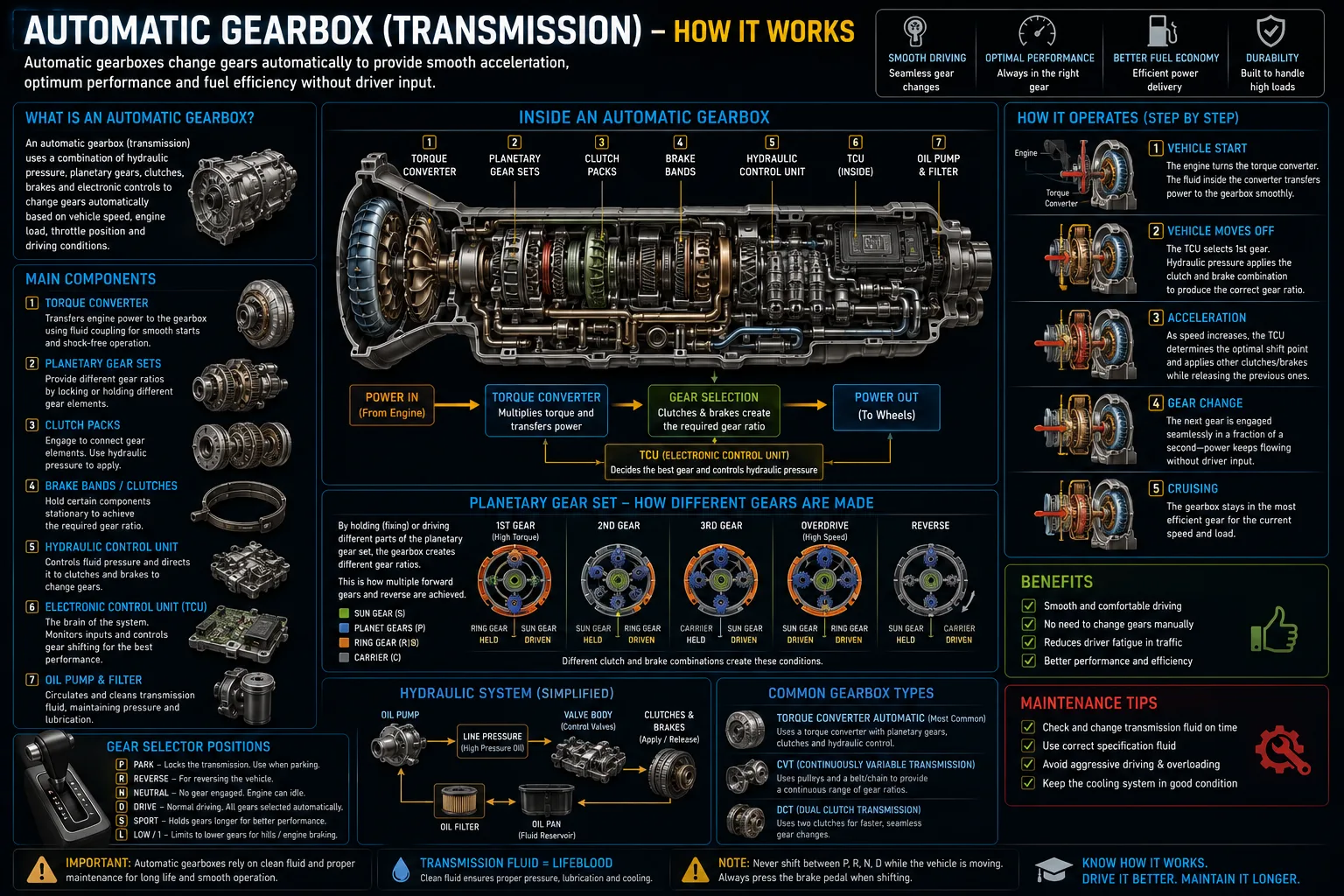
A manual gearbox is a precision mechanical ballet. Inside, several sets of gears spin constantly — but each ratio's gear pair freewheels on the output shaft until you select it. When you move the gear lever, a selector fork slides a synchromesh hub to engage the right pair. Here's the critical bit: before that engagement can happen smoothly, the synchromesh ring (also called a baulk ring or synchro ring) has to match the spinning speed of the gear you're about to engage to the speed of the output shaft. It does this by pressing against the target gear's cone surface, using friction to synchronise the two speeds. Then — and only then — the splined hub can slide in cleanly. That's why smooth, unhurried gear changes work better: you're giving the synchro time to do its job. The clutch is the other half of the equation. When you press the clutch pedal, the pressure plate releases the friction disc, disconnecting the engine from the gearbox input shaft. If the clutch doesn't fully disengage — because of a hydraulic leak, a worn master or slave cylinder, a misadjusted cable, or a dragging friction plate — the input shaft keeps spinning. The synchro then has to fight the still-spinning shaft as well as match the output side. Result: the grinding crunch you've been hearing every morning on the way to work. Add old, broken-down gearbox oil (which is often overlooked entirely at service time) or a worn gear linkage that means you're not quite selecting the gear you think you are, and you have a fairly long list of suspects — but one that methodical diagnosis can narrow down quickly.
“Which gear it happens in, at what point in the shift, and whether it's worse when cold — all of that is diagnostic information.”
Sound familiar?
So what's behind it?
What we do — at your door
We come to you — driveway, work car park, wherever the car is — and start by asking the right questions, because the pattern matters enormously: which gear, at what road speed, worse cold or hot, how long it's been happening. Then we do a proper test drive and assess the clutch pedal travel, bite point height and pedal feel; check the gearbox oil level and condition; inspect the clutch hydraulic system for leaks, fluid level and pedal free-play; check linkage condition and adjustment at the lever and at the gearbox end; and use a scan tool to rule out any electronically-reported drivetrain faults where applicable. If the clutch hydraulics or linkage are to blame that's usually a relatively straightforward fix we can price and often do on the spot. If it's pointing to internal gearbox wear (synchros or beyond), we'll tell you honestly what that means — including whether the cost of the repair makes sense for the car — before you commit to anything.
What affects the price
Cost varies enormously depending on what's actually causing it — which is exactly why diagnosis has to come before a quote. Hydraulic clutch repairs (master or slave cylinder, bleed, pipe repair) are at the affordable end. Clutch replacement — the full friction plate, pressure plate and release bearing job — sits in a wide range depending on the car, because it's all about labour: on some cars the gearbox has to come out, on others it's far more accessible. Gearbox oil changes are relatively cheap and often the first thing worth trying if the box has never been serviced. Linkage bushes and cables are usually modest. Internal synchromesh repair or a gearbox rebuild is where costs climb steeply — and on an older or high-mileage car, a quality reconditioned gearbox exchange unit can sometimes be better value than an internal repair. We'll always tell you the honest answer, including if the repair cost doesn't make financial sense for the vehicle.
Random knowledge you didn't ask for
Questions you're probably asking
Is it safe to keep driving with a crunching gearbox?
Short-term, you're usually not about to grind to a halt — but every crunchy change is accelerating the wear on whatever is already damaged. If it's a hydraulic clutch fault, those can progress to complete clutch failure without much further warning. If it's synchro wear, the longer you leave it the closer you get to needing a full rebuild rather than a more targeted fix. Get it checked before the expensive end of the spectrum becomes the only option.
It only crunches going into second — does that mean the whole gearbox is done?
Not necessarily. Second gear synchros are the most commonly worn on any manual gearbox precisely because they get the most use in UK driving. A selective synchro replacement or a gearbox oil change can sometimes address isolated second-gear issues. The diagnosis will tell you whether it's targeted or wholesale — and we won't tell you the whole box is gone if it isn't.
Could this just be a clutch problem rather than the gearbox itself?
Absolutely — and it's the first thing we check, because a clutch fix is usually considerably cheaper than a gearbox repair. If the clutch isn't fully releasing, the gearbox input shaft stays spinning during the change and the synchros have to fight it. Check the clutch fluid level yourself as a first step; if it's low, you likely have a leak in the hydraulic circuit and that's causing both the crunch and whatever's coming next.
My gearbox oil has never been changed — could that actually cause crunching?
Yes, and it's a cheap thing to rule out before anything else. Gearbox oil contains additives that protect synchro rings and lubricate selector forks; once they're depleted the oil becomes a thin, ineffective soup. A drain-and-refill with the correct spec oil (which matters — wrong viscosity can make things worse) sometimes transforms a notchy, crunchy box. Worth doing regardless of whether it cures the crunch.
How do you diagnose whether it's the clutch or the gearbox without taking it apart?
A lot of it is pattern recognition from the test drive and a thorough pedal and fluid check. If we can reproduce the crunch with the car stationary and the engine running (trying to engage first or reverse), that strongly implicates the clutch not releasing rather than internal gearbox wear. Live gearchanges at specific speeds, whether it's worse cold, and the feel of the clutch pedal travel all point in different directions. We don't guess — we narrow it down systematically before quoting anything.
Grinding When You Change Gear — sorted at your door
Stop procrastinating. Get a transparent quote and we'll come to you.