The TPMS Warning Light: Your Tyres Are Fine, It's the Sensor That's Having a Crisis
Your tyres are absolutely fine. Correct pressure, no slow puncture, not even mildly suspicious. And yet there it is — that little amber icon on your dashboard, the one that looks like a cross-section of a tyre with an exclamation mark having an identity crisis. Welcome to the wonderful world of the TPMS sensor: a system designed to give you peace of mind that has, ironically, become one of the more reliable sources of automotive anxiety. TPMS sensors run on little internal batteries that die after five to ten years. They get damaged when enthusiastic tyre fitters whip your wheels off without thinking. They need programming after every tyre swap, which — spoiler — most fast-fit places quietly forget to do. SOSCarFix comes to your driveway, scans the actual sensors, works out which of the several possible disasters has occurred, and fixes it. No garage. No queue. No one trying to upsell you air fresheners.
See our upfront pricingTPMS light on? Sensors dying, damaged, or refusing to relearn after a tyre swap? We come to you, diagnose properly, and sort it. Get a quote today.
How it actually works
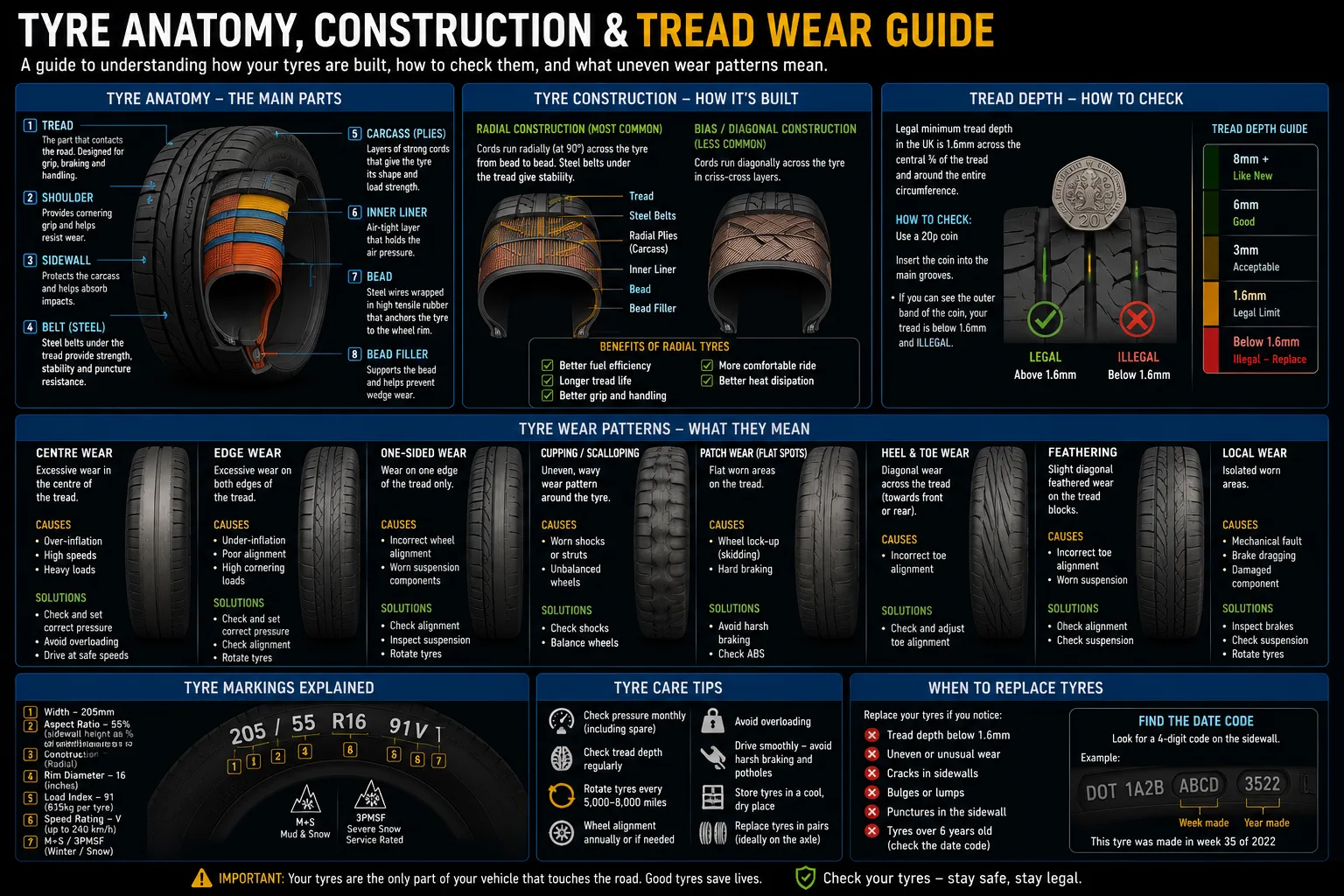
Each wheel on a TPMS-equipped car carries a small radio transmitter bolted to the inside of the valve stem or banded to the wheel. Direct TPMS — by far the more common system on UK cars built after 2014, when it became a legal requirement — has an actual pressure sensor in each wheel that measures real tyre pressure in PSI or bar and broadcasts that figure via low-frequency radio (usually 433MHz in the UK) to a receiver in the car. The ECU compares the reported pressure against your target values and lights the warning if any tyre drops roughly 25% below the recommended pressure. It also stores a unique ID for each sensor — which is exactly why moving your wheels around, fitting winter tyres, or having a tyre replaced means the system needs to relearn which sensor is which. Indirect TPMS, found on some older or more budget-oriented cars, is actually a clever bit of software cheating: it uses your ABS wheel speed sensors to detect if one tyre is rotating slightly faster than the others — which it will be if it's underinflated and therefore smaller in diameter. Elegant in theory. Less useful if all four tyres go down equally, which is why the EU mandated direct systems. The internal batteries in direct sensors are not replaceable on most units — when the battery dies, the whole sensor unit goes. They typically last five to ten years or 100,000 miles, whichever comes first to ruin your day.
“They need programming after every tyre swap, which — spoiler — most fast-fit places quietly forget to do.”
Sound familiar?
So what's behind it?
What we do — at your door
We come to wherever you and your car currently are — driveway, office car park, supermarket, the layby where you pulled over in a mild panic — and we do this properly. That starts with a scan tool that can actually talk to TPMS sensors: reading the individual sensor IDs, checking battery voltage levels where the sensor reports them, pulling ECU fault codes, and looking at live data to see what each sensor is broadcasting (or conspicuously not broadcasting). That diagnostic step is how we tell the difference between a dead battery, a damaged sensor, an uncompleted relearn, or a perfectly fine sensor that just hasn't been introduced to the ECU after a tyre swap. No guessing. No throwing parts at it on the assumption that sensors are cheaper than thinking. If a sensor needs replacing, we fit the correct type — OEM-spec or a quality aftermarket unit programmed to the right frequency and protocol for your specific vehicle — then carry out the relearn procedure on the spot, confirm all four sensors are talking to the ECU, and leave with the light off and the system actually working.
What affects the price
What you'll pay in the UK depends on a handful of very real variables, none of which we're going to paper over with a suspiciously clean round number. Sensors themselves range from modestly priced aftermarket universal units (which need programming to your car) to pricier OEM or OEM-equivalent sensors for prestige brands — a sensor for a German executive car costs more than one for a family hatchback, because of course it does. If only one sensor has died, you replace one; if the car is eight years old and the batteries are all the same age, it is worth having a frank conversation about replacing all four while the wheels are off anyway, since the labour is the same regardless. Programming and relearn time is a fixed overhead per visit regardless of how many sensors you're doing, which is another reason not to do them one at a time across four separate appointments. Valve stem condition matters too — corroded stems should be replaced at the same time, otherwise you've put a new sensor on a rusty time bomb. We'll quote you honestly based on your actual car and the actual fault before anyone picks up a tool.
Random knowledge you didn't ask for
Questions you're probably asking
Can I drive with the TPMS light on?
That depends entirely on why it's on. If you've manually checked all four pressures with a gauge and they're correct, the problem is a dodgy sensor rather than a soft tyre — so yes, you can drive, but you've now lost your early warning system for actual pressure loss, which rather defeats the point. Sort it sooner rather than later. If you haven't checked the pressures yourself, check them first. The light could be telling you something real.
Why did the TPMS light come on right after I had new tyres fitted?
Because the tyre fitter didn't do a TPMS relearn, which is a completely separate step after the physical tyre swap. Your car stores the unique ID of each sensor in each wheel position. New tyre on the same wheel is fine — the sensor stays. But if they rotated the wheels, or moved the spare into service, or (very common) accidentally damaged a sensor during the bead-breaking process, the ECU is now confused. A relearn with a proper TPMS tool sorts this. Some fast-fit places charge for this separately; some quietly skip it entirely.
How long do TPMS sensors last?
The internal battery — which is sealed in and cannot be replaced — typically lasts somewhere between five and ten years, with real-world variation depending on how often the sensor transmits (more frequent transmission drains it faster). Around the seven-year mark on cars with direct systems, it's worth being unsurprised if a sensor goes quiet. The sensor body itself is physically robust assuming it hasn't been whacked during a tyre change, which is the other main way they die prematurely.
Can you just replace the battery in a TPMS sensor?
On the vast majority of direct TPMS sensors fitted to UK cars, no — the battery is sealed inside the unit and there is no designed access point. A small number of older or specialist sensors were designed with replaceable batteries, but these are the exception. For most cars, a dead battery means a new sensor. It is annoying, and it is absolutely a design decision made by people who were not thinking about your wallet.
Do all four sensors need replacing at once?
Not necessarily, but it's worth thinking about the ages. If one sensor battery has died, the other three are the same age and the same design, which means they're probably not far behind. Replacing all four in a single visit means one call-out, one round of programming, one relearn — versus three more visits over the next couple of years. We'll tell you the battery status of all four sensors during diagnosis and let you make the call with the actual information rather than a coin flip.
The TPMS Warning Light — sorted at your door
Stop procrastinating. Get a transparent quote and we'll come to you.