Intake Air Temperature Sensor: The ECU's thermometer that your car really, really doesn't want you to ignore
Cold air is denser than hot air. More oxygen per cubic centimetre means more fuel you can burn and more power you can make. Your ECU knows this — and to do its job properly, it needs to know the temperature of the air entering the intake at all times. That job belongs to the intake air temperature sensor, a modest little thermistor tucked into your intake pipe or air filter housing that the ECU checks hundreds of times per second. When it fails, lies, or just starts sending nonsense, the ECU starts making fuel and timing decisions based on fictional data. You'll notice: worse MPG, hesitation under load, possible knocking, sluggish performance and, sooner or later, the engine management light glowing cheerfully on the dash. The fix is usually straightforward — but only after proper diagnosis, because a surprising number of things can mimic a dead IAT sensor, and parts-roulette is expensive.
See our upfront pricingFaulty IAT sensor causing hesitation, poor MPG or an EML? SOSCarFix diagnoses with live data, comes to you. No garage. Get a quote today.
How it actually works
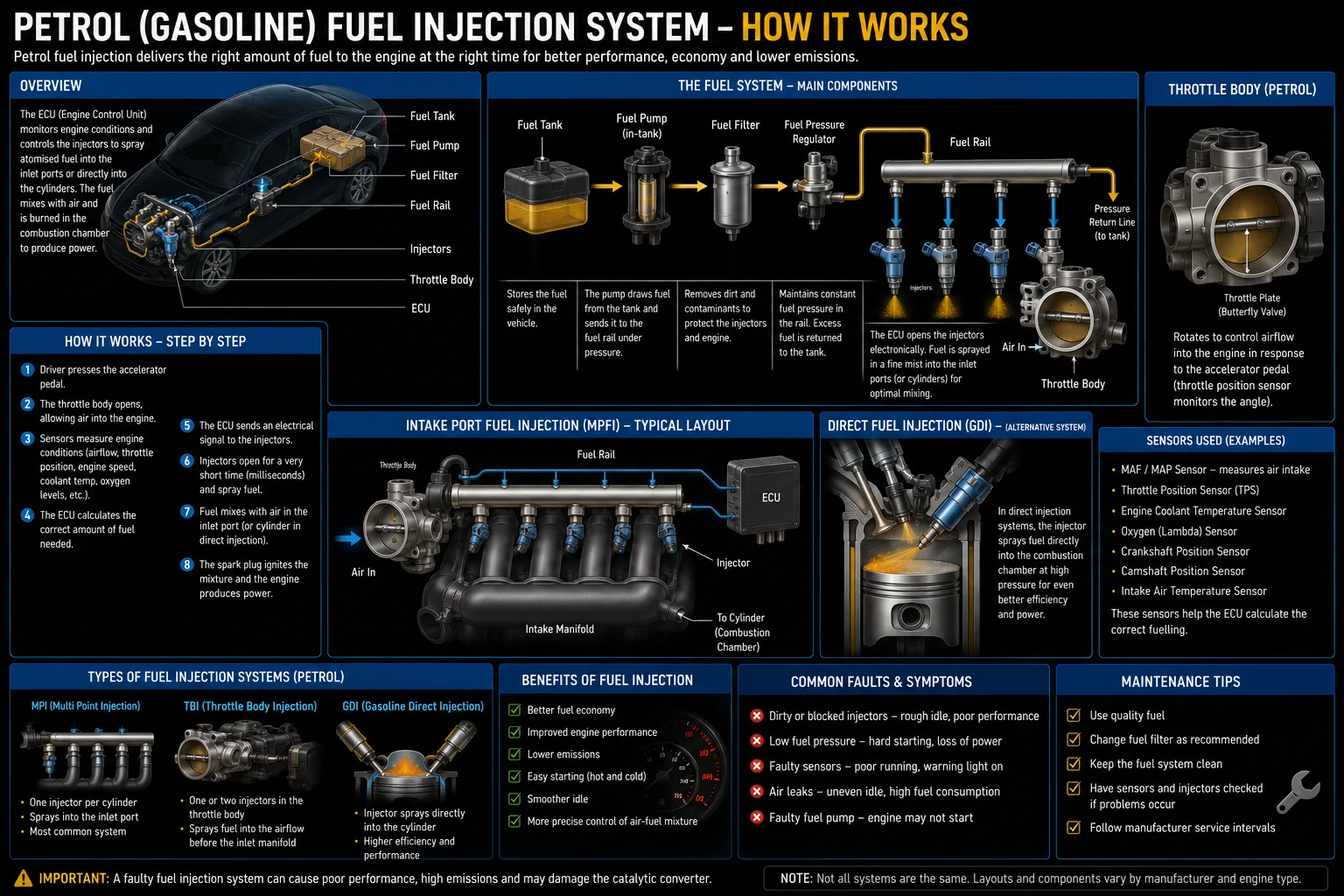
The intake air temperature sensor is a thermistor — a resistor whose electrical resistance changes predictably with temperature. Cold air makes it more resistive; warm air less so. The ECU reads the voltage across it and converts that into a temperature value in real time, then uses that figure in a cascade of calculations. Colder, denser air means more oxygen per stroke, so the ECU injects slightly more fuel to maintain the correct air-fuel ratio (stoichiometric target: 14.7:1 on petrol). It also adjusts ignition timing — cold dense air can tolerate more ignition advance before detonation, so timing goes slightly more aggressive in cold conditions to extract maximum power. Warm intake air is the opposite: less dense, less oxygen, pull the fuel back, retard timing slightly to avoid knock. Some vehicles integrate the IAT sensor into the mass airflow (MAF) sensor housing as a combined unit; on others it sits separately in the intake pipe or the airbox lid. Either way, the ECU treats that temperature signal as a fundamental input — get it wrong and everything downstream (fuelling, timing, turbo boost control on forced-induction engines) is working from bad data.
“Your ECU knows this — and to do its job properly, it needs to know the temperature of the air entering the intake at all times.”
Sound familiar?
So what's behind it?
What we do — at your door
We come to your driveway, car park or roadside and start with a proper scan across all modules — not just the engine — to pull any stored codes and, crucially, the live data. Looking at live data is the key move here: we watch what temperature the IAT sensor is actually reporting versus ambient air temperature, how it tracks as the engine warms up, and whether it behaves sensibly under different conditions. A sensor stuck at -40°C or 150°C is obviously dead; one that drifts or reads 10°C high all the time is trickier to catch without live data running. We also check fuel trim values, which tell us whether the ECU has been compensating for a rich or lean condition — that context makes the diagnosis bulletproof before we recommend any parts. If the sensor is faulty we replace it with a quality OEM-spec unit, clear the codes, and run the engine through a check to confirm the readings and trims normalise. If the fault is actually a wiring issue, a cracked intake pipe, or a PCV problem that's been coating the sensor, we address those too — because fitting a new sensor into the same oily, cracked intake just recreates the same fault six months later.
What affects the price
The IAT sensor itself is usually a cheap component — many are under £20 for a quality OEM-equivalent part, though on some makes where it's integrated into the MAF housing the combined unit is significantly more. What you're actually paying for is the diagnosis: pinpointing that it is the IAT sensor (and not a cracked boost hose, a fuelling issue, a clogged PCV, or a MAF that's done the same sensor a mischief) takes a mechanic with a proper scan tool, live data and some experience with fuel trim analysis. Labour on the replacement itself is typically straightforward — most sensors unplug and unscrew in minutes — but if the wiring is damaged or the connector is corroded and buried in the intake tract, that adds time. On some vehicles, especially turbocharged engines where the sensor is buried under boost pipes and intercooler plumbing, access is the main cost driver. We'll always tell you what the diagnosis found and give you a clear, itemised quote before any parts are ordered.
Random knowledge you didn't ask for
Questions you're probably asking
Can I just unplug the IAT sensor to see if the fault clears?
You can, but it won't tell you much. Most ECUs detect an open-circuit sensor and store a separate fault code, then substitute a fixed default temperature value — so the car may run slightly differently but the engine light stays on for a different reason. It's a common DIY experiment but it's not diagnosis. Live data with the sensor connected is what tells you whether the sensor's actual readings are plausible.
My car has an IAT sensor fault code but the sensor looks fine — what else could it be?
Several things: a cracked or split intake hose changes the air reaching the engine versus what the sensor sees, producing odd fuel trims that trigger the code; oily residue from a failing PCV system can coat the sensor element; corroded wiring or a dodgy connector creates a voltage offset the ECU reads as a wrong temperature. A fault code is always the start of the investigation, not the conclusion.
Will a faulty IAT sensor cause my car to fail its MOT?
Not directly on the sensor itself, but if the fault has lit the engine management light that's an automatic MOT failure under UK rules — the EML being illuminated is a fail regardless of what caused it. If the over-fuelling has pushed up your CO and HC emissions readings, that's another failure route. Sort the sensor, clear the codes, and run the car for a drive cycle to confirm the readiness monitors have reset before the MOT.
Is the IAT sensor the same as the MAF sensor?
No, though they're often confused and sometimes packaged together. The mass airflow (MAF) sensor measures how much air is flowing into the engine. The IAT sensor measures the temperature of that air. Some manufacturers combine both functions into a single unit — one plug, two sensors inside. If yours is a combined unit, a failed IAT element can mean replacing the whole assembly, which costs more.
How long does an IAT sensor replacement take?
On most cars, the physical swap is 15–30 minutes once diagnosed — it's a sensor in the intake pipe, usually one bolt and one plug. Diagnosis with live data and fuel trim analysis typically takes longer than the replacement. If wiring or intake pipework also needs attention, add time accordingly. We confirm the full scope when we quote.
Intake Air Temperature Sensor — sorted at your door
Stop procrastinating. Get a transparent quote and we'll come to you.