Your MAP Sensor Is Gaslighting Your Engine: What It Does, When It Fails, and Why Guessing Costs More Than Diagnosing
The manifold absolute pressure sensor is not glamorous. It doesn't have a cool nickname. Nobody's posted an Instagram reel about it. It's a small, often unremarkable lump bolted to your inlet manifold, connected to the ECU by a few wires and (on some engines) a vacuum hose, and its job is to quietly measure pressure all day long without anyone noticing it exists. And it does that job brilliantly — right up until it doesn't. When it fails, your ECU starts making fuelling decisions based on completely wrong information, which is roughly as effective as navigating a motorway with a map of the wrong country. The results range from embarrassing — poor acceleration, heavy fuel consumption, black smoke out the back — to genuinely disruptive, namely limp mode, an engine management light glowing like an accusation, and a failed MOT emissions test. SOSCarFix comes to you, scans the live data, confirms it's the sensor rather than something pretending to be the sensor, and replaces it on your driveway. No tow truck required.
See our upfront pricingBlack smoke, limp mode, or a car that accelerates like a tired labrador? Your MAP sensor's lying to the ECU. SOSCarFix diagnoses and fixes it at your door. Get a quote.
How it actually works
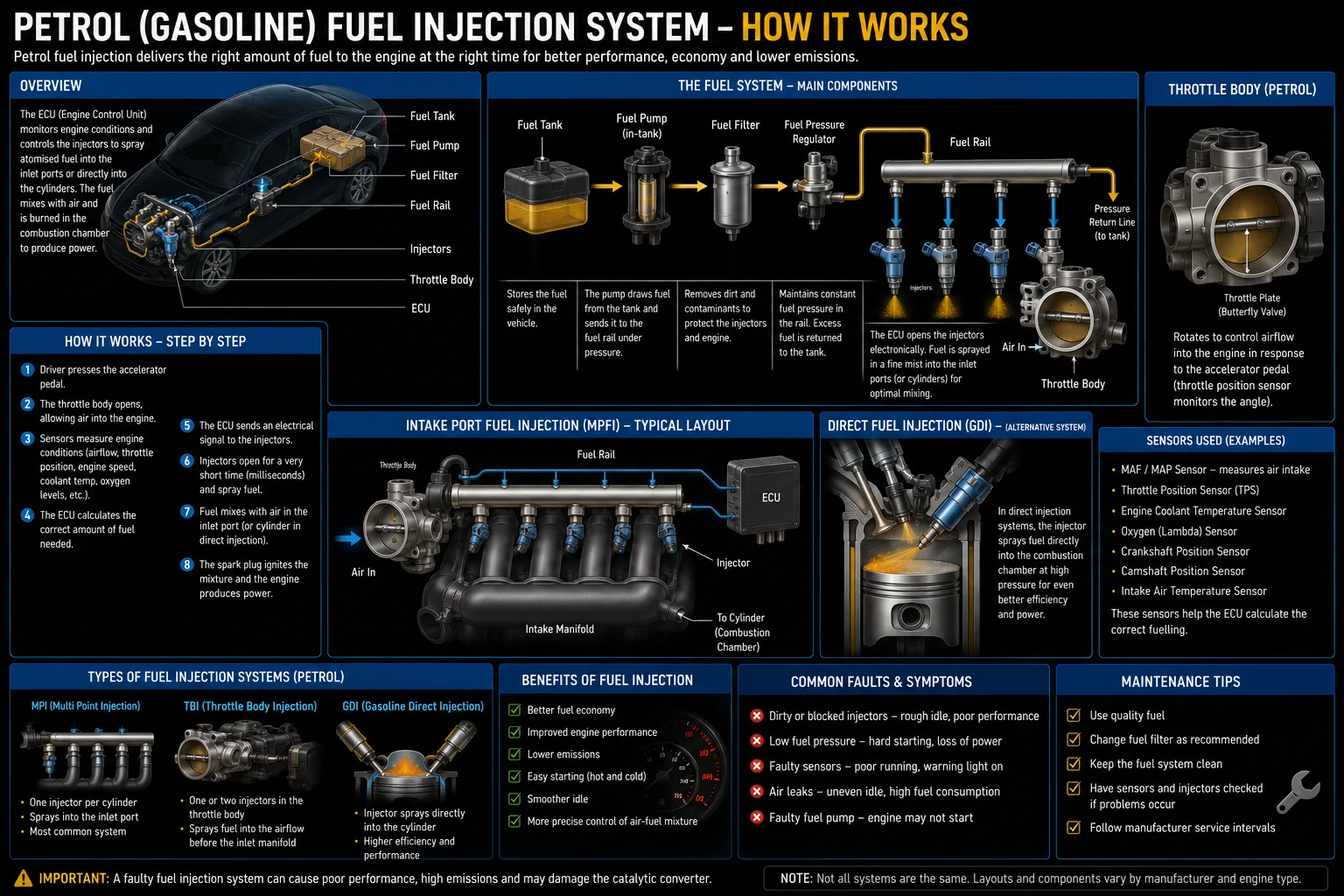
Every petrol or diesel engine that isn't carburetted needs to know how much air it's moving in order to inject the right amount of fuel. There are two main ways to measure this: a mass airflow (MAF) sensor that directly measures the weight of incoming air, and a MAP sensor that infers air mass indirectly by measuring the pressure inside the inlet manifold. Some engines use both; many use one or the other. Either way, the logic is sound — if you know the manifold pressure, the engine speed, and the intake temperature, the ECU can calculate the air charge in each cylinder and deliver the correct fuel quantity. On turbocharged and supercharged engines, the MAP sensor serves a second critical role: it tells the ECU exactly how much boost pressure the turbo is generating, which governs fuelling enrichment, ignition timing, and wastegate or bypass control. Get that reading wrong and you're either running lean (hot, potentially damaging), rich (smoky, expensive, fouled), or the ECU simply throws its hands up and engages limp mode as a safety measure. The MAP sensor itself works on a piezoresistive principle — a tiny silicon chip inside the sensor flexes in response to pressure changes, altering its electrical resistance, which the ECU reads as a voltage signal typically between 0.5V and 4.5V depending on manifold vacuum or boost. A reading outside that range, or one that doesn't change logically with engine load, triggers a fault code and starts the cascade of consequences you're probably already experiencing.
“And it does that job brilliantly — right up until it doesn't.”
Sound familiar?
So what's behind it?
What we do — at your door
We come to you — driveway, office car park, or the layby where limp mode deposited you — and we start with a proper scan tool, not a thirty-quid Bluetooth dongle. The difference matters: generic code readers see the fault code, which tells you a pressure sensor is unhappy; professional live data tells you what the sensor is actually reporting, at what engine speed, compared against the throttle position, MAF reading (if fitted), and RPM. That comparison is how you confirm it's the MAP sensor lying and not a boost leak, an air leak, or a failing turbo making the sensor look guilty by association. On turbocharged cars we check the boost pipework and intercooler connections while we're there, because fitting a new sensor into a leaky system is a guaranteed callback. Once we're satisfied the sensor is the actual fault, we replace it with a quality part to the correct specification for your engine — not a generic sensor from the discount end of the internet that outputs slightly wrong voltages and causes the ECU to be subtly confused indefinitely. We clear the fault codes, verify the live data is now reading sensibly across the load range, and if the car was in limp mode, we confirm it's driven out of it before we leave. The whole job is done at your location, in your time, without you needing to arrange alternative transport or explain to your employer why you're an hour late.
What affects the price
MAP sensor replacement is one of the more accessible sensor jobs in terms of parts cost — the sensor itself on most common UK cars (your Fords, Vauxhalls, Volkswagens, Citroens, and the like) is typically a modest part, and many are directly accessible without significant dismantling. What moves the overall cost around is primarily the car: sensors for prestige German marques cost more than sensors for volume-market cars, and some are integrated into the inlet manifold or throttle body in ways that make replacement rather more involved than unplug-and-replace. Labour time varies similarly — a sensor that's clearly visible and accessible on top of the inlet manifold is a quick job; one buried under air ducting, a heat shield, or the turbo pipework takes longer to reach. If the vacuum hose feeding the sensor is also perished (common, and worth doing at the same time), that adds a small cost but saves a repeat visit. Diesel engines with heavy inlet manifold contamination sometimes need the manifold cleaned or a blanking plate fitted to address the root cause, which is a separate job — we'll tell you honestly if the sensor is failing because the underlying environment is going to kill the replacement too. Diagnosis is always the first step: on a turbocharged car especially, confirming the sensor rather than a boost leak is what you're actually paying for with a proper diagnostic visit.
Random knowledge you didn't ask for
Questions you're probably asking
Can I just clean my MAP sensor instead of replacing it?
Sometimes. If the sensor is contaminated with oil vapour or soft carbon deposits — common on high-mileage engines with crankcase breather issues — a careful clean with electrical contact cleaner can restore a sensible reading. It's worth checking before buying a new one, and we'll tell you honestly if cleaning looks viable. If the sensor has failed internally or the piezoresistive element is damaged, no amount of cleaning fixes it. The only way to know which situation you're in is live data, not guesswork.
My scan tool says MAP sensor fault — do I definitely need a new MAP sensor?
Not necessarily, and this is where cheap code readers lead people astray. A P0105–P0109 code means the ECU has seen a MAP sensor signal it doesn't trust — but the underlying cause could be the sensor, a cracked vacuum hose giving it wrong reference pressure, corroded wiring, a boost leak on a turbocharged engine, or heavy inlet contamination. Replacing the sensor without checking these first is an expensive way to potentially not fix the problem. Proper live data diagnosis first — always.
Will my car fail its MOT because of a MAP sensor fault?
Yes, potentially in two ways. If the engine management light is illuminated and the car is presented for MOT, that's an automatic failure under the 2018 MOT rule changes regardless of what the light is for. Beyond the light, a faulty MAP sensor causing rich running produces excess hydrocarbons and CO in the exhaust, which will fail the emissions test on its own merits. Sort the sensor before the MOT, not after — the retest fee and the embarrassment are both avoidable.
My turbocharged car is in limp mode — is the MAP sensor the most likely cause?
It's a strong candidate, but turbocharged limp mode has several possible causes: boost leaks, a failing turbo, wastegate or VGT actuator faults, and MAP sensor failure can all trigger it. The ECU goes into limp mode when boost-related readings fall outside expected parameters — the MAP sensor is one of the key inputs to that decision. Live data will show you whether the sensor reading is plausible, whether boost is actually building, and whether any other systems are flagging. On turbo cars, we check the whole boost circuit, not just the sensor.
How long does a MAP sensor replacement take?
On most common UK cars where the sensor is accessible — which is the majority — the actual replacement is under an hour including the diagnostic scan and post-repair live data check. Cars where the sensor is buried under charge pipework, tucked behind other components, or integrated into the throttle body in an inconvenient way take longer. Diesel engines where inlet cleaning is also needed are a separate and longer job. We'll tell you realistic timescales based on your actual vehicle before we start.
Your MAP Sensor Is Gaslighting Your Engine — sorted at your door
Stop procrastinating. Get a transparent quote and we'll come to you.