Throttle Position Sensor: When Your Car Forgets How Hard You're Pressing the Pedal
There's a special kind of frustration reserved for cars that can't decide what the throttle pedal means. You press it gently to pull into traffic and the engine surges like you've floored it. You hold it steady on a dual carriageway and the revs hunt up and down as if the ECU is having some sort of existential crisis. Or — the crowning achievement — the car drops into limp mode on the M6 and caps you at 40mph while the engine management light stares at you like a disappointed parent. Nine times out of ten, the culprit lurking behind this particular flavour of chaos is the throttle position sensor: a small component whose only job is to tell the ECU exactly where the throttle is, and which has quietly decided to stop doing that job properly. SOSCarFix comes to your driveway or car park, diagnoses it properly with live data, and sorts it — no garage faff required.
See our upfront pricingTPS fault causing surging, limp mode or a twitchy idle? SOSCarFix diagnoses with live data and comes to you. No garage. Get a quote today.
How it actually works
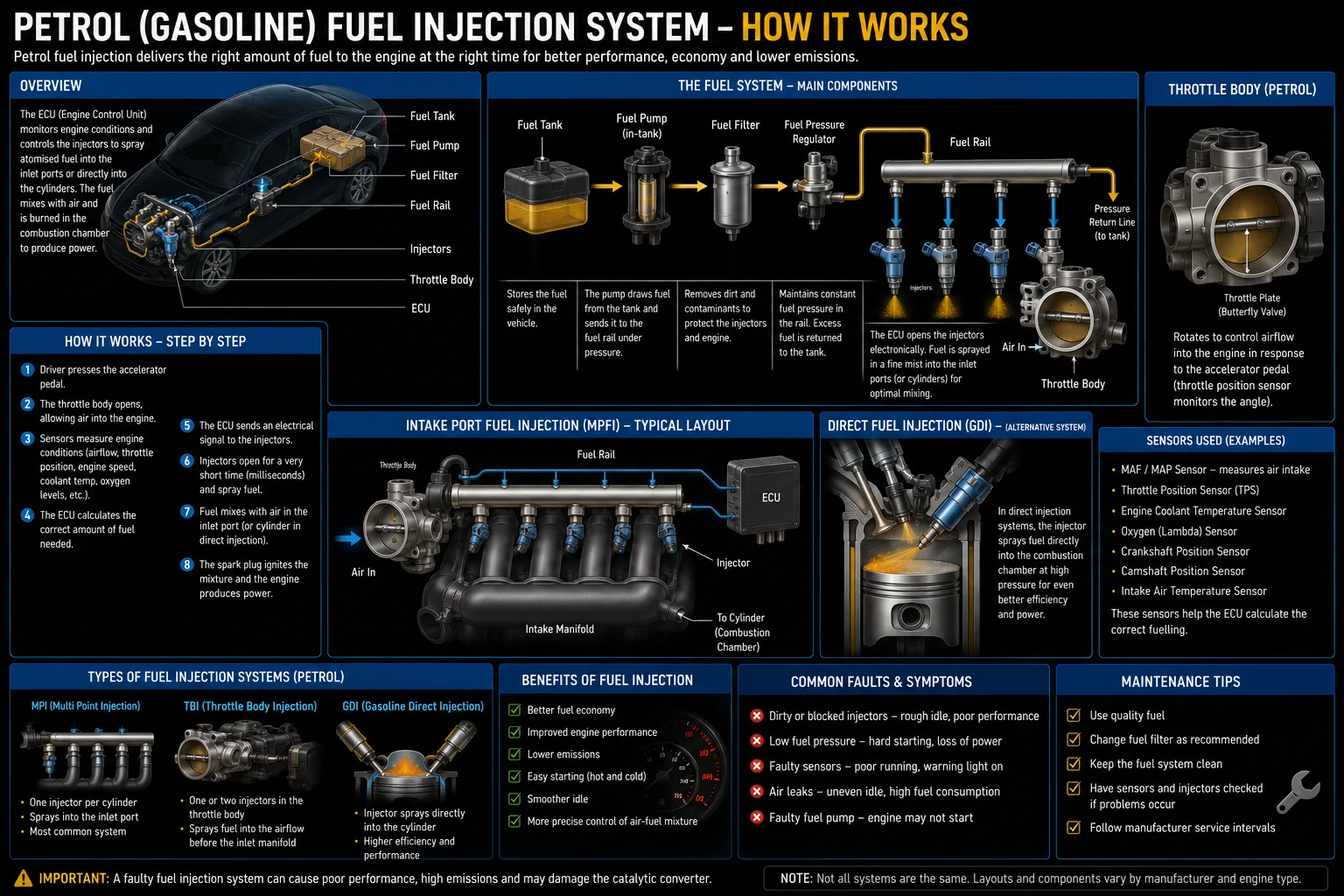
The throttle position sensor (TPS) monitors the angle of the throttle plate — that butterfly valve sitting inside the throttle body that regulates how much air enters the engine. Push the pedal down, the throttle opens, the TPS reports back to the ECU exactly how open it is, usually as a voltage signal that sweeps from around 0.5V at idle to roughly 4.5V at wide-open throttle. The ECU uses that signal constantly: to calculate the right fuel injection amount, to time gear changes in an automatic, to manage traction control, to enable idle speed control, and to decide whether you're accelerating gently or giving it the full beans. On older cars the TPS is a standalone sensor you can unbolt. On most modern cars — particularly anything made in the last fifteen years or so — the TPS is integrated into an electronic throttle body (sometimes called drive-by-wire or ETC, electronic throttle control). There's no physical cable from your pedal to the throttle any more; it's entirely electronic. These systems typically use two sensors in the throttle body for redundancy: if the signals don't agree with each other within a tight tolerance, the ECU throws a fault, stores a DTC, and may pull the car into limp mode as a safety measure. To add to the fun, many electronic throttle bodies require a throttle adaptation or relearn procedure after replacement — without it, the idle will be wrong and the car will drive oddly even with a perfectly good new part fitted.
“You hold it steady on a dual carriageway and the revs hunt up and down as if the ECU is having some sort of existential crisis.”
Sound familiar?
So what's behind it?
What we do — at your door
We come to you — driveway, office car park, or that layby you've been sitting in — with a proper scan tool that reads more than just the fault code. The code is where we start, not where we finish. We pull up live data from the TPS signal itself: watching the voltage sweep in real time as the throttle moves, checking for flat spots, dropouts, or mismatch between the two sensors on drive-by-wire systems. We test the wiring back to the ECU, check the connector and earth paths, and inspect the throttle body for contamination before recommending any parts. If the sensor or throttle body needs replacing, we supply and fit the correct unit — OE-quality where it matters — and then carry out the throttle body adaptation or relearn procedure required to get idle and throttle response back to how the manufacturer intended. We clear the fault codes once the fix is confirmed and road test to make sure the engine management light stays off and the car drives cleanly. No parts swapping on guesswork, no charging you for a new throttle body when a clean connector was all it needed.
What affects the price
The cost varies considerably depending on what the diagnosis actually finds — which is rather the point of diagnosing it properly before touching anything. On older cars with a standalone TPS sensor, the sensor itself is often inexpensive, and if it's a simple wiring or connector fault the repair cost is modest. The bill climbs meaningfully on modern drive-by-wire cars if the entire electronic throttle body needs replacing, since the unit contains the motor, the twin sensors, and the throttle plate assembly all in one housing — a genuine OE-spec unit for a mainstream European car will cost noticeably more than a cheap pattern part, and for good reason (a poorly-made throttle body on a drive-by-wire system can create more problems than it solves). Labour time varies by vehicle: some throttle bodies unbolt in twenty minutes, others require significant intake disassembly to reach. Factor in the throttle adaptation procedure too — on some vehicles this requires manufacturer-level tooling rather than a generic scanner. We'll quote you clearly once we know what we're actually dealing with, not before.
Random knowledge you didn't ask for
Questions you're probably asking
Can I clean the throttle body myself to fix a TPS fault?
Sometimes a heavy carbon deposit shifts the throttle plate's resting position enough to upset the TPS baseline, and a clean does help. But if the sensor itself has a worn resistive track or a wiring fault, cleaning changes nothing. Diagnose first with live data to see if the signal is actually bad before pulling out the carb cleaner — and on drive-by-wire cars, cleaning often needs to be followed by a throttle adaptation procedure or the idle will be worse afterwards.
Why does my car go into limp mode when the TPS fails?
Because the ECU genuinely cannot run the engine safely without knowing where the throttle is. In a drive-by-wire system the ECU commands the throttle electronically — if one of the two position sensors disagrees with the other, the ECU has no way to know which one is telling the truth, so it does the sensible thing: caps throttle opening to a fixed, safe position. Annoying on a motorway, but considerably less annoying than an engine that randomly lunges to full throttle.
I had my battery replaced and now the idle is rough and the throttle feels wrong — is the TPS faulty?
Almost certainly not. Disconnecting the battery on many modern cars wipes the throttle body's learned adaptation values — essentially the ECU's calibrated baseline for what 'fully closed' looks like. The fix is a throttle relearn or adaptation procedure via a scan tool, not a new sensor. It's a common misdiagnosis after battery changes and a frustrating one to pay for if you've already bought unnecessary parts.
My OBD reader says 'throttle position sensor' — can I just replace it?
You can, but you'd be gambling. A P0120-series code confirms the ECU has seen a problem with the TPS circuit — it doesn't tell you whether the sensor itself is dead, the connector is corroded, the wiring has a break, the earth is poor, or the throttle body needs adaptation. Replacing the sensor without testing the circuit first is how people end up buying the same part twice. Live data on a proper scan tool shows the actual signal behaviour and points you at the real fault.
Does a replacement electronic throttle body always need coding or adaptation?
On most modern vehicles, yes. The ECU needs to learn the new throttle body's fully-closed and fully-open positions through a relearn procedure — some cars do this automatically on a short drive, others need a specific procedure carried out with a diagnostic tool. Skip it and you'll likely have an incorrect idle, a hesitant throttle response, or fault codes that come straight back. We carry out the adaptation as part of the job, not as an optional extra.
Throttle Position Sensor — sorted at your door
Stop procrastinating. Get a transparent quote and we'll come to you.