MAF Sensor Replacement: Because Your Car Deserves Better Than Drowning in the Wrong Amount of Air
Your engine is, at its core, a controlled explosion machine. For those explosions to be controlled rather than catastrophic, the ECU needs to know exactly how much air is being rammed through the intake at any given moment — because without that figure, it's essentially guessing at how much fuel to inject, and your engine runs accordingly: lumpy, thirsty, gutless, occasionally embarrassing at roundabouts. That's the mass air flow sensor's entire job. It sits in the intake tract between the air filter and the throttle body, quietly measuring every gram of air your engine inhales, thousands of times per second, reporting back to the ECU so fuelling stays precise. When it goes wrong — through contamination, age, or the enthusiastic application of a pressure washer somewhere upstream — the ECU starts flying blind. And "flying blind" in engine management terms means EML, limp mode, terrible MPG, and a car that feels like it's running through treacle. SOSCarFix comes to you, diagnoses it properly with live scan data, and fixes it before you've had to endure a single waiting-room biscuit.
See our upfront pricingMAF sensor fault got your car hesitating, guzzling fuel and throwing an EML? We diagnose with live data and sort it on your driveway. Get a quote today.
How it actually works
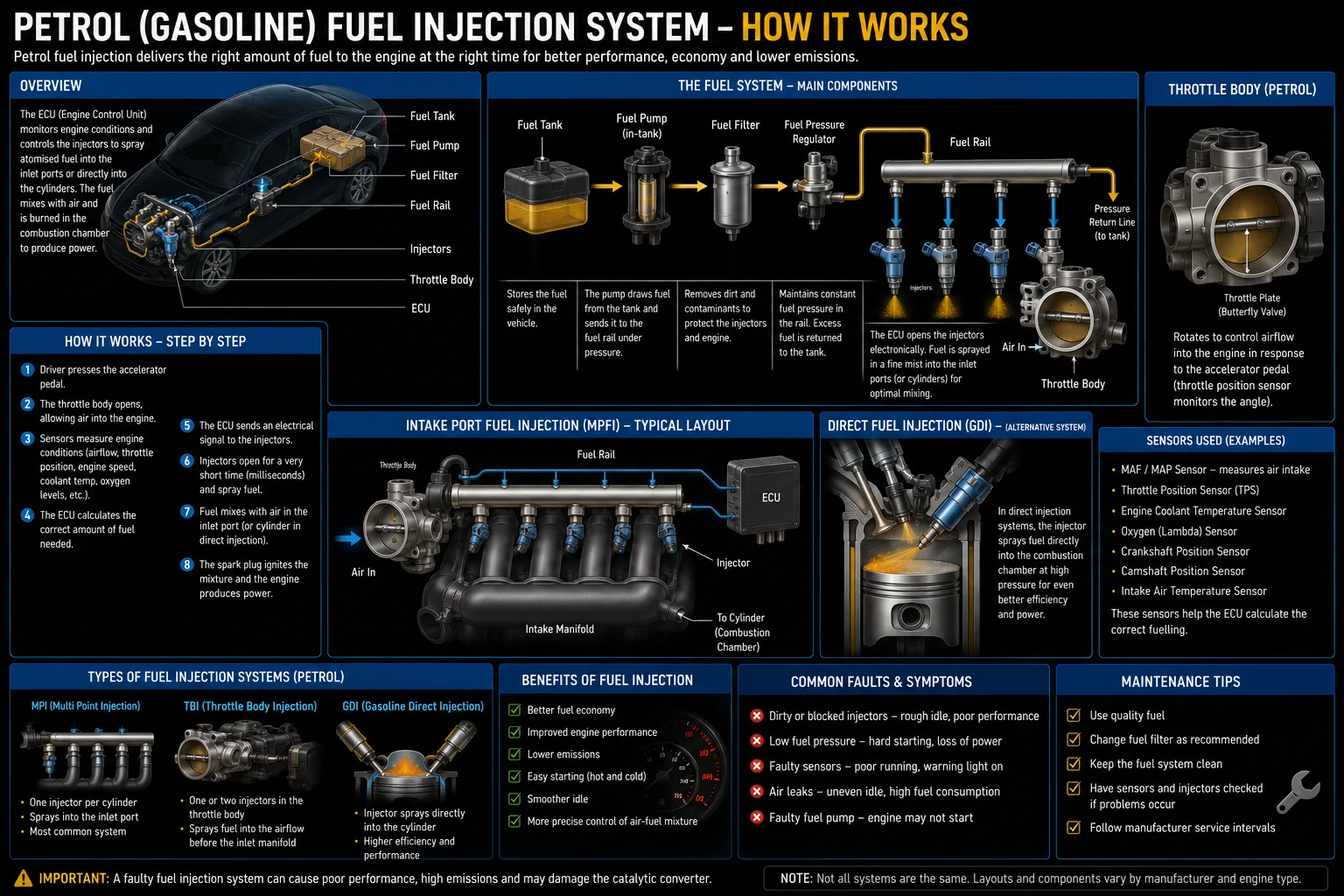
A mass air flow sensor — MAF sensor to everyone who doesn't enjoy typing — uses a heated element (typically a hot-wire or hot-film design in modern UK cars) suspended in the intake airstream. The principle is elegantly simple: the element is heated to a fixed temperature above ambient, and the ECU measures how much electrical current is needed to maintain that temperature as air rushes past and cools it. More air flow means more cooling means more current required. That current draw translates directly into an air mass figure in grams per second. The ECU takes that figure, cross-references it with engine speed, throttle position, coolant temperature and about a dozen other inputs, and calculates the precise fuel injection pulse width needed to hit the target air-to-fuel ratio — roughly 14.7:1 stoichiometric for petrol at cruise, richer under load, leaner at light throttle. Get the MAF signal wrong and the whole calculation collapses. A sensor reading low sends the ECU lean; it compensates by pulling timing, or the lambda sensor catches the error and adds fuel back in — but there are limits to how much correction the closed-loop system can apply before it sets a fault code, illuminates the engine management light, and in more severe cases, drops the car into a restricted limp mode to protect the catalytic converter from fuel-trim chaos. This is why live data matters: a scan tool reading the actual MAF output in g/s, compared to known good values for your specific engine at idle and under load, tells you definitively whether the sensor is the culprit — or whether you've been blaming the wrong component entirely.
“Your engine is, at its core, a controlled explosion machine.”
Sound familiar?
So what's behind it?
What we do — at your door
When SOSCarFix arrives at your driveway, car park, or that supermarket layby you've been sitting in for an hour hoping it'll sort itself out, we plug in a proper diagnostic scan tool before we touch anything — because the single worst thing you can do with a suspected MAF fault is reach for a new sensor without checking live data first. We pull the fault codes, then watch the MAF output in grams per second at idle, at warm-up, and under simulated load, comparing it against the known-good figures for your specific engine. That tells us whether the sensor is genuinely failing, whether a good clean with proper MAF-safe cleaner might restore it, or whether the actual problem is an air leak or a wiring fault making an innocent sensor look guilty. If replacement is the call, we fit a quality part — OE-spec or OE-equivalent, not the sort of no-name special that fails again in six months — reset the adaptations so the ECU relearns from a clean slate, and confirm the live data looks correct before we consider the job done. All of it on your driveway, without the garage waiting game.
What affects the price
What determines the cost of a MAF sensor job in the UK? A few honest variables. The sensor itself varies considerably by vehicle — a MAF for a common Ford Focus or Vauxhall Astra is a very different proposition to one for a BMW with a combined MAF and intake air temperature sensor in a single housing, or a performance diesel with a more complex air measurement setup. Labour is typically straightforward since most MAF sensors are accessible without significant dismantling, but some manufacturers have managed to position them in places that require removing substantial amounts of intake pipework to get near. Whether cleaning is worth attempting first also factors in — for a mildly contaminated sensor on a car with no other symptoms, a professional clean and retesting can defer replacement entirely and saves you money; for a sensor that's electrically failing or physically damaged, cleaning is just procrastination. We'll always tell you honestly which category yours falls into rather than reflexively reaching for the most expensive option, because that's not how we operate.
Random knowledge you didn't ask for
Questions you're probably asking
Can I just clean my MAF sensor instead of replacing it?
Sometimes, yes — and we'll always check this first rather than defaulting to a new part you might not need. If the sensor element is contaminated with oil mist or fine dust rather than electrically failing, a proper clean with MAF-specific cleaner (not WD-40, not brake cleaner, not whatever's on the shelf) can restore the signal and sort the fault. Live data before and after cleaning tells us definitively whether it worked. If the sensor is genuinely failing electrically or the element is physically damaged, cleaning is wishful thinking and replacement is the only honest answer.
What fault codes does a bad MAF sensor usually throw?
The standard P010x range covers MAF sensor faults — P0100 is a general circuit fault, P0101 is a range or performance issue (sensor reading outside expected parameters), P0102 is low input and P0103 is high input. You may also see associated fuel trim codes like P0171 or P0172 if the ECU has been compensating hard for a bad air signal. Worth noting: a lean code without a direct MAF code sometimes means an air leak downstream rather than the sensor itself, which is exactly why live data matters more than just reading fault codes.
Will a faulty MAF sensor damage my engine if I keep driving?
It won't cause immediate catastrophic engine failure the way, say, ignoring an oil pressure warning will — but it's not consequence-free either. Running persistently rich due to a low-reading MAF accelerates catalytic converter degradation, washes oil off cylinder walls with excess fuel, and hammers fuel economy. Limp mode, if triggered, is a protective measure but leaves you with significantly reduced power that makes certain driving situations genuinely unpleasant. Sort it promptly rather than treating the EML as decorative.
Does it matter whether I use an OE or aftermarket MAF sensor?
More than with many other components, yes. The MAF sensor calibration is specific to the ECU's expectations — a cheap pattern part that's slightly out of calibration will produce readings that are plausibly wrong rather than obviously wrong, meaning the car runs adequately but not correctly, fuel trims are slightly off, and you may never quite get the fault to clear cleanly. OE or OE-equivalent quality sensors are worth the premium here. We won't fit the kind of part that has you back on the phone in three months.
My car runs fine sometimes and badly other times — could that be the MAF?
Classic MAF behaviour, actually. Contaminated sensors and connectors with early corrosion often produce intermittent faults that correlate with temperature — the car starts fine when cold, the element heats up and the resistance characteristics shift, and suddenly the signal drifts. Or the fault clears after the engine restarts because thermal expansion briefly improves a dodgy connection. Intermittent faults are genuinely harder to catch without live data logging, but a mobile diagnostic visit can capture the MAF output across the warm-up cycle and catch the sensor misbehaving in real time.
MAF Sensor Replacement — sorted at your door
Stop procrastinating. Get a transparent quote and we'll come to you.