Knock Sensor Replacement: Your Engine's Ear to the Ground (And It's Gone Deaf)
Somewhere buried in your engine block there's a tiny, humble piezoelectric disc whose entire job is to listen. Not to your terrible taste in music — to the engine itself, hunting for the telltale rattle of detonation before it turns into something catastrophic. That sensor is the knock sensor, and when it fails, your ECU effectively goes deaf in one ear. It can't hear the pinking, so it can't retard the ignition timing to stop it, and your engine quietly starts suffering every time you put your foot down. The result: an engine management light (EML), noticeable power loss, worsening fuel economy, and — if you ignore it long enough — the kind of pinking you can actually hear through the firewall. SOSCarFix comes to your driveway, car park or office, connects proper diagnostic equipment, reads the live data, confirms the actual fault, and replaces the sensor. No garage drop-off. No guesswork.
See our upfront pricingYour engine's pinking and your ECU's panicking. Knock sensor faulty? We come to you, diagnose with live data, and sort it properly. Get a quote today.
How it actually works
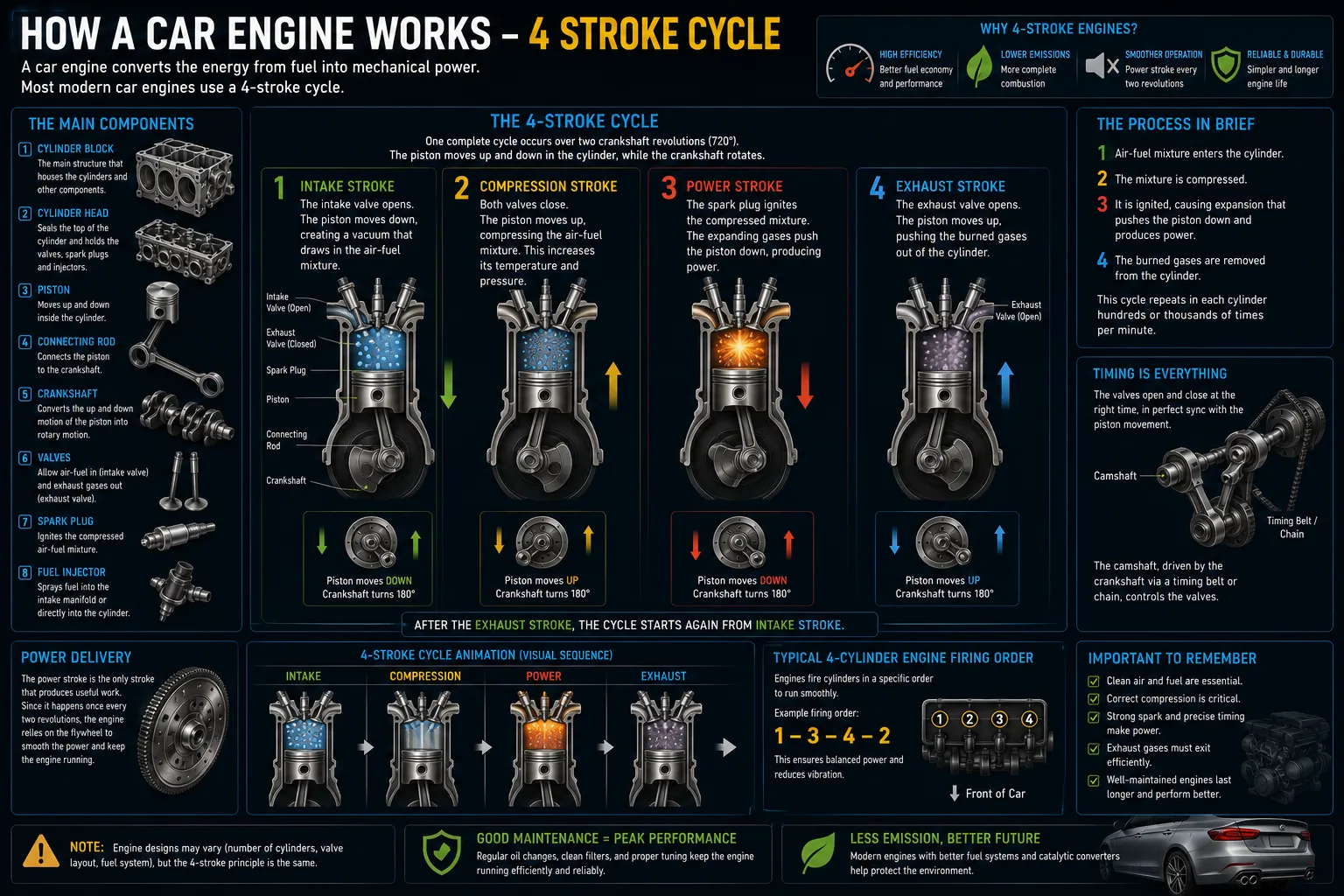
The knock sensor is a piezoelectric device — a crystal that generates a tiny voltage when it's physically vibrated. It's bolted directly to the engine block, usually between cylinders, where it picks up vibration through the metal. The ECU feeds it a reference frequency range and listens for the specific acoustic signature of knock (detonation): the uncontrolled self-ignition of the air-fuel mixture before the spark plug fires. This is also called pinking or pre-ignition, and it causes a rapid, damaging pressure spike in the cylinder. When knock is detected, the ECU retards (delays) the ignition timing — sometimes by several degrees, multiple times per second — to push combustion past the point where detonation can occur. It's continuously walking the ignition map right up to the edge of knock and pulling back as needed, extracting maximum efficiency without damaging the engine. It's genuinely elegant. When the knock sensor fails, or its wiring degrades, the ECU loses confidence in the signal. Rather than risk running on a timing map it can't verify is safe, it stores a fault code (commonly P0325, P0326, P0327 or similar), lights the EML, and often drops to a fixed, conservative timing map — one that's safe but robbed of the dynamic optimisation that gives your engine its proper power and economy. Diagnosing this properly requires reading live sensor data, not just pulling the code and assuming the sensor is dead.
“Somewhere buried in your engine block there's a tiny, humble piezoelectric disc whose entire job is to listen.”
Sound familiar?
So what's behind it?
What we do — at your door
We come to wherever your car is sitting — driveway, car park, layby — and start with a proper diagnostic scan across all modules, reading not just the stored fault codes but the live knock sensor data with the engine running. Because here's the thing: a P0325 code tells you the circuit flagged up; it does not tell you whether the sensor is dead, the connector has corroded, the wiring has chafed, or someone's fitted the replacement at the wrong torque. We read live data to see whether the sensor is producing any signal at all, check the wiring and connector condition, inspect the sensor torque where accessible, and only then confirm what actually needs replacing. If it's the sensor, we fit a quality replacement — correctly torqued, which matters more than most people realise — clear the fault codes, verify the EML has gone, and check live data to confirm the ECU is reading a normal signal. No throwing parts at it, no guessing, no sending you home with a cleared code and a wing and a prayer.
What affects the price
The cost of a knock sensor job in the UK varies based on a handful of genuinely important factors, so we won't make up a number. The sensor itself varies significantly by make and model — a knock sensor for a common Ford or Vauxhall is relatively affordable; the same job on a premium German saloon or a JDM import can cost considerably more for an OEM or equivalent-quality part. Accessibility is the other big variable: on some engines the sensor sits in plain view on the side of the block and takes twenty minutes; on others it's buried under the inlet manifold, which adds meaningful labour time. Wiring repairs — if the fault turns out to be in the harness or connector rather than the sensor itself — are priced on complexity. Our diagnostic visit is charged separately from the repair, because finding the real fault has value in itself — especially when the code alone could send you down the wrong path entirely. We quote transparently before any work starts.
Random knowledge you didn't ask for
Questions you're probably asking
Can I just clear the code and keep driving?
Technically yes, briefly. The code will come straight back because the fault is still there. More importantly, with a failed knock sensor the ECU is running a fixed, conservative ignition map — so you're losing power and economy every time you drive. And if the engine is genuinely pinking and the ECU can't hear it, you're slowly doing damage. It's not an emergency breakdown situation, but it's not something to leave for months either.
The code says P0325 — does that mean the knock sensor needs replacing?
P0325 means the ECU has flagged a fault in the knock sensor circuit — which could be the sensor itself, the wiring, or the connector. It does not confirm the sensor is dead. Diagnosing from the code alone and ordering a sensor is how you end up replacing the wrong thing. Live data and a wiring check first, then the correct repair. That's the difference between fixing it once and fixing it twice.
My car pinks on cheap petrol but not on premium — is this a knock sensor fault?
Probably not a faulty sensor — that actually sounds like a working sensor doing its job. Lower-octane fuel detonates more easily, the sensor detects it, and the ECU retards timing (sometimes noticeably). Premium fuel has a higher octane rating and resists detonation better, so the ECU doesn't need to pull as much timing. If the car pinks and the EML stays off, the sensor is likely fine. If the EML is on as well, get it scanned.
Is the knock sensor the same thing as the crankshaft sensor?
No — completely different components with completely different jobs. The crankshaft position sensor tells the ECU where the pistons are in their rotation, which is essential for firing the ignition at all. The knock sensor listens for detonation so the ECU can fine-tune the timing of that ignition. Both can cause EML lights and running issues, but they're diagnosed and replaced separately. A scan tool and live data will tell you quickly which one is misbehaving.
My car has two knock sensors — does both need replacing if one fails?
Not necessarily. Many V6, V8 and inline-six engines have two knock sensors covering different cylinder banks, and they each have their own fault codes. If only one circuit has flagged, only that sensor and its wiring need investigating. Replacing both as a precaution is sometimes sensible on a high-mileage engine where both are original, but it's a conversation to have after diagnosis, not a default.
Knock Sensor Replacement — sorted at your door
Stop procrastinating. Get a transparent quote and we'll come to you.