Coolant Temperature Sensor: When Your Car Thinks It's Always Cold (or Always Melting)
The engine coolant temperature sensor is one of those small, cheap, unremarkable components that quietly holds quite a lot of your car's behaviour together. It sits in the coolant circuit — usually screwed into the thermostat housing or cylinder head — and does one job: tells the ECU how hot the engine is. The ECU, being a creature of obsessive control, uses that reading for almost everything: how much fuel to inject, when to open the cooling fans, how to set ignition timing, and whether to go into closed-loop running. When the sensor lies — or just quietly stops working — the ECU carries on making decisions based on bad data. And because the ECU trusts it implicitly, you end up with a car that runs like it's permanently stuck in a January frost, or one that drinks fuel like it never left the forecourt. Either way, something is wrong, and it is not random.
See our upfront pricingEML on, cold starts rough, MPG gone south? Could be a coolant temp sensor. SOSCarFix diagnoses and replaces it at your door. Get a quote today.
How it actually works
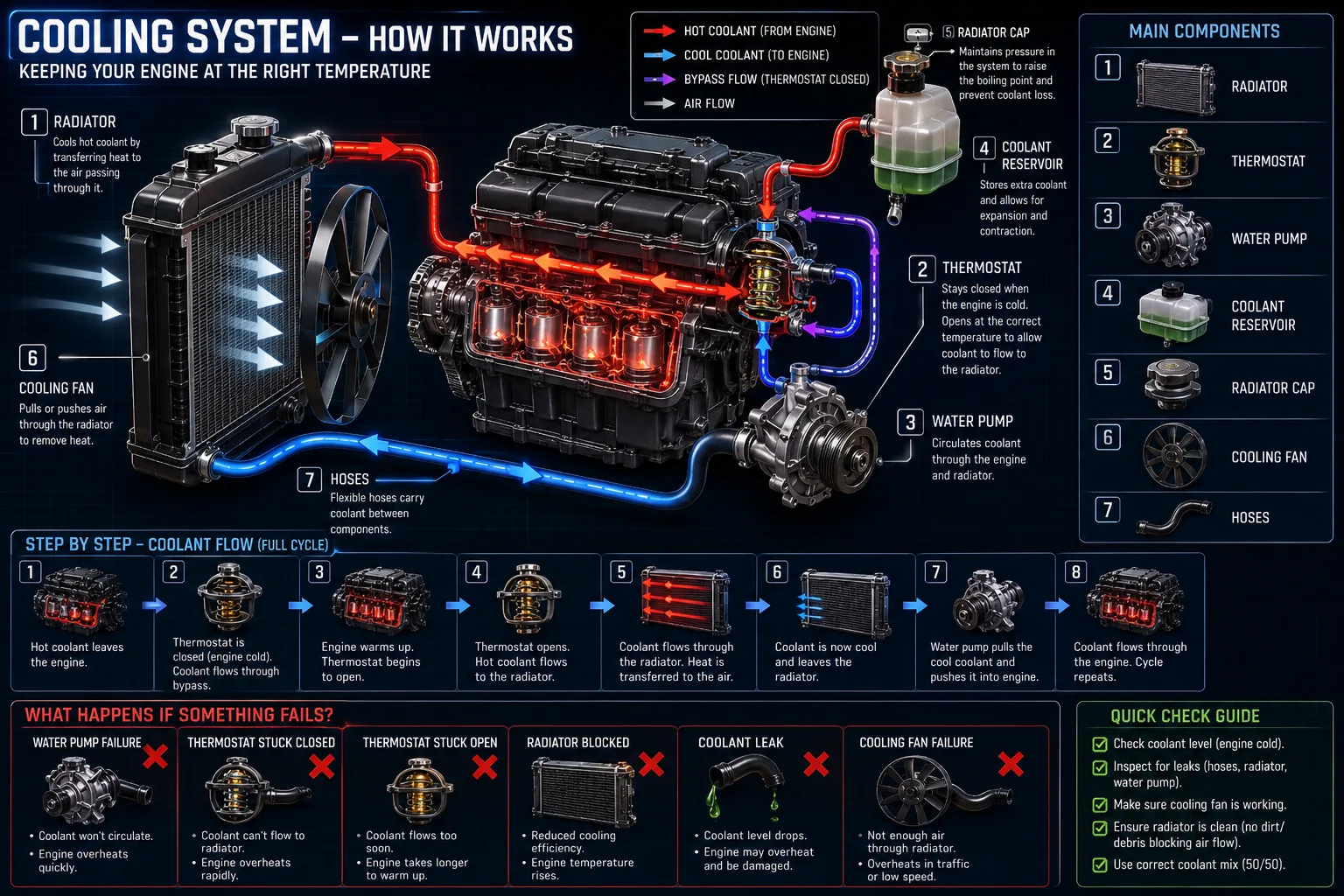
The engine coolant temperature (ECT) sensor is a thermistor — a resistor whose resistance changes predictably with temperature. Cold coolant means high resistance; hot coolant means low resistance. The ECU reads the voltage signal across this resistor constantly, interprets it against a known calibration curve, and arrives at a temperature figure it trusts completely. That figure then feeds into a surprising number of decisions. On a cold start, the ECU runs a richer fuel mixture to compensate for poor fuel atomisation in a cold engine — the same reason you used to pump a choke on old cars, just done electronically. As the engine warms up, it leans the mixture off and switches from open-loop (fixed fuel map) to closed-loop (using the lambda/oxygen sensors to trim fuel in real time). The cooling fans are also triggered by ECT readings on most cars — the ECU decides when to spin them up based on what the temperature sensor reports, not on actual engine temperature alone. If the sensor is reading minus 30°C when the engine is actually at 90°C, the ECU has no idea — and it will behave accordingly, which is badly. The sensor also feeds the dashboard temperature gauge, so a faulty one can either peg the needle at cold, bury it in the red, or make it wander like it's having an existential crisis.
“When the sensor lies — or just quietly stops working — the ECU carries on making decisions based on bad data.”
Sound familiar?
So what's behind it?
What we do — at your door
We come to you — driveway, work car park, roadside, wherever the car happens to be — and we do not guess. The first step is plugging in a proper scan tool and pulling not just the fault codes but live data: we watch the ECT sensor's reading in real time as the engine warms up, and we compare it against the actual coolant temperature (cross-referenced against another sensor or a thermal probe). A healthy ECT sensor should trace a smooth, predictable curve from cold ambient up to roughly 90°C and then stabilise as the thermostat opens. One that's reading minus 40°C on a warm engine, or jumping around erratically, is telling its own story. Once we've confirmed the sensor is the fault (and not, say, a wiring issue or a different cause for the same symptoms), we replace it — correct OE-spec or OE-equivalent part, fresh sealing washer, coolant topped up, connector cleaned and seated properly. We clear the fault codes, warm the engine and verify the live data looks right before we leave. Because diagnosing with live data and replacing with confidence beats buying a sensor off a shelf and hoping for the best.
What affects the price
The sensor itself is usually a modest part — but the cost of the job varies depending on where your particular sensor lives. On some engines it sits right on top of the thermostat housing, three-minute job. On others it's buried behind the inlet manifold, requires partial engine disassembly and a coolant drain, and becomes a proper afternoon. The make and model matters too: a sensor for a common Ford or Vauxhall costs a fraction of one for a prestige German brand, and the labour reflects that same disparity. On top of the part and labour, factor in a coolant top-up (and a proper flush if the coolant is old or contaminated — which is often worth doing while you're in there anyway, rather than putting clean parts into dirty coolant). We'll give you a straight quote for your specific car before we start anything — no garage-style "we'll see when we open it up" vagueness.
Random knowledge you didn't ask for
Questions you're probably asking
Can a faulty coolant temperature sensor damage my engine?
Not directly — the sensor doesn't cool anything. But the knock-on effects can cause problems over time. Running permanently rich washes oil off cylinder walls, increases fuel dilution in the sump and dirties the catalytic converter. Fans running flat-out at all times also suggests the ECU thinks it's constantly overheating, which can mask a genuine cooling fault developing quietly underneath. So: not immediately dangerous, but not something to leave indefinitely.
My temperature gauge reads fine but the engine management light is on — could it still be the coolant sensor?
Yes — and this is exactly why many people don't immediately suspect it. On a lot of cars, the gauge and the ECU are fed by different sensors, or the gauge sender can read correctly while the ECT sensor circuit has an intermittent fault the ECU has clocked. The fault code and live data from a scan tool will tell you far more than the gauge alone. A steady needle does not mean the ECU is seeing the right information.
How long does a coolant temperature sensor replacement take?
On an accessible engine — thermostat housing on top, easy connector — it's typically under an hour including diagnosis, replacement and verification. On engines where it's buried or requires a coolant drain and significant disassembly, it can be two to three hours. We'll tell you upfront based on your specific car, not a vague garage estimate.
Can I just clear the fault code and see if it comes back?
You can, but it's a bit like ripping the low-oil warning light out because it keeps annoying you. The code will come back if the fault is still there, and in the meantime your ECU is quietly making fuelling decisions based on bad data. Diagnosis first, clear second — that's the order that saves money.
Is it worth replacing the thermostat at the same time as the coolant sensor?
Often yes, if access to the sensor requires removing or disturbing the thermostat housing anyway. A thermostat is a cheap part, and if it's the original one with 80,000+ miles on it, doing both while you're in there makes more sense than paying the same labour cost twice six months later. We'll flag it if it's relevant to your job.
Coolant Temperature Sensor — sorted at your door
Stop procrastinating. Get a transparent quote and we'll come to you.