Suspension Bushes: The Silent Saboteurs Turning Your Car Into a Shopping Trolley
Suspension bushes are the car world's version of that bloke nobody notices until he's gone — small, unglamorous, wedged between metal and metal, quietly absorbing decades of potholes, speed bumps and the general misery of British roads. They're just rubber (or polyurethane, if you're feeling fancy), but they're doing extraordinarily important work: every wishbone, control arm, anti-roll bar drop link and subframe mounting in your suspension system pivots inside one. When they go — and they will go — your car stops handling like a car and starts handling like a bin on wheels. Knocking, clunking, vague steering, uneven tyre wear, MOT advisories. SOSCarFix comes to your driveway, presses in the new ones, and saves you from the slow spiral of "it's probably fine" that ends in a failed MOT and a tyre worn to canvas on one edge.
See our upfront pricingKnocking, clunky, vague handling, MOT advisory? Worn suspension bushes sorted on your driveway. Mobile mechanic, no garage faff. Get a quote.
How it actually works
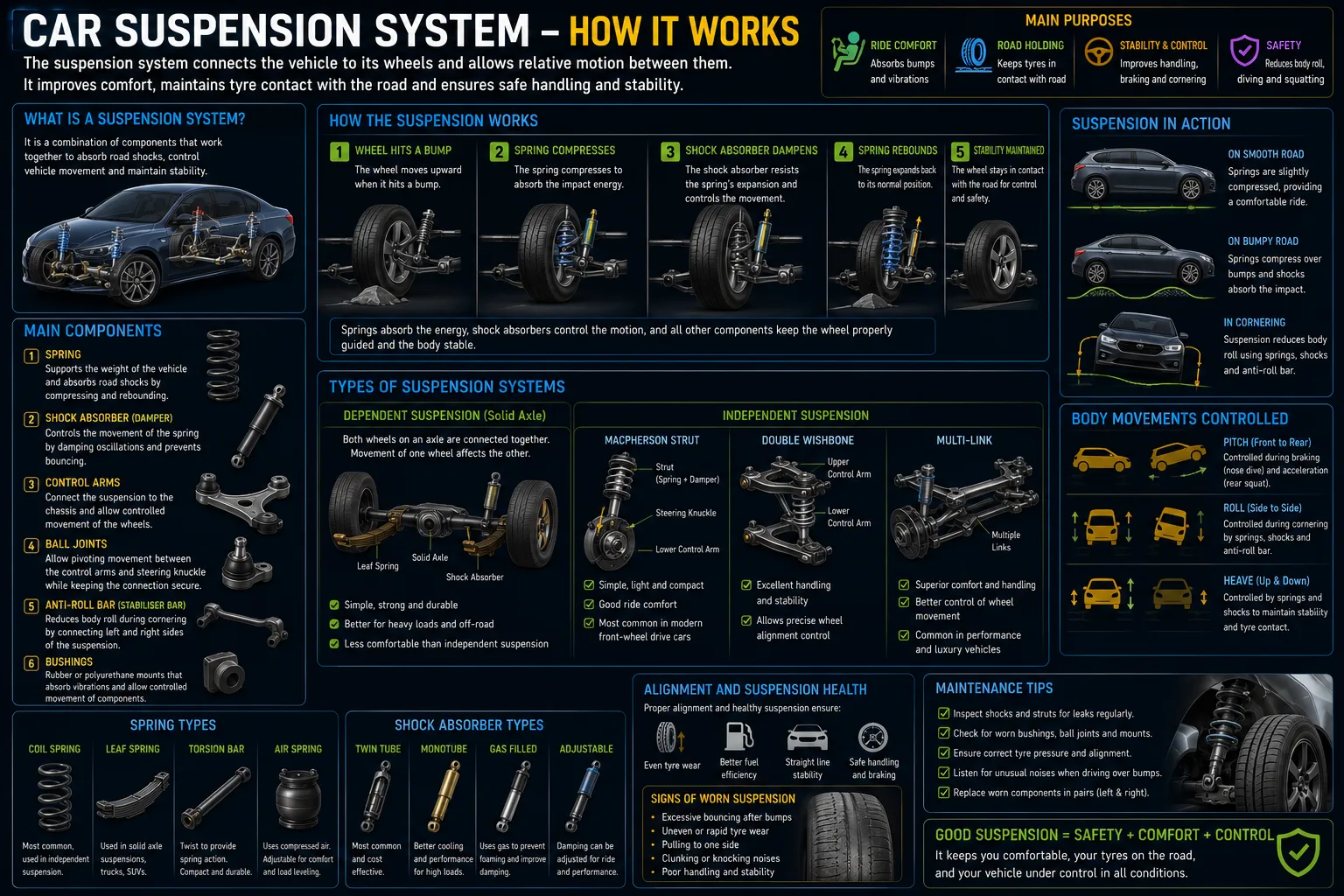
Every moving joint in your suspension needs two things: the ability to pivot, and the ability to absorb vibration. A solid metal-on-metal pivot would do the first but transmit every road imperfection straight to your spine — and it'd wear out in weeks. So engineers put a rubber bush in the middle: a cylinder of rubber (or polyurethane) bonded to an inner metal sleeve, pressed into the outer eye of the arm. The arm can articulate through its designed range of motion while the rubber absorbs the vibration and minor flex. That's it. That's the whole trick. The problem is rubber doesn't love the real world — it gets cracked by UV and ozone, softened by oil and brake fluid, compressed and distorted by continuous load, and eventually just disintegrates. The inner metal sleeve can also start to rotate freely inside the rubber (called spinning), or the outer shell can corrode and seize in the arm. Either way, the result is the same: slop. Metal touches metal, or moves further than it should, and what was crisp and controlled becomes unpredictable and knocking. Polyurethane bushes are firmer and far more durable — great for cars driven enthusiastically or doing high mileage — but they need greasing during fitting and can introduce a little more NVH (noise, vibration, harshness) into everyday driving. On a standard road car, quality rubber OEM-spec bushes are usually the correct choice.
“When they go — and they will go — your car stops handling like a car and starts handling like a bin on wheels.”
Sound familiar?
So what's behind it?
What we do — at your door
We come to you — driveway, car park, wherever the car lives — with a press kit, the correct replacement bushes for your specific vehicle, and the diagnostic nous to confirm the actual culprit before quoting. Knocking suspension can come from a dozen places: worn bushes, worn ball joints, drop links, loose strut top mounts, even a loose anti-roll bar clamp. We won't just replace the nearest rubber thing and hope for the best. We inspect the whole suspension assembly visually and by hand — rocking and levering the arms to check for play, assessing the condition of the rubber, checking for corrosion, listening carefully to where the knock is actually coming from. Where bushes are genuinely the issue, we press out the old ones and press in new quality replacements, degrease and check the surrounding components, and confirm the noise is gone before we leave. If the geometry has been affected we'll flag an alignment check, which is worth doing after any suspension work. No garage. No waiting room. Done on your driveway.
What affects the price
Suspension bush replacement cost in the UK depends on several honest variables — no single price fits all: - **Which bush and which car:** A front lower arm bush on a Ford Focus is a very different job from a rear subframe bush on a BMW 3 Series or a rear beam axle bush on a Volkswagen. Labour time varies from 30 minutes to several hours per side depending on accessibility and whether the whole arm needs to come off. - **Rubber vs polyurethane:** OEM-spec rubber bushes are almost always cheaper than polyurethane uprated alternatives. Both are available — we'll discuss the trade-offs. - **Single bush vs full arm replacement:** On some vehicles it's cheaper (or only practical) to replace the entire wishbone or control arm as an assembly rather than pressing the bush out separately. We'll quote both where relevant. - **How many need doing:** Suspension bushes tend to age together. If one is gone, the others from the same era are usually not far behind. We won't invent extra work, but we will point out what's approaching end of life. - **Access and corrosion:** A UK car that's seen its fair share of winter salting can make bush removal genuinely time-consuming — seized outer shells, corroded bolts, arms that have to be heated to release. We'll flag this if it applies. We quote per job, per vehicle, once we've seen it. No surprises.
Random knowledge you didn't ask for
Questions you're probably asking
Can I keep driving with a knocking suspension bush?
In the short term you're unlikely to end up in a hedge — a worn bush degrades gradually. But a badly worn bush affects your steering accuracy and braking stability, worsens tyre wear at an eye-watering rate, and will eventually fail an MOT. It also tends to take neighbouring components with it as uncontrolled movement puts stress where it wasn't designed. 'Keep an eye on it' is reasonable for a week or two; 'leave it for six months' is not.
My car just failed its MOT for a suspension bush — what does that mean exactly?
MOT testers check for play, visible splits, and deteriorated rubber when they prod and lever the suspension. A 'suspension arm bush deteriorated, excessive movement' is a fail; 'deteriorated, minor cracking' is often an advisory — a flag to watch, not a reason to fail yet. Either way it means the bush needs attention soon. We can replace it and you get the MOT retest.
What's the difference between rubber and polyurethane suspension bushes?
Rubber (OEM-spec) is softer, absorbs vibration better, and suits everyday road driving — it's what your car was designed around. Polyurethane is significantly stiffer and more durable, which sharpens handling feel and lasts longer, but introduces more road noise and harshness. For most UK road cars, good-quality rubber bushes are the right answer. Polybushes suit cars used on track days or owners who genuinely prefer the firmer feel and don't mind a bit more thrum.
Do I need a wheel alignment after suspension bushes are replaced?
Usually yes, and it's not optional padding on the invoice. Suspension geometry — toe, camber, caster — shifts when you change the pivot points. The size of that shift depends on which bushes and which car, but driving on a freshly-bushed suspension without an alignment check is how you end up with a perfectly repaired car that quietly destroys its new tyres in three months. We'll tell you if it's needed.
How long does suspension bush replacement take?
A front lower arm bush on an accessible mainstream car can be done in under an hour per side. Rear subframe or beam axle bushes, or anything on a heavily corroded car, can take considerably longer — a full afternoon isn't unusual on some vehicles. We quote the time honestly when we price the job, so you know what you're committing to before we start.
Why does my car creak or squeak over bumps and when turning?
Nine times out of ten that creak or squeak is a worn suspension bush — the rubber sleeve inside a wishbone, control arm or anti-roll bar drop link that's dried out, split, or started spinning in its housing. As the rubber degrades it loses its cushioning, metal begins to contact metal, and you get that charming noise every time the suspension articulates. It won't heal itself, and it'll get worse (and louder) until it either fails your MOT or costs you a tyre. Worth getting it checked before it does either.
Suspension Bushes — sorted at your door
Stop procrastinating. Get a transparent quote and we'll come to you.