Broken Coil Spring: When Your Suspension Decides to Snap Under the Pressure of British Roads
Coil springs are the steel helices doing the thankless job of absorbing every pothole, speed bump, and crumbling B-road the UK throws at your car — which, if you live anywhere outside a freshly resurfaced motorway service area, is quite a lot. They sit between your wheel assembly and your car's body, compressing under load and rebounding with every indignity the road surface dishes out. Quietly. Invisibly. Until one morning — often a cold one, because UK winters have a particular talent for being cruel — you hear a sharp clunk, the car drops half an inch on one corner, and suddenly you're driving a vehicle that looks like it's favouring one bad knee. A snapped coil spring is not a "drive it and see" situation. It's a fail-waiting-to-happen: tyres scrubbing unevenly, handling going odd, and an MOT inspector reaching for their red pen from approximately forty feet away. SOSCarFix replaces them without you ever seeing the inside of a garage.
See our upfront pricingSnapped coil spring? Car sitting lopsided, clunking over every pothole the council forgot to fix? We come to you. Get a quote from SOSCarFix today.
How it actually works
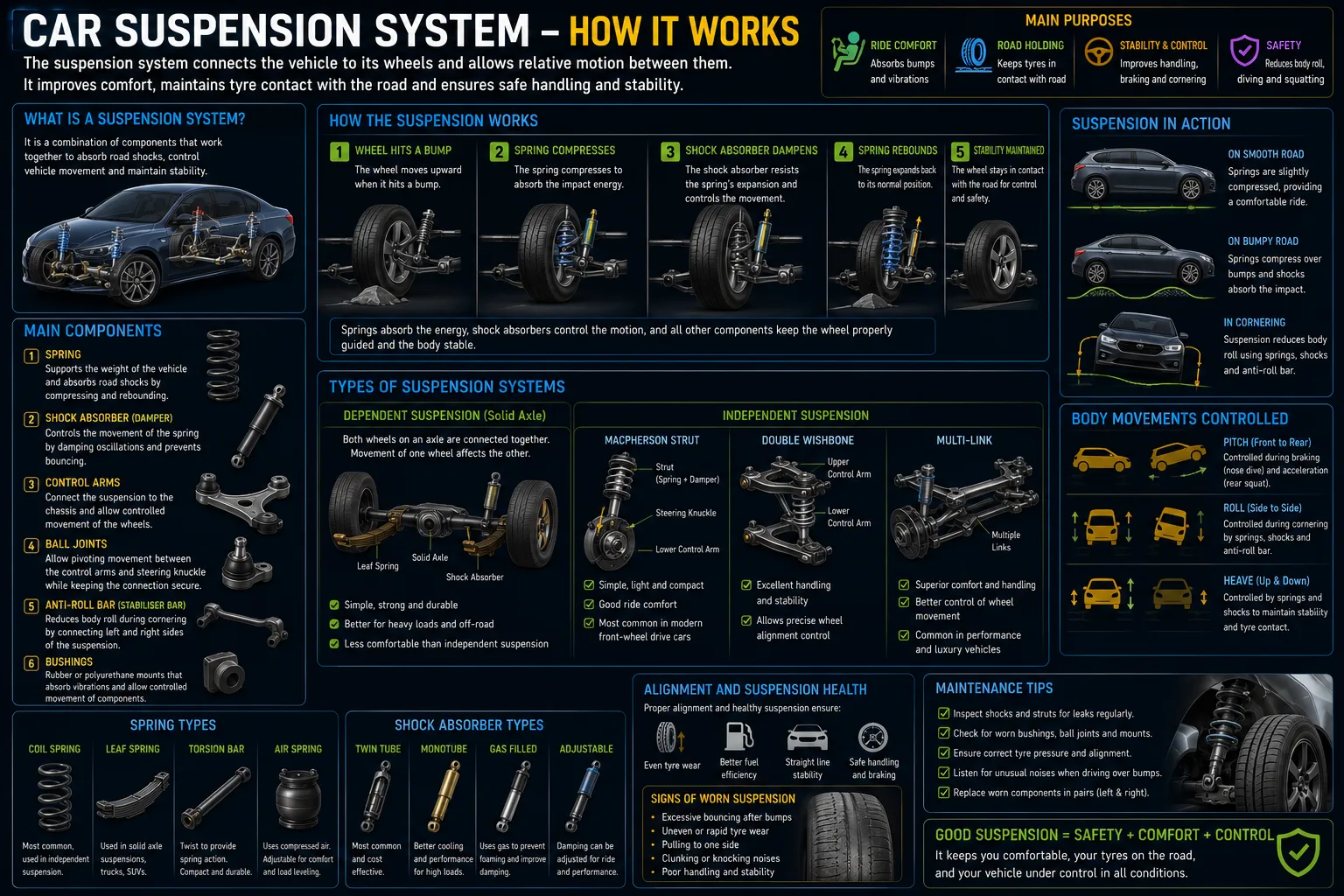
Coil springs are precision-engineered components made from hardened steel, wound into a helix and heat-treated to survive repeated compression cycles across the car's entire working life. They live inside or around your shock absorber (depending on your suspension design — MacPherson strut setups, which dominate most modern UK hatchbacks and saloons, wrap the spring around the damper as a single unit). The spring's job is to support the vehicle's weight and control how much the suspension travels under load. The shock absorber's job is to stop that travel turning into a bouncy castle impersonation. When a coil spring snaps — usually at the lower coil where corrosion and stress concentrate — it does one of two things. Sometimes it snaps cleanly and the car drops, making the problem hard to miss. Other times it partially fractures, continues to support some weight, and just quietly ruins your handling and tyre wear for weeks before someone notices. Either way, it needs to come out. Springs are always replaced in pairs on the same axle — fit one new spring and you've immediately created a left-right imbalance, which means uneven ride height, uneven tyre wear, and handling with the predictability of a wet motorway merge. The old spring is compressed using specialist spring compressor tools (do not attempt this at home; the energy stored in a compressed spring is spectacular and unforgiving), removed, and the new one fitted and torqued to spec. Wheel alignment is worth checking afterwards — a snapped spring can pull things out of true.
“SOSCarFix replaces them without you ever seeing the inside of a garage.”
Sound familiar?
So what's behind it?
What we do — at your door
SOSCarFix sends a qualified mobile mechanic to wherever the car is — your driveway, your work car park, a sensible layby, or a quiet road if that's where you've ground to a halt — with the correct replacement springs for your make and model already in the van. We lift the car safely, remove the wheel, compress and extract the failed spring using proper spring compressor tooling (not improvised enthusiasm), fit the new pair on that axle, torque everything back to specification, and lower it down. We'll eyeball the shock absorber while we're in there — a failed spring has sometimes been bouncing against a worn damper for a while, and that's worth knowing about before the next MOT. No garage queues, no courtesy car faff, no being talked into a service you didn't ask for. Just working suspension, fitted at your location, and then we leave you to it.
What affects the price
Several things pull the cost up or down when it comes to coil spring replacement in the UK, and it's worth being honest about all of them. The make and model of your car matters enormously — springs for a Ford Focus or Vauxhall Astra are cheap as chips and widely available; springs for a prestige German marque or an older vehicle with dwindling parts supply are considerably less cheerful. Whether your car uses MacPherson struts (common on front-axle setups) or a separate spring-and-damper arrangement affects labour time. If the shock absorber or top strut mount is also shot — which is worth investigating while the spring is out anyway — that adds to parts cost. Fitting is always done in pairs on the same axle, so you're buying two springs, not one. And as with all mobile work, your location in the UK has a small bearing on the call-out element of the quote. Quality of spring matters too: budget aftermarket springs exist, and they'll work, but OEM-specification or reputable branded alternatives (Monroe, Meyle, KYB, Bilstein) are the sensible choice for something that's holding your car off the tarmac.
Random knowledge you didn't ask for
Questions you're probably asking
Can I drive on a broken coil spring?
Briefly, possibly, and unwisely. If the spring has snapped cleanly, the car will be sitting low on one corner and the broken end can potentially puncture your tyre or damage brake lines as the suspension moves — which makes 'briefly' an optimistic word. If it's a partial fracture, you might not notice immediately, but your handling is compromised and an MOT will fail it on sight. The sensible answer is: don't. Book the repair, or call us to come to where the car already is.
Do both coil springs need replacing at the same time?
On the same axle, yes — always. If you replace one spring and leave the other original one in place, you've created an immediate imbalance between left and right: different ride heights, different spring rates, handling that pulls to one side. It also means the surviving original spring is probably not far behind its partner in age and condition. Fitting in pairs costs more upfront but saves you paying for the labour twice in three months.
How do I know if it's the coil spring or the shock absorber that's failed?
Sometimes both have gone together, frankly. A snapped spring is often detectable visually — you can see the break in the coil, or the car sits clearly lower on one corner. A worn shock absorber tends to show up as excessive bounce, a wallowing ride, or the car taking multiple oscillations to settle after a bump. On MacPherson strut setups they're part of the same assembly, so we assess both while we're in there. No point replacing the spring and ignoring a damper that's weeping fluid.
Will a broken coil spring fail an MOT?
Yes, unambiguously. A fractured or broken coil spring is a Category S (previously 'major') MOT failure — the vehicle fails on the spot, no advisories, no goodwill. Inspectors check spring condition visually and can identify fractures, severe corrosion, and insufficient ride height. If your car is already close to MOT time and you're hearing clunks or sitting lopsided, get it looked at before you present it for test — failing and needing to re-present costs more time and usually a re-test fee.
How long does a coil spring replacement take on the roadside or driveway?
For most common UK cars — your Fiestas, Golfs, Corsas, Astras, and the usual suspects — replacing a pair of front or rear coil springs takes roughly one to two hours on site. That includes safe lifting, spring compression, removal and refitting, and getting everything back to torque. Rear spring setups on some vehicles are more accessible and can be quicker; some independent rear suspension designs are more involved. We'll tell you what to expect for your specific car when you book.
Broken Coil Spring — sorted at your door
Stop procrastinating. Get a transparent quote and we'll come to you.