The Clonk That Never Goes Away: Strut Top Mount Replacement
The strut top mount is one of those car parts you've never heard of until it starts making a noise you cannot unhear. It sits at the very top of your front suspension strut — between the strut and the car's body — and its job is to let the suspension move up and down (over bumps) while also allowing the whole strut to rotate (when you steer). When it wears out, you get a clonk over every speed bump, a creak on full lock, and sometimes a notchy, gritty feeling through the steering wheel — as if someone has hidden a bag of gravel in your front suspension. Which, structurally speaking, is basically what's happened. SOSCarFix comes to you, no garage required, and fits new top mounts — usually alongside springs or shock absorbers, since you're already in the area.
See our upfront pricingThat clonk over every speed bump? Notchy steering on full lock? Your strut top mount has given up. We come to you and sort it. Get a quote.
How it actually works
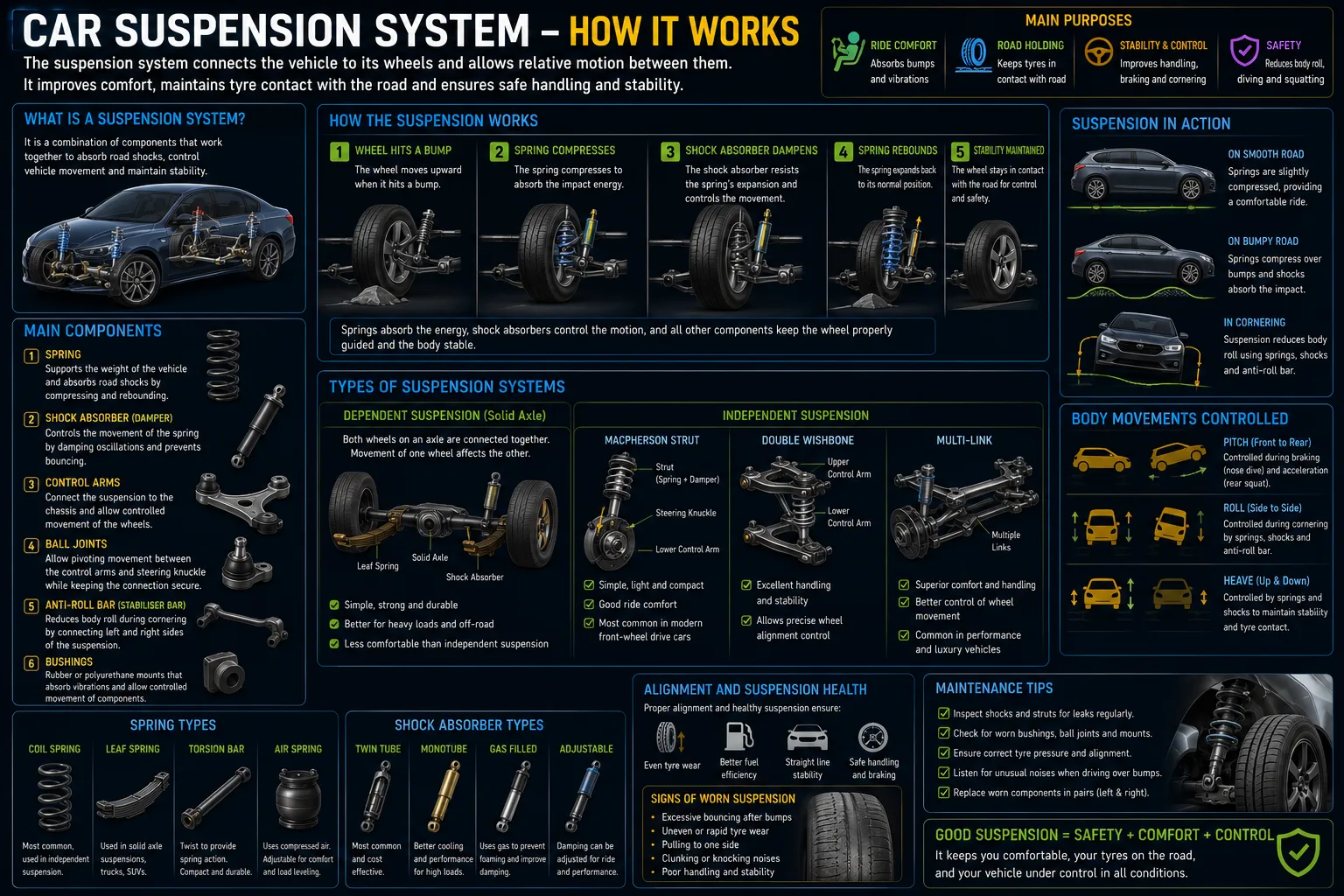
Your front suspension is almost certainly a MacPherson strut setup — the dominant design on UK hatchbacks, saloons and crossovers since the 1970s and still the most common configuration today. In a MacPherson strut, a single combined unit handles both damping (the shock absorber inside) and structural support (the strut itself acts as the top pivot for the wheel). The strut top mount is the interface between the top of that strut and the car's inner wing (the metal in your engine bay). It does two distinct jobs simultaneously. First, it acts as a flexible rubber buffer that absorbs small vibrations and knocks before they feed through into the car body — your noise isolation. Second, it contains a bearing (sometimes called the top mount bearing or thrust bearing) that allows the entire strut to rotate smoothly as you steer, so the wheel can turn left and right without the suspension fighting the steering. The rubber element degrades over time — it hardens, cracks and separates. The bearing wears and corrodes. Either way, what was once a smooth, silent joint becomes a metal-on-metal clonk factory. Top mounts are also the reason a strut replacement job without replacing the top mount is usually a false economy — you've done the hard work and left the worn-out part in situ.
“The strut top mount is one of those car parts you've never heard of until it starts making a noise you cannot unhear.”
Sound familiar?
So what's behind it?
What we do — at your door
When you book with SOSCarFix, we come to your driveway, workplace, or wherever the car happens to be sitting. Because the clonk from a worn top mount sounds remarkably similar to anti-roll bar drop links, a worn strut bearing, or even a knackered lower ball joint, we don't just take your word for what it is — we diagnose it properly first. That means bouncing the suspension, reproducing the noise, checking for play at the strut top in the engine bay, and listening carefully to whether the noise changes with steering input (which points squarely at the bearing). Once we've confirmed the fault, we give you an itemised quote before any spanners come out. The job involves removing the wheel, unbolting the strut, compressing the spring safely with proper spring compressors (not the murderous scissor type you can hire from Halfords), and pressing or swapping the top mount. Where springs or dampers are also due, we'll do the lot in one visit — it makes zero sense to split the labour. The car's back on the road the same day.
What affects the price
Several things influence the cost of a strut top mount replacement in the UK. The main variables are: the car make and model (part prices vary enormously — a top mount for a Ford Focus or Vauxhall Astra is cheap and plentiful; a premium German car or anything with an unusual strut geometry will cost more); whether one or both sides need doing (if one has failed, the other is often close behind, and doing both while the suspension is apart saves substantial labour); whether the shock absorber and/or spring also need replacing at the same time (very commonly they do on high-mileage cars, and the labour overlap makes this the economical moment to do it); and whether the top mount comes as a complete assembly with integrated bearing or as separate components. We don't publish fixed prices because honest pricing means quoting for your actual car in its actual condition — we'll always give you a clear, itemised quote before starting work.
Random knowledge you didn't ask for
Questions you're probably asking
Can I just replace the top mount on its own, or do I have to do the shocks and springs too?
You can replace the top mount in isolation — and if the shocks and springs are genuinely fine, that's perfectly sensible. The honest answer is that if the car has significant mileage and the springs and dampers haven't been touched recently, it's worth checking them while the strut is out. Splitting the labour later costs more than doing it together now. We'll tell you the state of everything and let you decide.
Is a clonking noise over bumps always the top mount?
No — and this is important. Anti-roll bar drop links, lower ball joints, worn strut bearings, broken spring coils and even loose wheel bolts can all produce a clonk over bumps. The location of the noise (top of the strut versus bottom), whether it changes when you steer, and a physical check for play are what separate them. We diagnose before we quote — we're not in the business of replacing parts on a guess.
Will a failed strut top mount fail an MOT?
Potentially, yes. An MOT tester checking suspension will look for excessive play and deterioration of the top mount. If the rubber has clearly separated, the bearing has significant play, or the mount itself is loose, it can be flagged as a failure or an advisory depending on severity. A knocking noise alone isn't automatically a fail, but the underlying wear that causes it often is.
Do I need a wheel alignment after strut top mount replacement?
If only the top mount was replaced and the strut itself wasn't removed and refitted in a way that alters geometry, alignment often remains within spec — but it's worth checking, especially if the car was already pulling or wearing tyres unevenly. If shocks, springs or other suspension components were done at the same time, a four-wheel alignment check afterwards is strongly advisable and we'll say so.
How long does strut top mount replacement take on the driveway?
A top mount replacement on one side, done properly with spring compressors and a thorough check, typically takes around 1.5 to 2 hours per side. If both sides are being done or other suspension work is combined in the same visit, we'll give you a time estimate when we quote. It's a same-day job — you won't be carless overnight.
The Clonk That Never Goes Away — sorted at your door
Stop procrastinating. Get a transparent quote and we'll come to you.