The Clonk That Won't Shut Up: Ball Joint Replacement Done at Your Door
Your car's ball joints are, conceptually, not complicated: a ball sitting inside a socket, coated in grease, doing the unglamorous job of connecting your lower suspension arm to your hub so that you can steer and go over bumps without the whole arrangement turning into abstract sculpture. The problem is that "simple" doesn't mean "immortal." These things wear. The grease leaks out through a cracked rubber boot. The socket gets sloppy. And then one day you're pulling out of your driveway at 2mph and there's a clonk so loud your neighbour looks up from his lawn. That clonk is your ball joint politely — or not so politely — informing you that the ball is no longer sitting snugly in its socket. Ignore it long enough and the consequences range from uneven tyre wear to a geometry disaster to, in the exciting extreme, the wheel adopting an unplanned angle at an inopportune moment. SOSCarFix comes to you, diagnoses which joint has gone rogue, and fits the replacement before your MOT tester gets the satisfaction of writing it up.
See our upfront pricingKnocking over bumps? Clonk on full lock? Your ball joints are staging a protest. SOSCarFix replaces them at your door — no garage faff. Get a quote.
How it actually works
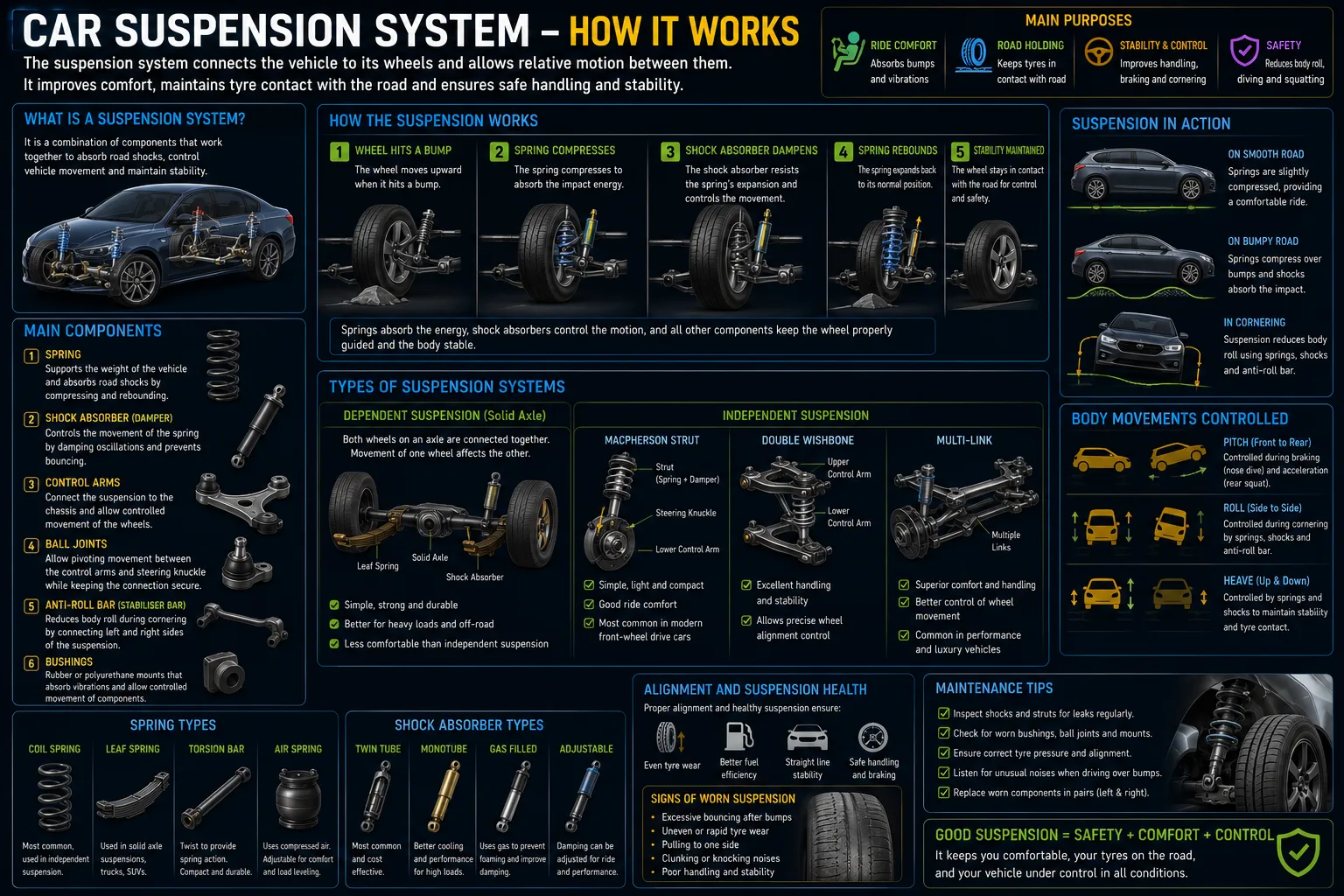
A ball joint is a pivoting connection — like a hip joint, but considerably less biological. In most modern cars, the lower arm ball joint is the critical one: it takes the vehicle's weight through the suspension, copes with the up-and-down travel of the wheel over bumps, and simultaneously allows the steering to swivel the hub left and right. It lives in a dusty, gritty, constantly flexing environment, sealed from the outside world by a rubber gaiter (the "dust boot") packed with grease. That boot is the ball joint's only defence. When it splits — and it splits — road muck gets in, grease gets out, and metal starts working against metal. On most lower arms, the ball joint is either pressed into the arm as a separate component that can be replaced alone, or it's integral to the arm itself, meaning the whole lower arm comes off. Both are entirely manageable roadside jobs with the right press tools and lift equipment. On some Fords, VWs, Audis, and similar, third-party ball joints of perfectly acceptable quality are available; on others, the whole lower arm is the sensible replacement unit. The steering geometry — specifically the camber and toe — needs checking after any ball joint work, because the joint's position directly affects how the wheel sits and points. We'll tell you honestly whether a four-wheel alignment is needed or whether the factory settings survive the swap intact.
“And then one day you're pulling out of your driveway at 2mph and there's a clonk so loud your neighbour looks up from his lawn.”
Sound familiar?
So what's behind it?
What we do — at your door
We arrive at your location with a hydraulic trolley jack, axle stands, and the press tools needed to deal with pressed-in joints on the common makes we work on — because rocking the car on a floor jack and tugging at the wheel is a rough screening test, not a diagnosis. We lift the vehicle safely, inspect the dust boot condition, and check the joint for play by loading and unloading it properly. If there's genuine play, we'll confirm which joint and whether it's the joint alone or the entire lower arm that needs replacing; some vehicles make the pressed-joint route sensible, others make the whole-arm swap the faster and more economical option. We fit the replacement, torque everything to specification, and advise you on whether a four-wheel geometry check is required — we'll be straight with you about that rather than quietly hoping the tyres hide it. No guesswork, no "we'll see when we get in there" drama. We tell you what's wrong, what it costs, and we fix it on your driveway.
What affects the price
What you pay for a ball joint replacement in the UK depends on a few genuinely variable things: whether your car takes a separate pressed-in ball joint (cheaper) or requires the whole lower arm as a unit (more parts cost, less labour relative to the parts bill); whether the joint is on one side or both — and if one has failed, it's entirely reasonable to do both sides simultaneously, since the other is usually at a similar mileage; the make and model, because a ball joint for a common Ford Focus costs meaningfully less than the equivalent for a BMW or Land Rover; and whether the job exposes other worn components such as the lower arm bushes, which it often does once everything is apart and visible. We use quality-tier aftermarket parts unless you specifically want OEM, and we'll tell you the difference honestly. The job typically takes between one and two hours per side on most vehicles. Geometry alignment afterwards adds to the total but is not always strictly necessary — we'll tell you when it is and when it isn't.
Random knowledge you didn't ask for
Questions you're probably asking
Can I drive with a worn ball joint?
Depends how worn. An advisory on a split boot with no play yet? Yes, though get it sorted quickly before water and grit finish the job. An MOT failure for actual excessive play? No — that's the examiner telling you the joint is already beyond the safety threshold. A ball joint that goes completely can allow the wheel to change angle abruptly at speed, which is the kind of thing that makes the incident report very difficult to explain. Don't gamble with it.
How do I know if it's the ball joint or something else making the knock?
Honestly, without lifting the car and loading the joint properly, you don't — and neither does anyone else regardless of what they tell you on a forum. A knock over bumps has several possible authors: ball joints, drop links, anti-roll bar bushes, top mounts, tie rod ends. They all feel vaguely similar from the driver's seat. We come out, lift the car, and actually check each component systematically rather than guessing from a description. That's the only way to know.
Do both sides need replacing at the same time?
Not always, but often sensibly, yes. If one side has failed through normal wear at, say, 80,000 miles, the other side has 80,000 miles on it too. Doing both in the same visit costs less in labour than two separate call-outs, and it avoids the other side failing three months later. We'll tell you the condition of both sides once we've looked, and you can decide — we won't pressure you to do the second side if it genuinely looks fine.
Will I need a wheel alignment after a ball joint replacement?
Frequently yes, though not always. The ball joint's position influences the geometry of the wheel — specifically camber, and indirectly toe. If the old joint had significant wear, the wheel may have been sitting at a subtly wrong angle for some time, meaning the geometry was off before we arrived. Replacing the joint restores the correct position, but that position might differ from where things were sitting before. We'll advise you honestly; if the tyres are new, a geometry check is particularly worth doing.
What's the difference between replacing just the ball joint and replacing the whole lower arm?
Some manufacturers fit the ball joint as a pressed-in component that can be removed and replaced separately — which is the cheaper route and perfectly sound if the arm itself is in good condition. Others integrate the ball joint into the lower arm as a unit, or the arm is corroded or bent enough that replacing the joint alone would be a false economy. On certain makes, a complete lower arm with joint already fitted is actually comparable in price to a ball joint alone. We'll tell you which situation applies to your car before we start.
The Clonk That Won't Shut Up — sorted at your door
Stop procrastinating. Get a transparent quote and we'll come to you.