The Drop Link: Tiny Bar, Enormous Clonk — Anti-Roll Bar Link Replacement
Anti-roll bar links — also called drop links, or sway bar links if you've been watching too many American YouTube mechanics — are among the most satisfying repairs in the whole catalogue. The part costs very little. The job is quick. And the result is instant: that maddening clonk-clonk-clonk over every speed hump, every pothole, every gust of crosswind that makes you feel like something catastrophic is about to detach itself from the underside of your car — just gone. Silence. Peace. The ability to drive over a sleeping policeman without wincing. SOSCarFix comes to your driveway, fits the new links, and you'll find yourself hunting out speed humps just to enjoy the quiet.
See our upfront pricingThat clonk over every speed hump? It's your drop links. Cheap part, common MOT advisory, mobile mechanic fixes it on your driveway. Get a quote.
How it actually works
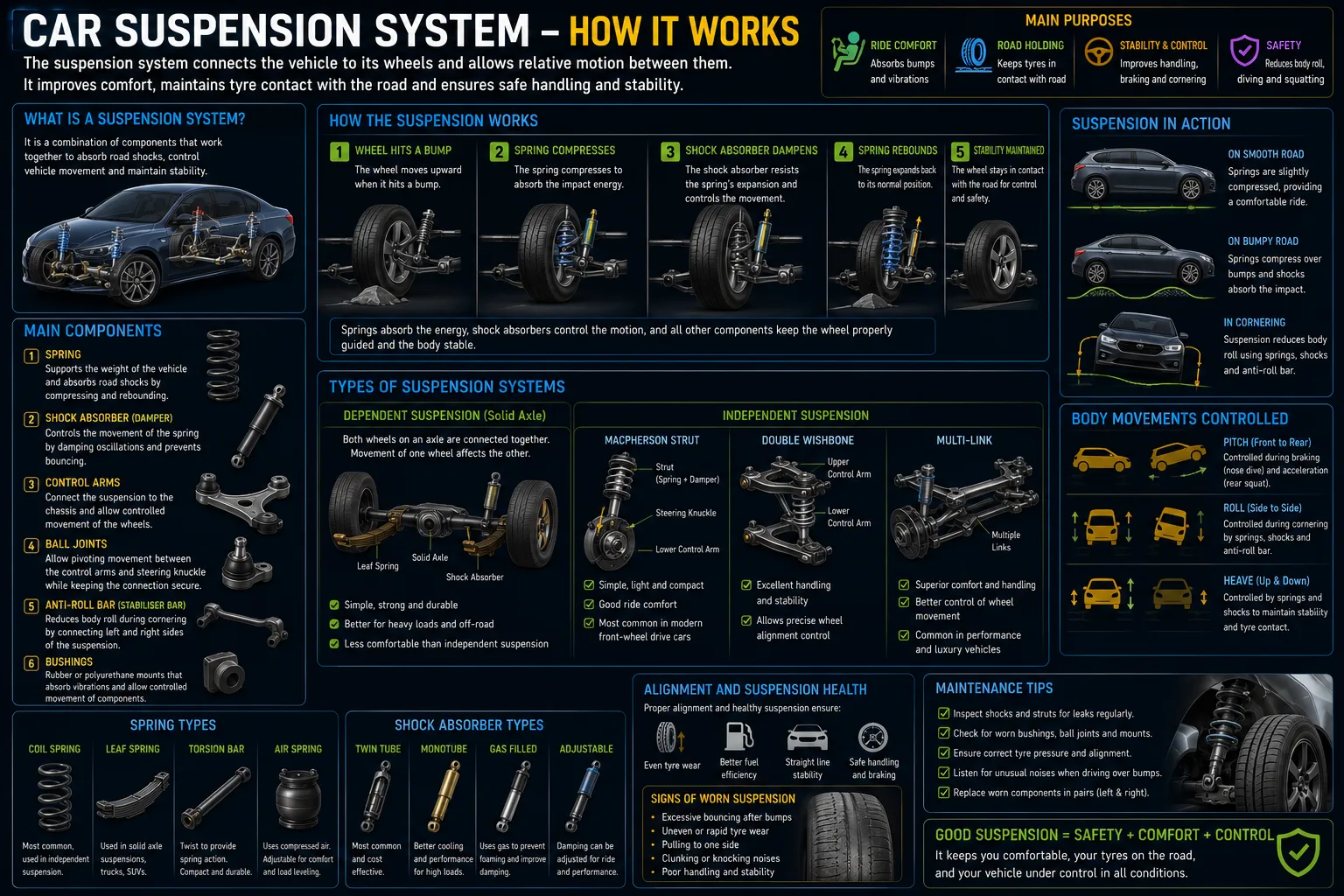
Your car has an anti-roll bar (sometimes called a stabiliser bar) running across the front and/or rear axle. It's a steel torsion bar that links the left and right suspension together. When one side of the car drops — say, over a bump — the bar twists and transfers some of that force to the other side, levelling the car out and reducing body roll through corners. Without it, your car would wallow like a narrowboat negotiating a roundabout. The anti-roll bar doesn't bolt directly to the suspension strut or wishbone. Instead, it connects via drop links: short, rod-like components with a ball-joint at each end. Those ball-joints allow the necessary movement between the bar and the suspension as the wheel travels up and down. It's a simple, elegant solution that works perfectly — right up until the rubber boots around the ball-joints crack, let in water and grit, and the joints start to wear loose. Once there's play in the joint, every bump produces a knock as the metal-to-metal slap reverberates through the subframe and into the cabin. That's the clonk. It's not subtle. It follows you everywhere. It gets louder in winter. It gets personal.
“SOSCarFix comes to your driveway, fits the new links, and you'll find yourself hunting out speed humps just to enjoy the quiet.”
Sound familiar?
So what's behind it?
What we do — at your door
We come to you — driveway, car park, workplace — and start with a proper hands-on inspection under the car, checking both ends of each drop link for play (a quick physical check with the wheel off the ground tells you instantly), inspecting the rubber boots, and checking the anti-roll bar bushes while we're there, because if the links are gone the bushes often aren't far behind. We then give you a clear, itemised quote before a single bolt is touched. Replacing the links themselves is a straightforward job: we remove the old ones (which sometimes requires heat and patience if corrosion has welded the securing bolt in place — the joys of British winters), fit new OEM-spec or quality aftermarket links, torque everything correctly, and check there's no remaining knock. If the bar bushes also need attention, we'll quote those at the same time, since the job is half-done anyway. No garage visit, no recovery truck, no waiting-room coffee that tastes like it was brewed in 2019.
What affects the price
The drop link itself is a low-cost part — that's why it's one of the more painless repairs you'll face. Cost varies depending on the car (a link for a Ford Focus is considerably less than one for a BMW 5 Series or a Land Rover, where the parts pricing reflects the badge rather than the engineering complexity), whether the front or rear axle is involved, and how many links need replacing. We'll often recommend doing both sides of the same axle at once: if one is worn, the other is usually not far behind, and the additional labour is minimal when you're already under the car. Corroded fasteners can add time if the bolts need cutting off and helicoiling, which is honest work that occasionally happens on older UK cars. Anti-roll bar bush replacement at the same time is sensible and cost-effective — ask us to check them when we quote.
Random knowledge you didn't ask for
Questions you're probably asking
Is it safe to drive with a worn anti-roll bar link?
A clonking drop link isn't an immediate 'pull over now' emergency in the way a brake failure is, but it's also not something to ignore for months. A fully failed link means the anti-roll bar is doing nothing on that corner, which increases body roll and can make the car unpredictable in fast cornering or emergency manoeuvres. More practically, it will fail an MOT and it will get worse, not better. Drive carefully and book it in promptly.
Will this fix my MOT advisory for 'anti-roll bar link'?
Yes — this is exactly the job. An advisory for excessive play in the drop link means the ball-joint has worn loose enough to be noticed but not (yet) bad enough to fail outright. By the time the next MOT comes around, 'not yet bad enough' usually becomes a fail. Replace the link now, and it's one less item on the advisory list — and the fix costs a fraction of what a failure and re-test costs in time and hassle.
How long does anti-roll bar link replacement take?
On a cooperative car with non-corroded fasteners, replacing a pair of front drop links is typically a 30–45 minute job. Rear links can be slightly more involved depending on the car layout. The wildcard is corroded bolts — if the securing nuts have fused to the stud over a British winter or three, getting them off without snapping them can take more time. We'll flag this if it's likely from the inspection.
Should I replace both drop links or just the one that's worn?
We usually recommend replacing both links on the same axle in one visit. The parts are cheap, and if one side is worn the other is probably not far behind — especially on a car that does a lot of urban driving. Doing one now and returning for the other in six months costs you more in call-out terms than doing both at once. That said, it's your car and your budget, and we'll give you the honest assessment either way.
What's the difference between a drop link and an anti-roll bar bush?
They work together but they're different components. The drop link is the short rod that connects the anti-roll bar to the suspension strut or wishbone, with a ball-joint at each end. The anti-roll bar bush is the rubber mounting that holds the bar itself to the subframe or body. Both can wear and both can cause knocking and increased body roll. When we're under the car for the links, we'll check the bushes too — replacing them at the same time is much cheaper than a separate visit.
The Drop Link — sorted at your door
Stop procrastinating. Get a transparent quote and we'll come to you.