The Wishbone Problem: Your Car Is Not Supposed to Feel Like a Shopping Trolley
Your suspension arm — also called a wishbone or control arm, depending on which part of the internet raised you — is the structural link between your wheel hub and your car's subframe. It keeps your wheel pointing in the right direction, at the right angle, through every pothole, speed bump, and ill-advised kerb mount Britain has to offer. Bolted to the car at one end via rubber bushes (which absorb vibration and allow controlled flex) and connected to the hub via a ball joint at the other, it sounds simple. It is simple. Until it isn't. When the rubber perishes, the ball joint wears, or the arm itself corrodes — as they all inevitably do on a British car that has spent its formative years marinating in road salt — your suspension geometry quietly falls apart. The result is a car that wanders, clunks, eats tyres, and eventually gets an MOT advisory that becomes a failure. SOSCarFix comes to your driveway and sorts it without the waiting-room biscuits and the upsell chat about your cabin filter.
See our upfront pricingKnocking suspension, vague steering or an MOT advisory for worn wishbone bushes? SOSCarFix comes to you. No garage faff. Get a quote today.
How it actually works
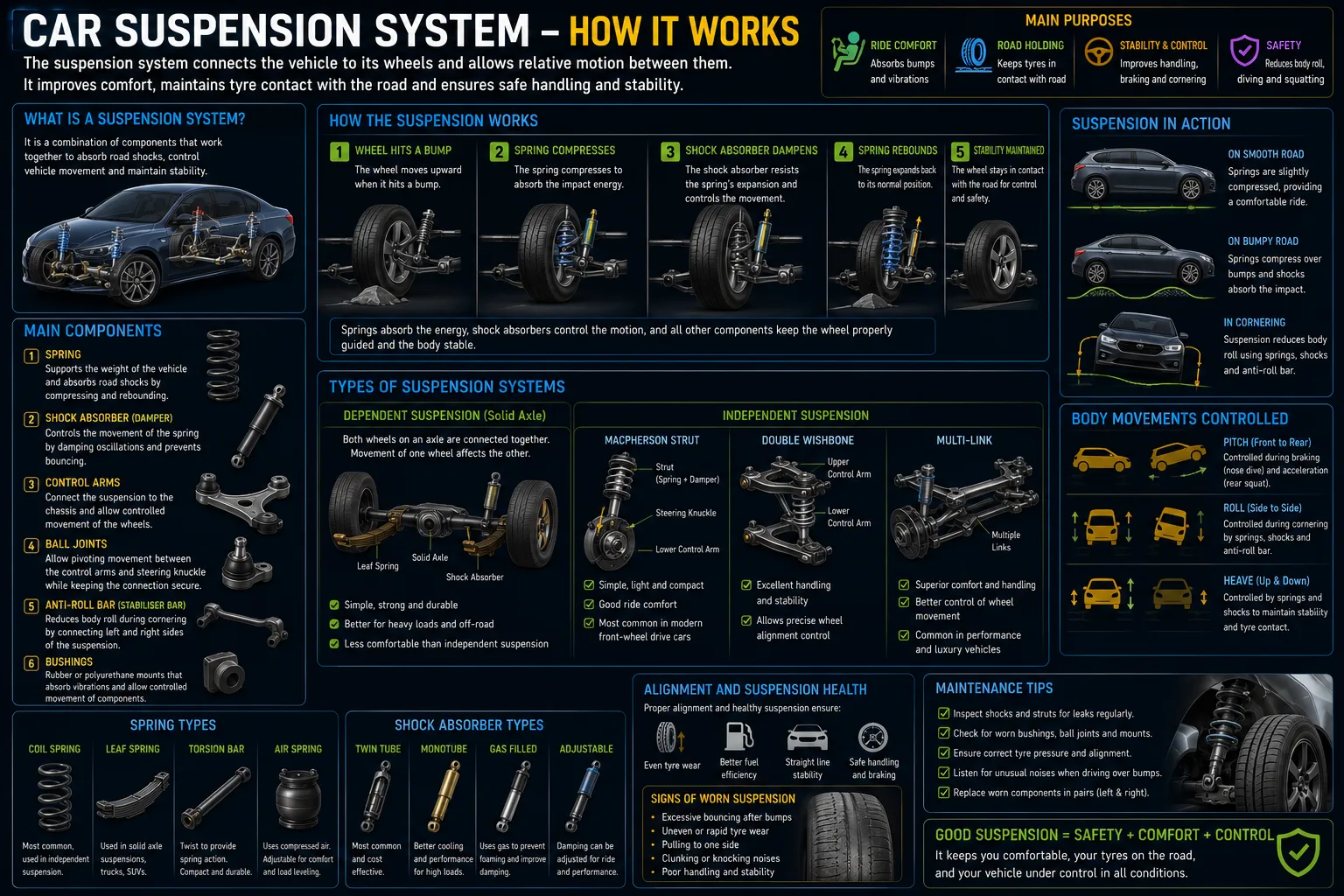
A suspension arm works by triangulating the forces acting on your wheel. In a typical MacPherson strut setup — which covers the front of the vast majority of UK cars — the lower control arm (wishbone) runs from the subframe outward to the hub carrier. The inner end mounts via two rubber bushes: a front bush that handles fore-aft loads and a rear bush that handles lateral ones. At the outer end sits the ball joint, which allows the wheel to steer and articulate vertically while staying connected to the arm. Some cars use a pressed-in ball joint that can be replaced independently; others have it integrated into the arm, meaning you swap the whole lot. When a bush hardens, splits, or collapses — typically after 80,000–120,000 miles or a decade on UK roads, whichever torments it first — you lose the precise, damped movement the geometry depends on. You get knock, wander, and tyre wear that no amount of tracking adjustments will fully fix while the root cause remains. When the ball joint wears, you get play in the steering, a clonk on full lock, and — in the worst case — the joint separating entirely, which is as exciting as it sounds and not in a good way. Replacing the arm (bushes, ball joint, and all, typically as a complete unit on modern cars) restores geometry, eliminates noise, and means your next MOT is slightly less of a horror show.
“SOSCarFix comes to your driveway and sorts it without the waiting-room biscuits and the upsell chat about your cabin filter.”
Sound familiar?
So what's behind it?
What we do — at your door
SOSCarFix sends a qualified mobile mechanic to wherever your car currently lives — your driveway, your office car park, a supermarket bay, or the roadside if things have progressed to that point. We carry a professional hydraulic jack and axle stands, torque wrench, and the tooling to press bushes or fit complete wishbone assemblies depending on what your car requires. We'll inspect the arm, bushes, and ball joint properly, tell you exactly what needs doing and why, and fit quality parts without the theatre of a waiting room or a courtesy car conversation. Once the arm is fitted, we'll check the wheel for any obvious geometry issues and advise on whether a four-wheel alignment is needed after the repair — which, on most cars, it will be, and we'll be honest about that rather than pretending a new arm magically self-aligns. The whole job is typically completed in one to two hours on your driveway, and your car goes back into use the same day.
What affects the price
Suspension arm replacement cost in the UK varies considerably, and the honest answer is that several things determine the final figure. The biggest variable is whether your car requires a complete arm-and-ball-joint assembly or whether the bush and ball joint can be replaced independently — pressing new bushes into an existing arm (where the geometry permits it) is cheaper than a complete unit, but many modern cars simply don't give you that option. Parts cost depends heavily on the make and model: a wishbone for a common Ford or Vauxhall is a fraction of the price of one for a German premium brand, which seems to treat suspension components as a lifestyle choice. Whether one side is affected or both matters too — worn symmetrically on both sides is common, and doing both at once saves labour compared to two separate visits. Labour is straightforward for most front wishbones on standard cars; rear multi-link setups on some vehicles involve considerably more disassembly. A wheel alignment check after the repair is a separate cost but genuinely necessary — don't skip it and then wonder why your new tyres are wearing unevenly in three months.
Random knowledge you didn't ask for
Questions you're probably asking
How do I know if it's the bush or the whole arm that needs replacing?
On many modern cars, the ball joint and bushes are not serviceable separately — they're either pressed in with specialist tooling or integrated into the arm as a single assembly. A mechanic inspecting it properly can tell you which applies to your car. If the arm itself is bent, corroded through, or cracked (visible on inspection), the whole thing goes regardless. Trying to re-bush an arm that has structural damage is cosmetic, not a repair.
Can I drive with a worn suspension arm or wishbone bush?
Technically yes, right up until the point you can't. A mildly worn bush is annoying and damaging to your tyres and geometry, but it's not immediately catastrophic. A worn ball joint is a different matter — if it separates at speed, you lose steering control of that wheel with essentially no warning. MOT failures for ball joint play exist for this exact reason. Drive carefully to get it sorted, but don't use 'I can still drive it' as a reason to postpone indefinitely.
Will I need a wheel alignment after a suspension arm replacement?
Almost certainly yes, and anyone who tells you otherwise is being optimistic on your behalf. Removing and refitting a suspension arm changes the geometry settings that determine how your wheel sits relative to the road — camber and toe in particular. Even if the new arm is identical to the old one, the act of disturbing the joints shifts things. A four-wheel alignment after the repair is not an upsell; it's the thing that stops your new tyres wearing unevenly in three months.
Is it worth replacing just the bushes, or should I do the whole arm?
If your car's arm accepts independent bush replacement (requires pressing equipment and a suitable replacement bush kit), and the arm itself is sound, bush-only replacement is perfectly valid and often cheaper. If the ball joint is also worn, or the arm shows corrosion or damage, a complete arm assembly makes more sense economically — you're paying labour once rather than twice. We'll tell you which applies to your specific car rather than defaulting to whichever is more expensive.
My car got an MOT advisory for suspension arm bushes last year and I ignored it — is it worse now?
Probably, yes. An advisory is the MOT system's polite way of saying 'this is currently borderline — we are watching you.' Rubber bushes do not stabilise at 'worn'; they continue to deteriorate. What was an advisory in January may well be a failure by the following test, and in the meantime your tyres have been wearing unevenly and your steering has been getting progressively more approximate. The advisory was the cheap moment to sort it. Now is still considerably cheaper than later.
The Wishbone Problem — sorted at your door
Stop procrastinating. Get a transparent quote and we'll come to you.