Your Steering Angle Sensor Has Resigned: And It's Taken Your ESP, Traction Control, and ABS Warning Light Budget With It
There's a delightful irony to the steering angle sensor: it's a component you've never thought about once in your entire motoring life, right up until the morning you start your car, find three different warning lights blinking at you from the dash, and realise your ESP, traction control, and ABS have all simultaneously lost the plot. The sensor itself is not large, not dramatic, and not expensive to understand — it simply tells the car which way you're pointing the steering wheel and how fast you're moving it. That information turns out to be absolutely fundamental to every stability and safety system on your vehicle. Without it, the ESP computer is essentially flying blind: it cannot tell whether you're deliberately steering into a corner or fighting a skid, which means it cannot help you. So it turns itself off, lights up your dashboard like a budget Christmas tree, and politely informs you that today you're on your own. SOSCarFix comes to you — driveway, car park, office, roadside — diagnoses the fault properly with live data, and either replaces or recalibrates the sensor so your safety systems come back to work.
See our upfront pricingESP and traction control off? Stability gone AWOL? Your steering angle sensor is probably the culprit. SOSCarFix diagnoses and fixes it at your door. Get a quote.
How it actually works
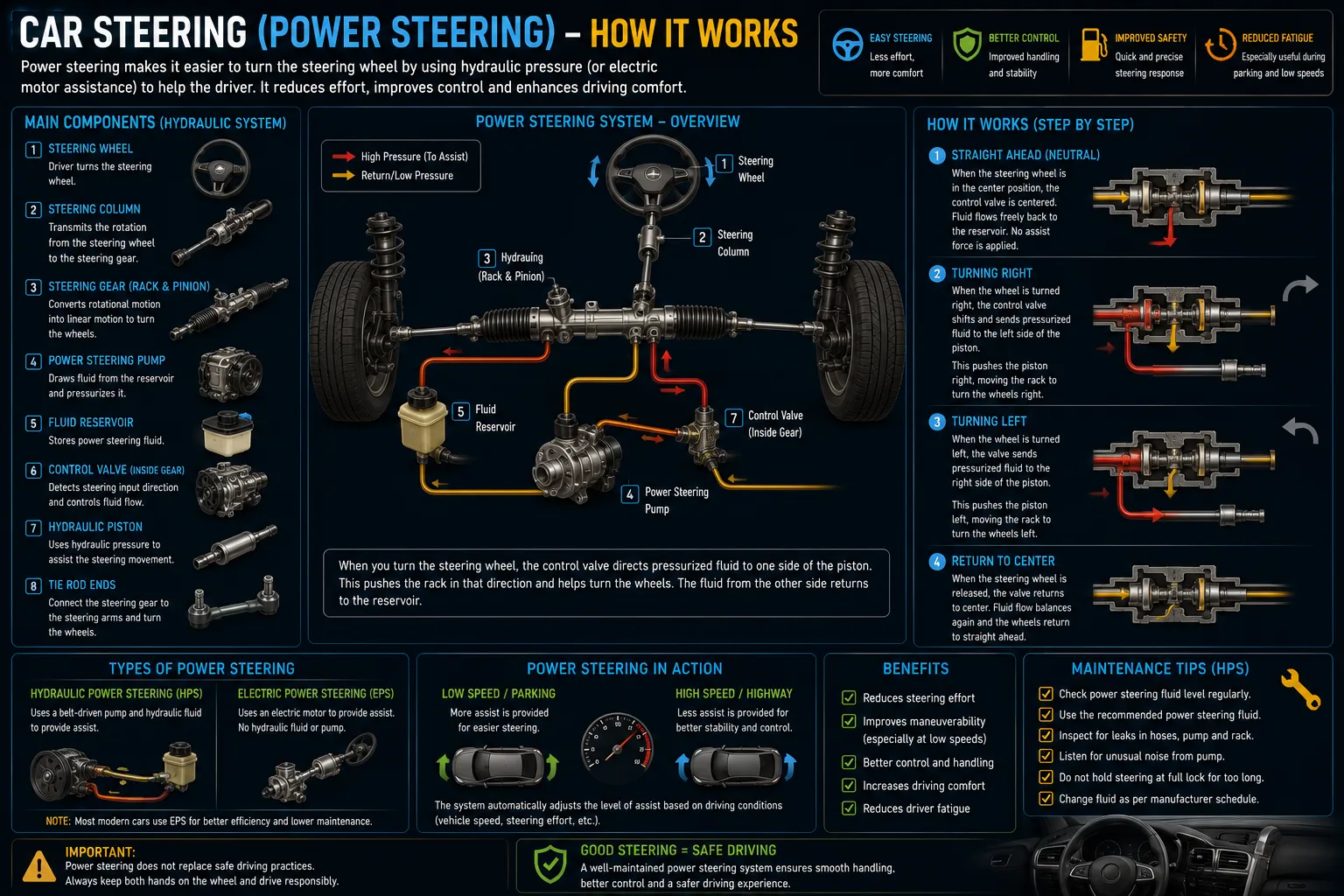
The steering angle sensor — usually called the SAS, or sometimes the steering wheel position sensor depending on who wrote the manual — sits in the steering column, typically inside or just behind the steering wheel clockwise indicator ring assembly. Its job is to measure two things simultaneously: the angle of the steering wheel relative to its centred position (in degrees, often to a resolution of less than a degree), and the rate at which that angle is changing — how fast you're turning. It reports both of those values continuously to the Electronic Stability Programme module via the car's CAN bus network. The ESP module combines this data with inputs from the yaw rate sensor (which measures actual body rotation), individual wheel speed sensors from the ABS system, and the lateral acceleration sensor to build a real-time picture of what the car is doing versus what you're trying to do. If you're pointing the wheel right but the car is rotating left — classic oversteer — the ESP intervenes, braking individual wheels and reducing throttle to bring it back in line. Remove the steering angle data from that equation and the whole model falls apart. The ESP cannot distinguish a controlled corner from a slide. So it shuts down, along with traction control which relies on the same data, and sends an alert through the ABS warning circuit. All three lights, all at once, all because one sensor the size of a large biscuit has stopped cooperating. Critically, the sensor also requires calibration — it needs to know where steering wheel dead-centre actually is, because it measures relative angles. After any work touching the steering, suspension, or wheel alignment, that calibration must be reset using a diagnostic tool, or the sensor hands the ECU wrong data even while working perfectly.
“That information turns out to be absolutely fundamental to every stability and safety system on your vehicle.”
Sound familiar?
So what's behind it?
What we do — at your door
We come to you — your driveway, your workplace car park, or wherever the dashboard has decided to hold its light show — and start with a proper multi-system diagnostic scan, not a one-line code reader that just confirms the obvious. We pull fault codes across all modules, check the live data stream from the steering angle sensor in real time (looking at the angle value, the rate of change, and whether the signal is clean or erratic), and compare it against what the yaw rate sensor and wheel speed sensors are reporting simultaneously. That combination tells us whether the sensor has failed outright, whether it's wiring or supply voltage, or whether the fault is purely a calibration issue that doesn't require a new sensor at all. If replacement is needed, we fit the correct sensor for your vehicle, reconnect to the CAN bus, and carry out the electronic calibration procedure to set the centre-point reference — because fitting a new sensor without calibrating it is half a job that leaves your warning lights exactly where they started. Calibration after steering or alignment work, without sensor replacement, is equally available. No guessing, no parts thrown speculatively, no garage required.
What affects the price
The cost of steering angle sensor work in the UK depends on several variables, and the range is wide enough that any quote without knowing your specific make and model is essentially fiction. The sensor itself varies considerably: on high-volume common vehicles — your Fords, Vauxhalls, Volkswagens, Renaults — the part is sensibly priced; on BMW, Mercedes, Audi, and prestige brands the cost climbs meaningfully, and some sensors are only available from the dealer network. Some vehicles integrate the steering angle sensor into a larger column switch assembly that must be replaced as a unit, which increases the parts cost regardless of how small the actual fault is. Labour time is generally modest for straightforward sensor replacement, as access is typically reasonable. The calibration procedure adds a small amount of time but is non-negotiable — an uncalibrated steering angle sensor is no better than a failed one from the ESP's perspective. If the fault turns out to be purely a calibration reset (common after alignment work), the job is quicker and cheaper than a full replacement. Wiring faults, if present, add diagnostic and repair time depending on where the damage sits in the harness.
Random knowledge you didn't ask for
Questions you're probably asking
Can I drive with the ESP and traction control warning lights on?
Legally, yes — the car is technically roadworthy with stability systems disabled. Practically, you need to understand what you've lost: on a wet or slippery road, the systems that catch oversteer and understeer are not there anymore. You are driving a car from 2005 with 2005-era safety assistance. That's fine if you're a measured driver in dry conditions; it becomes significantly less fine in the rain, on a roundabout, on a cold morning. Don't park it indefinitely, but don't treat it as trivial either.
My ESP light came on right after a wheel alignment — is that the alignment shop's fault?
Partially. After any work that involves moving the steering — tracking adjustment, geometry correction, suspension changes — the steering angle sensor calibration should be reset as a matter of course, because the sensor's stored centre-point reference may no longer match the actual straight-ahead position. Many independent garages and tyre shops don't have the tooling to do this, so the calibration reset gets skipped. The sensor hasn't failed; it just needs telling where straight-ahead is again. A five-minute job with the right diagnostic equipment.
A code reader says I have a steering angle sensor fault — does that definitely mean the sensor needs replacing?
Not necessarily, which is exactly why a code is the start of the diagnosis rather than the end. The same fault code can mean the sensor has electrically failed, that there's a wiring fault to the sensor, that the calibration is simply out, that there's a supply voltage problem, or that a previous owner cleared a fault that hasn't fully set yet. Live data from the sensor — watching the actual angle value while someone turns the wheel — tells you far more than the code alone. Throwing a sensor at the problem on code evidence only is how people end up with the same light still on and a lighter wallet.
Does the steering angle sensor need calibrating after every wheel alignment?
In theory, yes — any adjustment that changes the steering geometry can shift the sensor's reference point. In practice, minor tweaks on a car that was only slightly out of alignment may not produce a noticeable or fault-code-triggering offset. But on a car that needed significant correction, or after subframe or steering component work, calibration is not optional. The safe answer is: if the ESP light comes on after alignment work, the calibration wasn't done. If it doesn't, the offset was within tolerance. Either way, asking the workshop to confirm they've reset it is entirely reasonable.
How long does steering angle sensor replacement or calibration take?
Calibration alone — when the sensor is working but just needs its centre-point reset after alignment work — is typically a fifteen-to-thirty-minute job once we're set up. Sensor replacement on most common UK vehicles is a one-to-two-hour job including the calibration at the end. Vehicles where the sensor is integral to a larger column switch assembly take longer due to the more involved strip-down. Wiring faults, if that's the actual cause, depend entirely on where the damage is. We'll give you a realistic estimate once we've confirmed what the car actually needs.
Your Steering Angle Sensor Has Resigned — sorted at your door
Stop procrastinating. Get a transparent quote and we'll come to you.