Shock Absorber & Strut Replacement — We'll Stop Your Car Acting Like It's at Sea
There's a very specific kind of misery in driving a car that's decided it would rather be a rigid inflatable dinghy. Every speed bump sends the nose pitching skyward. Every corner has you rolling like you're crossing the Channel in a Force 6. Every pothole launches a follow-up bounce, then another, then a faint third one just for the craic. That's not your suspension doing its job — that's your shock absorbers quietly resigning their post and leaving you to figure it out alone. We come to you, swap them out properly, and restore the kind of ride that doesn't make your passengers reach for a sick bag.
See our upfront pricingYour car doing its best dinghy impression — wallowing, nose-diving and bouncing down every road? SOSCarFix replaces shock absorbers and struts at your door, anywhere in the UK. No garage, no faff.
How it actually works
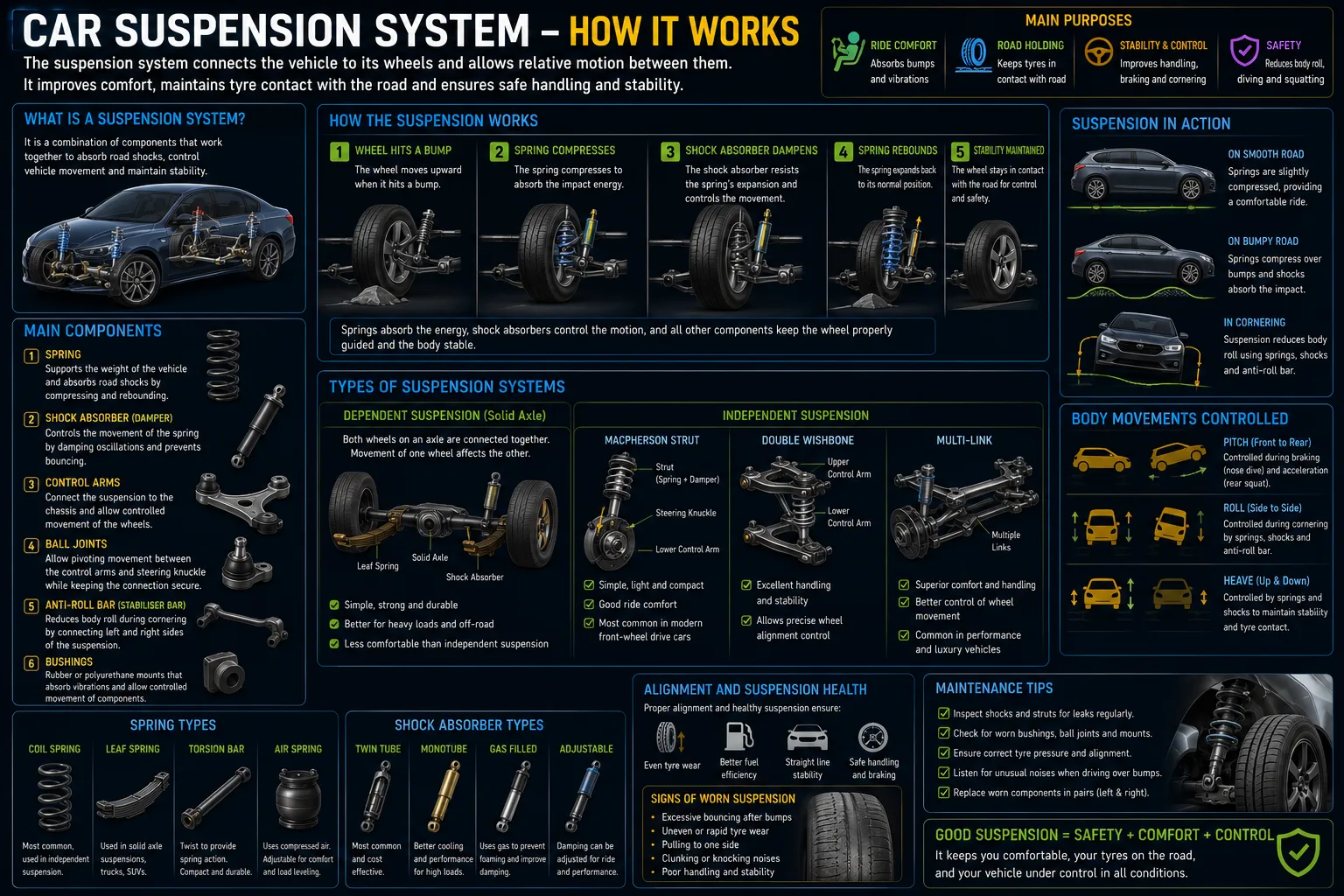
A shock absorber — or damper, if you want to sound like an engineer at a dinner party — is a hydraulic device that turns suspension movement into heat, then gets rid of it. When your wheel hits a bump, the spring compresses to absorb the impact. Without a working damper, the spring just keeps bouncing up and down like a over-excited labrador, because nothing's there to control it. The shock absorber forces hydraulic fluid through tiny calibrated valves under high pressure, and that resistance is what kills the oscillation dead. Struts do the same job but go one step further — they're structural components that also support the weight of the car and form part of the steering geometry. Think of the shock absorber as the crew keeping the boat steady, and the strut as the hull itself. Replace one side without the other, and you've sewn one new patch on an old sail.
“We come to you, swap them out properly, and restore the kind of ride that doesn't make your passengers reach for a sick bag.”
Sound familiar?
So what's behind it?
What we do — at your door
One of our mobile mechanics comes to your driveway, workplace, or wherever the dinghy has finally beached itself. We assess both dampers on the affected axle — because replacing one side and leaving a clapped-out one on the other is the mechanical equivalent of fitting one new welly boot. We replace the shock absorbers or struts with quality parts, swap the top mounts and bump stops while we're in there (no point fitting new dampers into perished mounts), and recheck everything before handing the keys back. We work in pairs across the axle as standard, because that's how it's done properly. If the strut replacement means the geometry has moved — which it often does — we'll tell you straight, and we can arrange a wheel alignment check to follow. No surprises, no garage markup on a courtesy car you didn't want, no waiting three days to be told the part's on backorder.
What affects the price
Several things push the cost up or keep it sensible: the type of component matters significantly, since a basic monotube shock absorber is a very different job to a full strut assembly that includes the coil spring, top mount and bearing plate all as one unit. The make and model of the car is the biggest variable — a set of dampers for a ten-year-old Ford Focus and a set for a German executive SUV do not cost the same, and anyone pretending otherwise is lying to you. Whether top mounts and bump stops need replacing alongside (they usually do, and skipping them is a false economy) adds to both parts and labour. Finally, the accessibility of the components on your specific car affects the labour time — some are straightforward, some require half the front end coming apart before you can even see them. We give bespoke quotes because a single price for shock absorbers would only be accurate by accident.
Random knowledge you didn't ask for
Questions you're probably asking
Can I drive with worn shock absorbers?
Technically yes, in the same way you can technically sail a leaky dinghy — it'll move, but with increasing peril. Worn dampers extend braking distances by up to 20-30%, let the car wallow through corners, and cause tyre wear that'll cost you money in short order. An MOT tester can also fail the car if the damping is demonstrably negligible or the unit is visibly damaged or leaking significantly. If it's just vaguely floaty, you probably won't fail the MOT — but you'll notice every single mile of it.
Do you always need to replace shock absorbers in pairs?
Yes, and anyone telling you otherwise is doing you a disservice. The two dampers on an axle work together to keep the car balanced. Replace only the knackered one, and the new side will be noticeably firmer than the old one — meaning the car will handle asymmetrically, pulling and rolling in ways that feel worse than before you spent the money. Pairs, always.
What's the difference between a shock absorber and a strut?
A shock absorber is purely a damping device — it controls spring movement but doesn't bear the vehicle's weight or affect steering geometry on its own. A strut is a structural assembly that combines the damper with a mount for the coil spring and, in many designs, forms the actual pivot point for the front steering. Struts are more involved to replace, but the underlying job — stop the car turning into a wallowing vessel — is the same.
How long should new shock absorbers last?
Under normal UK driving conditions, good quality dampers typically have a service life of somewhere between 50,000 and 100,000 miles, with the wide range explained by road quality, driving style, and whether your commute involves a particular pothole that has its own postcode. If you cover mostly smooth motorway miles gently, you'll be at the longer end. If you live down a single-track lane and take it at pace, considerably less.
Shock Absorber & Strut Replacement — sorted at your door
Stop procrastinating. Get a transparent quote and we'll come to you.