Rough Idle / Car Shaking at Standstill: What's Actually Going Wrong
A car that idles smoothly is a small daily pleasure most drivers never notice — right up until it starts shaking like a tumble dryer with a brick in it. Rough idle is one of those symptoms that sounds innocuous but actually covers a surprisingly long list of causes: a misfiring cylinder, dead spark plugs, a failing ignition coil, a vacuum leak, a gunked-up throttle body, dirty injectors, a failing idle-control valve, or engine mounts that have turned to mush. Some of these are cheap and cheerful. Others, left alone, escalate. The vibration you feel through the seat and steering wheel isn't the car being dramatic — it's a cylinder (or several) failing to burn fuel properly, and the imbalance rippling through the whole drivetrain. We come to you, plug in proper diagnostics, and find the actual cause before quoting a penny of work.
See our upfront pricingCar shaking or rough idle driving you mad? Could be plugs, coils, vacuum leaks or worse. We diagnose it on your driveway — no garage faff. Get a quote.
How it actually works
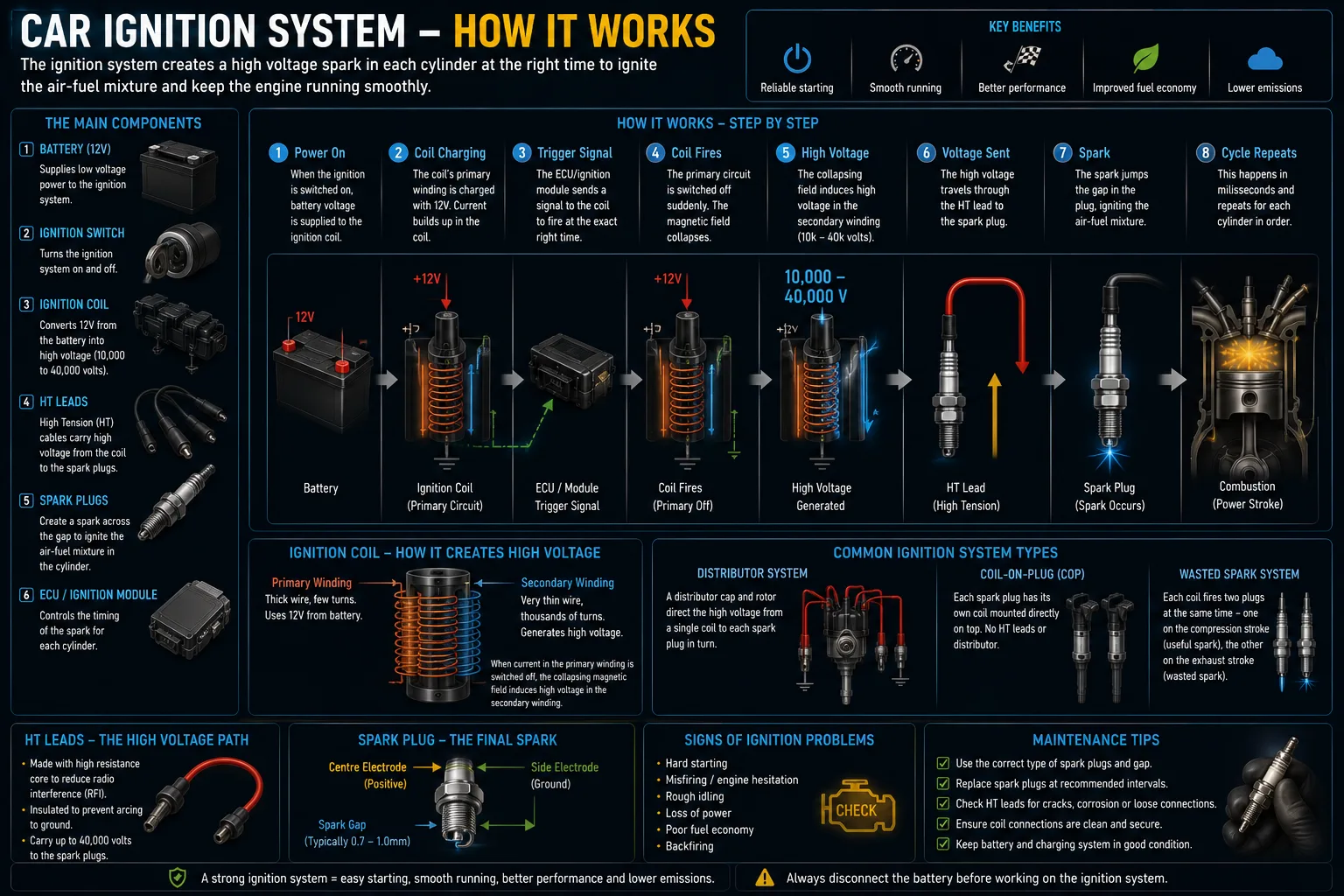
A petrol engine produces smooth power by firing its cylinders in a precise sequence — each one adding a controlled push to the crankshaft in turn. At idle, the engine is balancing on a knife edge: relatively low RPM, minimal throttle, yet it still needs every cylinder contributing its fair share to keep things smooth. When one or more cylinders misfire — failing to ignite the fuel-air mixture properly, or not burning it completely — the crankshaft gets uneven pulses instead of smooth ones. That's the shake. Diesel engines work on compression ignition (no spark plugs), but they're equally susceptible: fuel delivery problems, faulty glow plugs in cold starts, worn injectors dribbling instead of spraying cleanly, or EGR issues can all cause rough idle on a diesel. Beyond combustion itself, two mechanical culprits often get overlooked. Engine mounts are rubber-and-metal cushions that isolate the engine's vibration from the rest of the car — when they collapse or crack, even a perfectly healthy engine will shake the cabin. And the idle-control system (whether a separate idle air control valve or a drive-by-wire throttle body managing idle electronically) has to deliver exactly the right amount of air to hold a stable RPM. If that's dirty or faulty, the engine hunts up and down or settles at the wrong speed. Diagnosis — real diagnosis, with live data and a smoke machine — is what separates a £30 fix from an unnecessary engine rebuild.
“We come to you, plug in proper diagnostics, and find the actual cause before quoting a penny of work.”
Sound familiar?
So what's behind it?
What we do — at your door
We come to you — driveway, car park, workplace — with a proper multi-system scan tool, not the £25 Bluetooth dongle from a motorway service station. We pull fault codes across all modules, look at the live data (misfires-per-cylinder counts, short- and long-term fuel trims, MAF readings, throttle position) and check the freeze-frame from when the fault first triggered. If the data points to a vacuum leak, we use a smoke machine to find it — none of this "rev it up and listen hopefully" business. We check plug condition and coil output, test injector balance, and physically inspect the engine mounts. You get a plain-English explanation of what we found, a clear itemised quote, and — if you want the repair done on the spot — we get on with it straight away.
What affects the price
Cost depends almost entirely on what's actually causing it, which is why diagnosis first genuinely saves money. Spark plugs are typically one of the cheaper fixes — parts are inexpensive on most engines, though some layouts (transverse V6, tight bays) add labour. Ignition coils vary: a single coil-on-plug unit is usually modest; a distributorless ignition pack on older engines is pricier. Vacuum hose repairs and throttle body cleans are generally at the economical end. Fuel injector work ranges from an ultrasonic clean (modest) to replacement (more meaningful), and engine mount replacement varies with how many mounts need doing and how accessible they are. We'll tell you the range upfront once we've diagnosed the actual cause — no guessing, no part-swapping on your tab.
Random knowledge you didn't ask for
Questions you're probably asking
Is it safe to keep driving if my car is shaking at idle?
It depends on severity and cause. A mild rough idle from worn plugs is usually fine to drive short distances while you book it in. A persistent misfire — especially a flashing engine management light — is a different matter: an active misfire dumps unburnt fuel into the exhaust and can destroy a catalytic converter in short order. Expensive cats aside, if the shake is accompanied by loss of power, knocking, smoke or a flashing warning light, drive as little as possible and get it looked at promptly.
My car only shakes when the engine is cold — is that normal?
A slight roughness for the first 30–60 seconds on a cold start can be normal, especially on diesels and older petrols, as the fuelling is richer and ignition less efficient until things warm up. If it lasts more than a minute or two, gets worse over time, or comes with smoke or a warning light, it's worth diagnosing — common culprits include worn plugs, a lazy lambda sensor or a sticky idle-control valve that only plays up when cold.
I've been told it's a misfire. Does that mean I need a new engine?
Almost certainly not. 'Misfire' is a description of a symptom — a cylinder not firing properly — not a death sentence. The vast majority of misfires fix down to something straightforward: worn spark plugs, a single failed ignition coil, a vacuum leak, or dirty injectors. Even the more involved causes (low compression, a leaking valve) don't automatically mean a new engine. Proper diagnosis tells you exactly what you're dealing with.
Could the shaking actually be the engine mounts rather than a misfire?
Yes, and it catches people out regularly. Engine mounts fail gradually, so the vibration creeps up on you. The key difference: a mount issue usually means the engine vibrates at a consistent level regardless of load, whereas a misfire or ignition fault tends to cause a rhythmic stumble or jerky quality. We check both during diagnosis — it's a physical inspection alongside the scan data, not one or the other.
Can a dirty throttle body really cause rough idle, and is cleaning it worth it?
Absolutely. The throttle body controls how much air enters the engine, and at idle it's barely cracked open — so even a modest carbon build-up on the throttle plate disrupts the tiny airflow needed to hold a stable idle. Cleaning it is a relatively straightforward job and often transforms an otherwise unexplained lumpy idle on engines with 40,000+ miles on them. We inspect it as part of the diagnosis and only recommend cleaning if it's genuinely dirty.
Rough Idle / Car Shaking at Standstill — sorted at your door
Stop procrastinating. Get a transparent quote and we'll come to you.