Petrol Injector Problems: Your Engine Is Telling You Something and You've Been Turning the Radio Up
Petrol fuel injection is one of those systems that works so reliably for so long that drivers genuinely forget it exists — until it doesn't. A modern petrol engine depends on its injectors to deliver a precisely metered, atomised mist of fuel into the intake port or directly into the combustion chamber, hundreds of times per minute, timed to within microseconds of the piston position. When the injectors are clean and healthy, this happens invisibly and your engine purrs. When they're clogged with lacquer deposits, partially blocked, leaking internally, or running with a degraded spray pattern, the combustion events start going wrong in small but accumulating ways. The result is a car that idles like it's having an existential crisis, hesitates when you put your foot down, drinks more fuel than it used to, and occasionally misfires at exactly the wrong moment — like pulling onto a roundabout. SOSCarFix comes to your driveway or car park, diagnoses what's actually wrong with your fuel delivery, and cleans or replaces the injectors without the garage drop-off, the courtesy car conversation, or the bill that arrives with mysterious line items.
See our upfront pricingRough idle, misfire, hesitation, or tanking MPG? Dirty or leaking petrol injectors diagnosed and cleaned (or replaced) at your door. No garage. Get a quote.
How it actually works
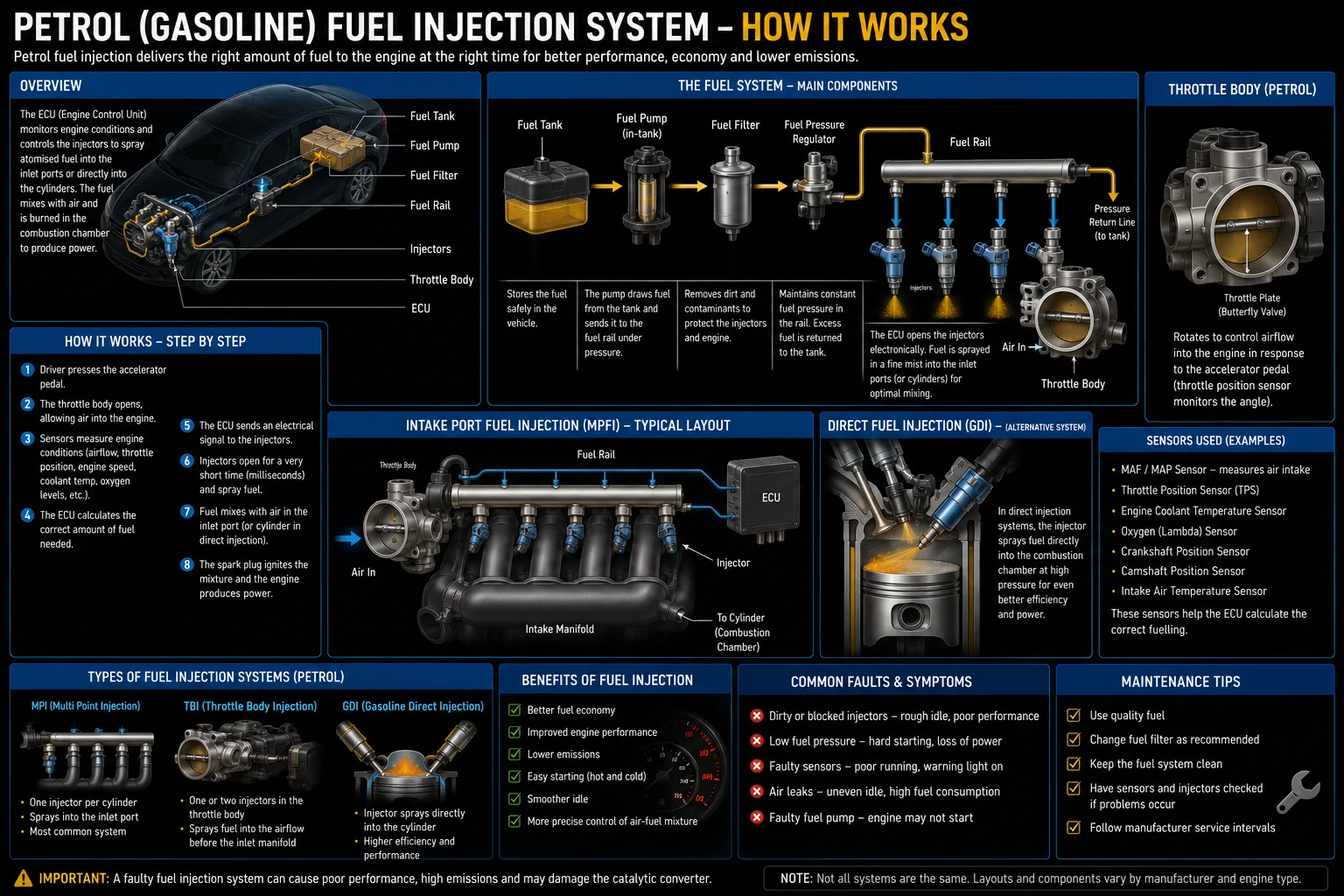
Petrol fuel injection comes in two main flavours and they fail differently, which matters a lot. Port fuel injection (PFI) — still common on older engines and many modern naturally-aspirated units — sprays fuel into the intake port upstream of the intake valve. The valve acts as a self-cleaning surface; fuel washing over it keeps carbon deposits from building up. The injectors themselves can gum up with lacquer deposits from fuel that's sat in the hot injector tip between drives, degrading the spray pattern from a fine cone into an asymmetric dribble that doesn't atomise or mix with air properly. Cleaning is genuinely effective here, either by in-situ fuel system flush using a pressurised cleaner running through the fuel rail, or by removing injectors and sending them for ultrasonic cleaning and flow-bench testing. Direct injection (GDI — Gasoline Direct Injection) is a different beast entirely. The injector fires directly into the combustion chamber at very high pressure — typically 100–200 bar — which is more efficient but removes the intake valve wash effect. Carbon builds up on the backs of the intake valves and in the inlet ports because nothing ever cleans them. After 60,000–80,000 miles on many GDI engines (certain VAG, BMW, Ford EcoBoost, and Hyundai units are notorious), the carbon deposits are thick enough to restrict airflow and cause misfires, rough idle, and cold-start hesitation that no amount of injector cleaning will address. Some modern engines use both port and direct injection together specifically to solve this problem. For GDI carbon build-up, walnut shell blasting of the intake valves is the proper fix — a workshop process — but diagnosing whether you're dealing with dirty injectors or carbon-fouled valves first is exactly what we're here for.
“When the injectors are clean and healthy, this happens invisibly and your engine purrs.”
Sound familiar?
So what's behind it?
What we do — at your door
We come to you — driveway, office car park, or wherever the car has decided to become a problem — and start by finding out what's actually wrong before suggesting anything. That means a full diagnostic scan to read live fuel trim data, misfire counts per cylinder, injector pulse-width data, and fuel pressure readings. Live data tells us whether the engine is compensating for lean or rich mixture on specific cylinders (pointing at injector faults), running uniformly lean across the board (more likely a fuel pressure or sensor issue), or misfiring in a pattern consistent with carbon-fouled valves rather than dirty injectors. If in-situ injector cleaning is the right call — typically for port-injection engines with mild to moderate deposit build-up — we carry out a pressurised fuel system clean through the rail, confirm fuel trims have improved in live data, and clear any fault codes. If cleaning isn't going to be sufficient (worn, leaking, or electrically failed injectors) we'll replace them with correct OE-quality parts and rescan. We won't hand you an invoice for a cleaning service and a hopeful smile if the injectors actually need replacing, and we won't recommend replacement if a clean will genuinely sort it. Honest call, either way, made on your driveway without a garage's overhead baked into the recommendation.
What affects the price
Petrol injector cleaning and repair costs in the UK are driven by a few honest variables rather than a single number anyone quotes you online. The first is what you actually need: an in-situ pressurised fuel system clean is a straightforward job with modest parts cost; having injectors removed, ultrasonically cleaned on a flow bench and refitted is more involved; replacing one or more failed injectors brings full parts cost back in, and that varies enormously from a modest four-pot on a supermini to a high-pressure GDI unit on a premium German engine that costs several times as much per injector. Vehicle access plays a role too — injectors buried under an intake manifold are more labour-intensive than those sitting in plain sight. If GDI carbon build-up on intake valves turns out to be the culprit rather than the injectors themselves, walnut blasting is a dedicated workshop procedure with its own cost that's separate from injector work entirely. What mobile diagnosis removes is the recovery cost if the car isn't driveable, the garage drop-off overhead, and the markup on speculative work ordered before anyone has actually looked at the data. We diagnose first, quote specifically, then do only what's needed.
Random knowledge you didn't ask for
Questions you're probably asking
Can petrol injector cleaning actually fix a rough idle, or is it just a placebo?
It depends on what's causing the rough idle, which is exactly why diagnosis comes first. For a port-injection engine with genuine lacquer deposits degrading spray pattern — something confirmed by fuel trim data showing per-cylinder lean compensation or by flow-bench testing of removed injectors — cleaning works measurably well. For a GDI engine where the symptom is carbon on the intake valves rather than dirty injectors, no injector cleaning product will shift it because the deposits aren't on the injectors. And if the rough idle is a failing ignition coil or a compression issue, cleaning injectors does precisely nothing. Honest diagnosis tells you which situation you're in.
How do I know if my GDI engine has carbon build-up and what can be done about it?
Symptoms are rough idle and cold-start misfires that clear as the engine warms up, sometimes with a lumpy throttle response at low load — broadly the same as dirty injectors, which is the frustrating part. Confirmation usually comes from a borescope inspection of the intake ports with the intake manifold off, or from live data showing misfires on all cylinders rather than one or two specific ones. The fix is walnut shell blasting of the intake valves — a proper workshop job that strips the carbon mechanically. Not cheap, but effective, and not something that needs doing more than once every 50,000–80,000 miles on most affected engines.
Is there any point in putting fuel system cleaner in the tank myself?
On a port-injection engine with mild deposits, a reputable over-the-counter fuel system cleaner (products from Forte, Liqui-Moly, and similar specialist brands rather than generic shelf fillers) has genuine but limited effect over several tanks of fuel. It's not a fix for a car that's already misfiring — it's more of a maintenance measure that slows deposit accumulation. On a GDI engine with carbon-fouled intake valves, no tank additive reaches the problem because the fuel never touches the intake valves. Think of it as flossing: useful prevention, not a substitute for treatment once something is already wrong.
My car smells of petrol but runs fine — could that be an injector?
Yes, and it's worth sorting promptly rather than ignoring. A fuel smell without a running fault usually points to an injector O-ring or body seal that's weeping fuel into the intake manifold or externally — you may not notice a running fault yet because the leak is small, but unburnt fuel near hot engine components is a fire risk. It can also cause a gradual rich mixture that kills fuel economy and loads the catalytic converter. A fuel smell is never just a smell worth living with.
Should I replace all my petrol injectors at once or just the faulty one?
On a high-mileage engine where one injector has failed and the others are the same age, there's a reasonable case for doing the set — the labour time to access them is often the same whether you're doing one or four, and an injector that hasn't failed yet on a 120,000-mile engine may follow within the year. On a lower-mileage car or where the failed injector is clearly a one-off fault (electrical failure of a solenoid, damaged O-ring rather than general wear), replacing just the faulty one is perfectly sensible. We'll tell you which situation you're in and what we'd do on our own car.
Petrol Injector Problems — sorted at your door
Stop procrastinating. Get a transparent quote and we'll come to you.