Your NOx Sensor Is Lying to Your ECU: And the Countdown Clock Has Already Started
Euro 6 diesels are the automotive equivalent of a reformed smoker — they really, genuinely, legally cannot be seen emitting nitrogen oxides in any quantity, and the SCR (Selective Catalytic Reduction) system with its AdBlue tank is how they keep that promise. The NOx sensor is the referee in this arrangement. Positioned in the exhaust stream — usually one upstream of the SCR catalyst and one downstream — it measures actual nitrogen oxide concentrations in parts per million and reports back to the ECU in real time, so the system can fine-tune exactly how much AdBlue to inject to neutralise those gases. When the sensor fails, the ECU stops getting reliable data, decides it cannot verify emissions compliance, and reacts in the way all bureaucratically minded control units do: it panics, illuminates everything on the dashboard simultaneously, and in some cases starts a countdown to engine shutdown that would feel dramatic even on a nuclear submarine. SOSCarFix comes to you, diagnoses which sensor is actually at fault with live data, and replaces it without you needing to panic-book a main dealer at main-dealer prices.
See our upfront pricingAdBlue warning, countdown timer, limp mode on your Euro 6 diesel? Your NOx sensor is the culprit. SOSCarFix diagnoses and replaces it at your door. Get a quote.
How it actually works
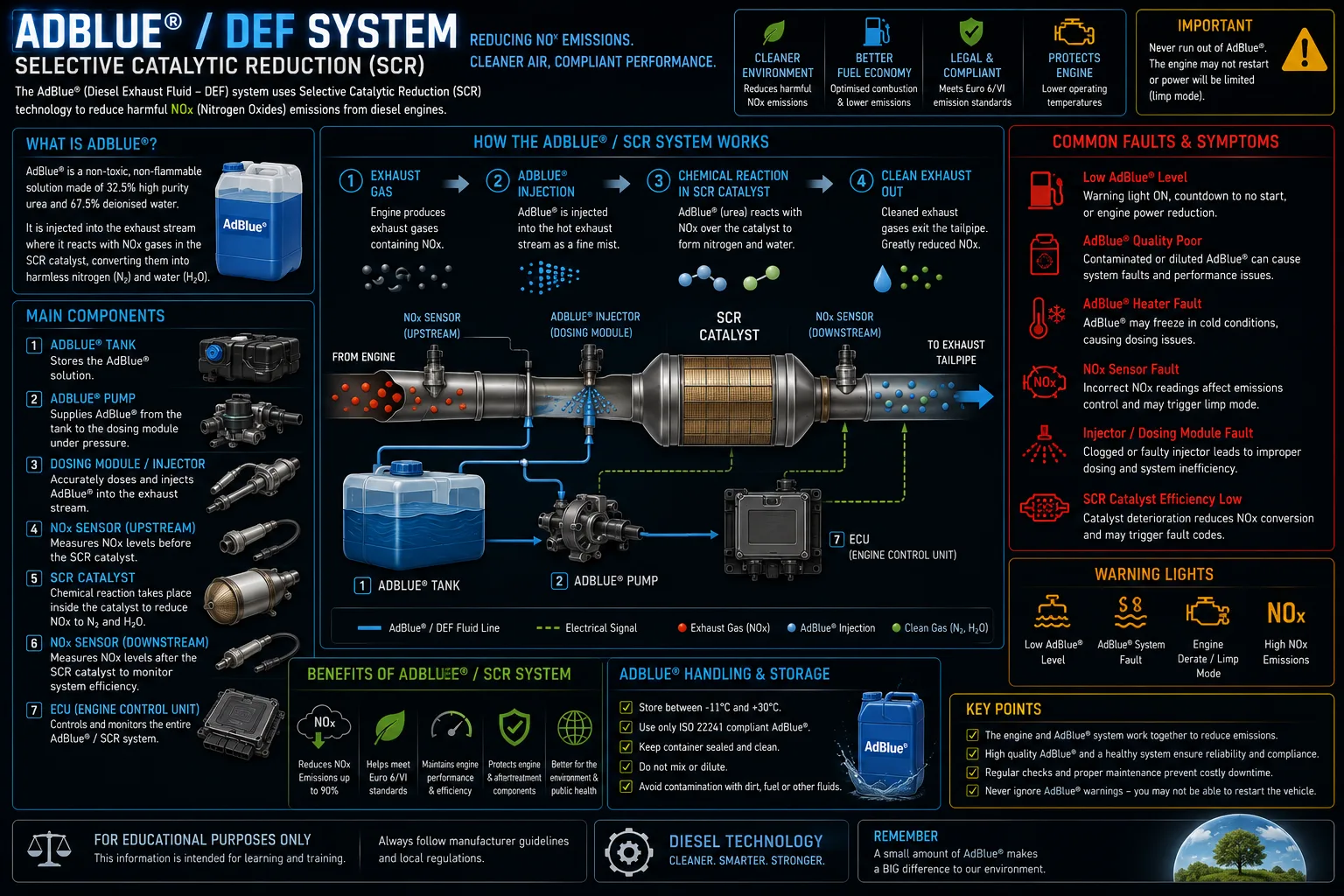
Diesel combustion produces nitrogen oxides — NOx — as an unavoidable byproduct of the very high temperatures and pressures that make diesels efficient in the first place. Euro 6 emissions legislation, in force for new cars since September 2015, sets a NOx limit of 80mg/km, which is considerably tighter than what came before and means simply having a catalytic converter is no longer nearly enough. Enter the SCR system: AdBlue — a precisely mixed solution of 32.5% urea and deionised water — is injected into the exhaust stream upstream of the SCR catalyst, where it vaporises, decomposes into ammonia, and reacts with the nitrogen oxides to produce harmless nitrogen and water vapour. It is, remarkably, a system that actually works. The NOx sensor is the feedback mechanism that keeps the whole arrangement honest. The upstream NOx sensor measures how much NOx is entering the SCR catalyst from the engine, allowing the ECU to calculate exactly how much AdBlue to inject. The downstream NOx sensor measures what's leaving the catalyst, confirming the system is achieving the conversion efficiency it needs to. If the downstream reading is too high — meaning the cat isn't cleaning up enough — the ECU knows something is wrong: maybe the AdBlue has run dry, maybe the injector is blocked, maybe the catalyst itself is poisoned, or maybe the sensor measuring all of this has simply failed and is feeding nonsense data into a system that cannot distinguish between a real emissions problem and a faulty sensor. That ambiguity is precisely why a proper scan with live data is the only sensible starting point — and why guessing and throwing sensors at it without diagnosis is an expensive and occasionally pointless exercise.
“The NOx sensor is the referee in this arrangement.”
Sound familiar?
So what's behind it?
What we do — at your door
When you book with SOSCarFix, we come to your driveway, car park, workplace, or wherever your countdown-afflicted diesel is currently parked in quiet existential dread. We arrive with a professional-grade diagnostic tool capable of reading manufacturer-specific fault codes and, critically, pulling live NOx sensor data — because the difference between a faulty upstream sensor, a faulty downstream sensor, a contaminated catalyst, a blocked AdBlue injector, and a wiring fault all presenting with superficially similar symptoms is not something a generic code reader can resolve, and it is absolutely not something you want to guess at when a new OEM NOx sensor costs what it does. We look at live sensor voltages, internal heater resistance, NOx concentration readings at both positions, and cross-reference against AdBlue dosing data to establish where the fault actually lives before anyone suggests a part. If it is the sensor, we replace it with a quality part to the correct specification for your specific vehicle and engine variant, clear the fault codes, verify the system re-initialises correctly, and confirm the countdown has been cancelled rather than merely paused. If it turns out to be a wiring fault, a corroded connector, or a software issue, we tell you that and sort the actual problem. No parts cannon. No guesswork. No returning next week because we replaced the wrong thing first.
What affects the price
NOx sensor replacement cost in the UK varies considerably and anyone quoting you a fixed price without knowing your specific vehicle and which sensor position is involved is estimating from a very long distance. The sensor itself is the largest variable: OEM NOx sensors — and for some applications the OEM sensor is the only reliable option, because the aftermarket has not caught up on all Euro 6 applications — can be expensive components, particularly on vehicles from manufacturers who treat their emissions hardware as proprietary. Upstream and downstream sensors are often different parts at different price points. Labour time is generally modest on vehicles where the sensor is accessible, but on some installations the exhaust routing or underbody shielding makes removal and refitting a lengthier operation. If the sensor threads have corroded — not uncommon on exhaust hardware with several UK winters on it — extraction can become its own separate operation. If the diagnostic investigation reveals the underlying issue is the SCR catalyst rather than the sensor, that is a substantially larger job and cost. The countdown timer or limp mode urgency should not, however, push you into accepting a diagnosis-free parts swap at a premium — proper diagnosis is the difference between fixing the car and replacing an expensive sensor that was reporting a real problem accurately.
Random knowledge you didn't ask for
Questions you're probably asking
My car says engine will not start in X starts — how urgent is this?
Very. The countdown to no-start is a legally mandated deterrent built into Euro 6 vehicle software specifically to prevent indefinite operation with a non-compliant emissions system. It is not a suggestion and it does not reset itself. Once it reaches zero, the engine genuinely will not start until the fault is resolved and the system is cleared by a diagnostic tool. If you are within single digits on the counter, treat it as the automotive equivalent of a red warning light, because it essentially is.
Can I just top up the AdBlue and make the warnings go away?
If the AdBlue level was genuinely low, topping it up will clear the level warning, yes. But a NOx sensor fault is a separate issue entirely — it is not caused by low AdBlue, and adding fluid does not fix a failed sensor or a wiring fault. The system will still register a fault in the SCR monitoring circuit regardless of how full the AdBlue tank is. If warnings persist after topping up, the sensor or the broader emissions system needs proper diagnosis rather than another bottle of fluid.
Is it the upstream or downstream NOx sensor that usually fails first?
Both fail, but for different reasons and at different rates. The upstream sensor runs in hotter, harsher exhaust conditions, so its heater element and sensing element tend to degrade earlier. The downstream sensor is in a cooler, cleaner post-catalyst stream but is occasionally the first to flag a fault because it is detecting a genuine catalyst efficiency problem rather than its own failure. This is precisely why live data diagnosis — not just reading the fault code position — is necessary before ordering anything.
My diesel is under five years old. Should it really need a NOx sensor already?
Frustratingly, yes, sometimes. NOx sensor failures on relatively modern, lower-mileage Euro 6 vehicles are more common than they should be, and a combination of heater circuit design, exhaust temperature cycling on short urban journeys, and AdBlue quality issues can shorten sensor life considerably on certain applications. Some manufacturers have issued technical service bulletins acknowledging premature sensor failures on specific models. Whether that opens a warranty or goodwill claim is worth checking against your ownership history and the manufacturer's service records.
Will a faulty NOx sensor cause my car to fail its MOT?
Almost certainly yes, though the MOT failure mechanism may be indirect. A stored fault code relating to the NOx sensor or SCR system constitutes a fault in the emissions control system, which is an MOT failure category under the current (2018 revision) MOT rules for Euro 5 and later vehicles. Beyond that, if the SCR system is disabled or operating in a degraded mode, actual NOx emissions at the tailpipe will likely exceed permitted levels on a direct measurement check. Either route ends the same way: a red certificate and a repair bill.
Your NOx Sensor Is Lying to Your ECU — sorted at your door
Stop procrastinating. Get a transparent quote and we'll come to you.