Your Car Has Given Up: diagnosing loss of power, limp mode and the great acceleration disappearing act
One moment you're pulling out onto a dual carriageway with entirely reasonable confidence. The next, your car has apparently decided it's a milk float — pressing the accelerator produces a faint wheeze and roughly the forward momentum of a determined hedgehog. Welcome to loss of power: one of the most common, most misdiagnosed and most anxiety-inducing things a modern car can do to you. It might be a boost leak the size of a pinhole. It might be a clogged DPF screaming for a regeneration. It could be a failing fuel pump, a dirty MAF sensor, or an ignition system that's quietly falling apart. The only certainty is that swapping parts on guesswork will burn through your wallet and still leave you doing 38mph on a 70mph road. SOSCarFix comes to you, plugs in, reads the live data, and finds the actual cause before anything gets replaced.
See our upfront pricingCar losing power or stuck in limp mode? We come to you, plug in, and find the real cause — turbo, DPF, MAF or fuel — without guesswork. Get a quote.
How it actually works
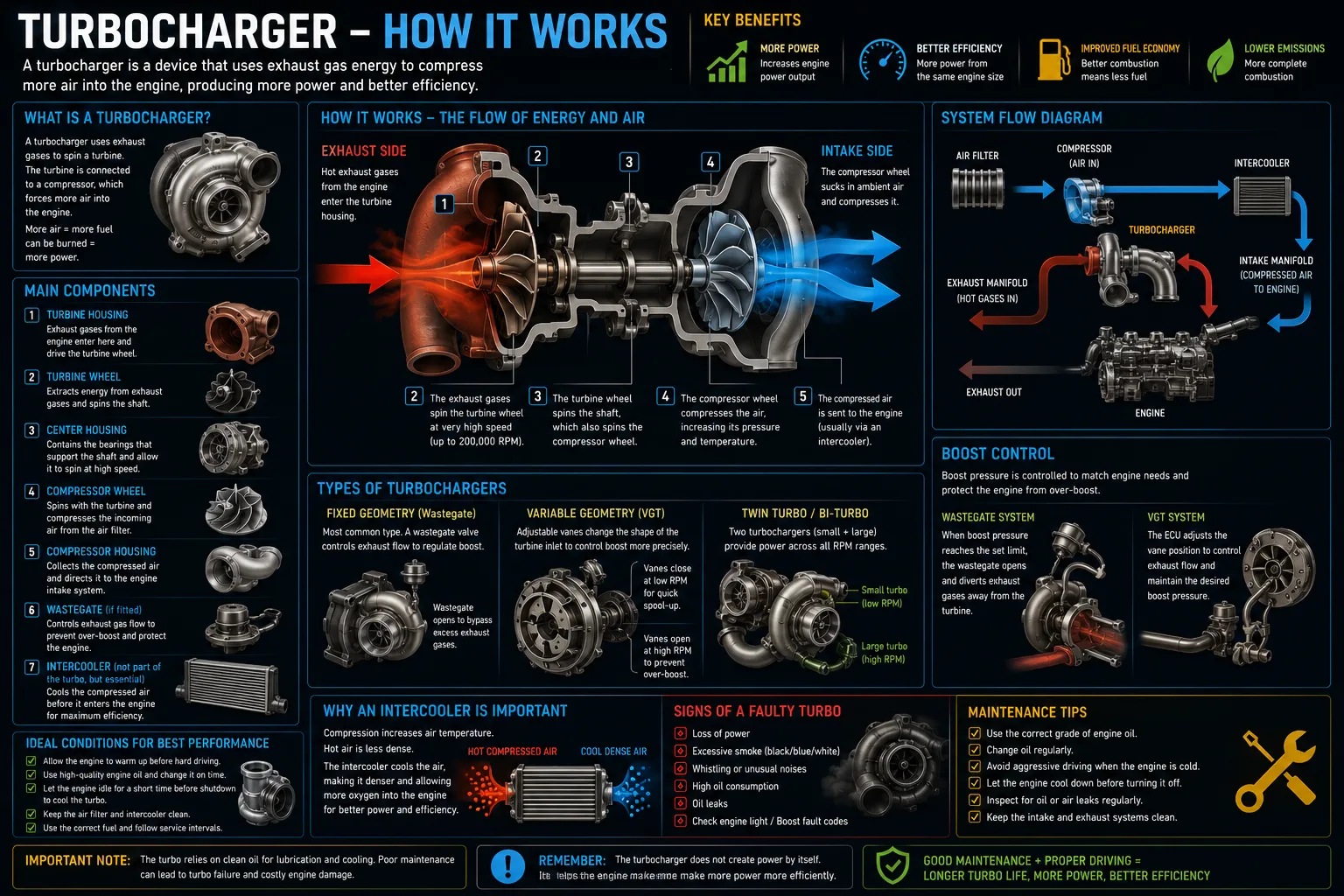
Your engine makes power by burning a precisely controlled mixture of air and fuel. Everything that feeds into that process — the air intake, the turbocharger or supercharger (if fitted), the fuel delivery system, the ignition system and the exhaust — has to be working correctly and in the right proportions. When any part of that chain falters, the engine either can't get enough of what it needs (air, fuel, spark) or can't push the burnt gases out efficiently enough, and power drops. On turbocharged engines — which now covers the vast majority of new petrol and diesel cars sold in the UK — the turbo compresses intake air to shove more of it into the cylinder per stroke, which is the whole point. Any boost leak between the turbo and the engine (a split intercooler hose, a cracked pipe, a weeping boost solenoid) bleeds that pressure away before it gets there. No boost, no power. Simpler than it sounds. On top of that, modern diesel engines have a DPF (Diesel Particulate Filter) that captures soot from the exhaust. When it gets too full — usually because it never gets hot enough to regenerate on short journeys — it restricts exhaust flow and the car enters limp mode as a self-preservation measure. EGR valves (Exhaust Gas Recirculation) clog up with carbon, MAF sensors get contaminated with oil and start misreporting the airflow, fuel pumps weaken with age, and ignition coils start misfiring under load. The ECU watches all of this and often reduces power deliberately — limp mode isn't a fault in itself, it's the car doing the electronic equivalent of crossing its arms and refusing to continue until you sort it out.
“Welcome to loss of power: one of the most common, most misdiagnosed and most anxiety-inducing things a modern car can do to you.”
Sound familiar?
So what's behind it?
What we do — at your door
We come to you — your driveway, workplace, a car park — and start with a full diagnostic scan across all modules, not just the engine ECU, reading every stored and pending code alongside the live data and freeze frame. On a power loss job, the live data is everything: we watch actual boost pressure versus requested boost, MAF readings versus what the ECU expects for that engine at that load, fuel trims drifting lean or rich under load, DPF soot loading percentages, EGR position, and injector pulse widths. That combination of data tells us whether this is a boost leak, a sensor lie, a fuel delivery problem or something mechanical before we touch a single part. For suspected boost leaks we can perform a pressure test of the intake system. For DPF issues we can assess the soot loading and advise whether a forced regeneration or a proper clean is the appropriate next step. For MAF faults and EGR issues we test the component live before condemning it. You get a plain-English diagnosis and a clear quote — not a shrug and a list of parts to try.
What affects the price
The cost of fixing a power loss fault varies enormously because the causes vary enormously — a split boost hose is a relatively inexpensive fix, while a turbocharger replacement on a diesel is a more significant job. Our diagnostic visit pins down exactly which one you're dealing with before you commit to anything. Factors that influence the total bill include: which component is actually at fault (sensor vs. mechanical), whether it's a petrol or diesel (diesel DPF and EGR work is its own category), the make and model (German and French diesels can have significantly more complex DPF and EGR systems than a Fiesta), the age and mileage of the vehicle, and whether a forced DPF regeneration is sufficient or a replacement filter is needed. We'll always tell you clearly what you're looking at before we proceed.
Random knowledge you didn't ask for
Questions you're probably asking
Is limp mode safe to drive in?
Technically, yes — limp mode is deliberately limited to protect the engine, so you can usually drive slowly and gently to get the car somewhere safe or to a mechanic. What you should not do is ignore it, thrash the engine trying to override it, or keep driving normally and hope it clears. It's the car asking — firmly — for a diagnosis.
My car loses power on the motorway but seems fine around town. Why?
Because at low speeds and light throttle, a marginal boost leak, weak fuel pump or ageing coil can keep up. Under heavy load at high speed the demand is much greater — and whatever's struggling gets exposed. It's actually a useful clue: faults that only appear under load often point to turbo/boost issues, weak fuel delivery or ignition faults that can't keep up at full demand.
Can I fix a DPF problem with an additive or a long motorway run?
Sometimes. If the DPF is only moderately loaded and the rest of the system is healthy, a sustained run at higher revs (not just motorway cruising — higher rpm is key) can allow it to regenerate. But if it's heavily blocked, the regeneration won't complete and you'll still be in limp mode. An active (forced) regeneration with a diagnostic tool is more reliable, and if the filter is beyond that, it needs professional attention.
The fault code says 'boost pressure too low' — does that mean the turbo is dead?
Not necessarily. That code means the ECU isn't seeing the boost pressure it asked for — but there are several reasons why. A split boost pipe is a far more common (and cheaper) cause than a failed turbocharger. We test the system properly rather than assuming the most expensive answer is the right one.
Will clearing the fault codes fix the limp mode?
It'll clear the light and the car might briefly come out of limp mode — right up until the ECU re-evaluates the same dodgy data and puts it straight back in. Clearing codes without fixing the underlying fault is a short-lived trick that throws away the diagnostic data we need. We find the cause first, then clear everything once it's actually resolved.
Your Car Has Given Up — sorted at your door
Stop procrastinating. Get a transparent quote and we'll come to you.