The Gearbox Whisperer: When Your Car Decides Gears Are Optional
The gearbox is the one component most drivers spend zero time thinking about — right up until the morning it decides to have a very loud, very expensive opinion about things. Crunching into second, clunking out of third, an automatic that hunts through its ratios like it's lost the plot — these are not sounds or sensations you should get used to. They are your transmission politely screaming for attention before it escalates to something that requires a flatbed and a long, painful conversation with your bank. SOSCarFix mobile mechanics come to you — driveway, office car park, wherever the car happens to be sulking — and give your gearbox a proper diagnosis before anyone recommends anything. Honest assessment first, repair second. That's the bit most garages skip when they can already smell the labour hours.
See our upfront pricingCrunching gears, slipping automatics, whining bearings — SOSCarFix diagnoses gearbox problems at your driveway, no garage faff. Get a quote today.
How it actually works
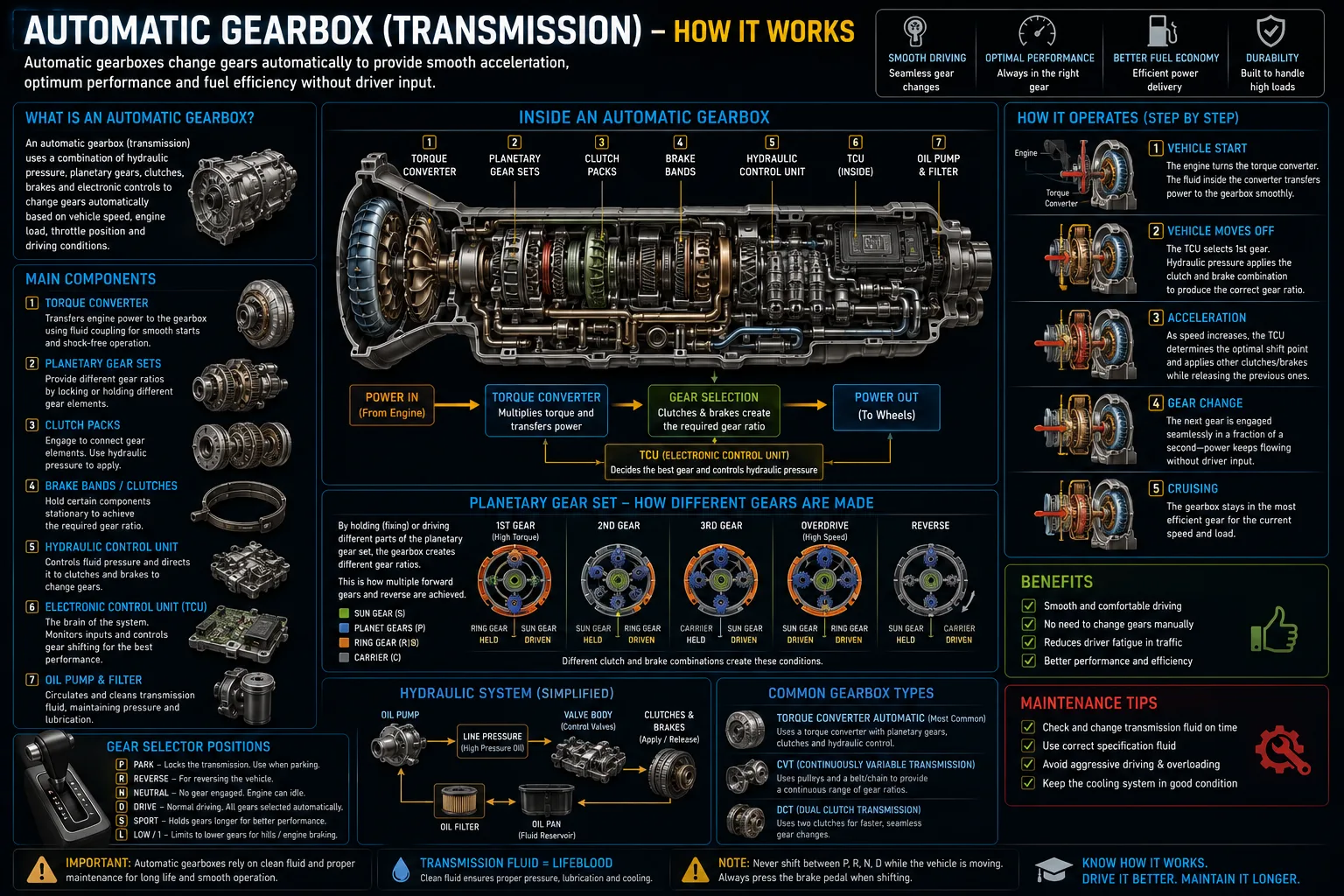
A gearbox exists to translate the engine's limited rev range into the wide range of road speeds you actually need — from pulling away at 5mph to cruising at 70. In a manual box, a set of helical gears are always spinning in mesh with each other; synchromesh rings match the speed of the gear you're selecting before the dogs lock in, which is why double-declutching was a thing before synchros existed. When synchros wear out, you get the crunch. In an automatic, a torque converter replaces the clutch, and a hydraulic valve body — controlled by the transmission ECU — decides which planetary gear set to engage and when. Modern dual-clutch gearboxes (DSG, PDK, EDC) are essentially two manual gearboxes in one housing, pre-selecting the next gear before you've even asked. CVTs use a steel belt between two variable-diameter pulleys and don't have gears at all in the traditional sense, which is why they sound like a hairdryer attached to a bored wasp. All of these designs share one critical weakness: they hate being ignored. A manual box needs oil checked periodically; an automatic needs its fluid changed on a schedule many manufacturers used to call "lifetime" — which turned out to mean "the lifetime of the warranty, not the car." Most gearbox failures are a slow build, not a sudden catastrophe. That's both the good news and the annoying bit.
“That's the bit most garages skip when they can already smell the labour hours.”
Sound familiar?
So what's behind it?
What we do — at your door
We arrive at wherever the car is, plug in the diagnostic kit and pull any live gearbox fault codes first — because before anything else, we want to know what the transmission ECU already thinks is wrong and whether it matches what you're feeling. From there it's a combination of a road test (we need to replicate the symptom, not just guess at it), a physical inspection of the gearbox mounts, linkage, and any visible oil leaks, and a fluid condition check. On a manual box we'll check the oil level and condition through the filler plug; on an auto we'll check the ATF level and colour via the dipstick or filler point if accessible. We'll then give you a straight, itemised assessment: what's causing the problem, what the fix is, whether it's something we can complete on-site (fluid change, mount replacement, linkage adjustment, selector cable, speed sensor), or whether it needs a workshop lift and specialist attention — in which case we'll tell you that plainly rather than have you find out the hard way. We do not recommend a full gearbox rebuild every time someone's linkage just needs adjusting. That would be embarrassing for everyone.
What affects the price
Gearbox work in the UK spans an enormous cost range, and anyone who quotes you a single price before diagnosing the problem is either remarkably confident or remarkably optimistic. At the cheap end: a manual gearbox oil change or linkage adjustment is a modest job. A gearbox mount replacement is similarly sensible. Automatic transmission fluid changes vary by type — basic drain-and-fills on older boxes are straightforward, while a full flush on a modern ZF 8-speed or a DSG fluid service with filter access costs more in parts alone because the fluid specification matters enormously and cheap ATF in the wrong box causes more damage than the original problem. Internal gearbox repairs — synchro replacement, bearing replacement, selector fork work — require removal of the box, strip-down, inspection, machining if needed, rebuild and refitting. That's substantial labour regardless of who does it. A reconditioned or used gearbox supply-and-fit is sometimes more economical than a rebuild depending on availability. The honest answer is: diagnosis first, cost second. What looks like a terrifying transmission failure is occasionally a selector cable that costs a fraction of the catastrophe you'd imagined.
Random knowledge you didn't ask for
Questions you're probably asking
Can I keep driving with a crunching gearbox?
Depends what's crunching. Occasional light crunch into second — especially when cold — is often a lazy synchro begging for fresh oil or the early stages of synchro wear; you can typically drive on it for a while if you're gentle. A consistent, worsening crunch, or a bang that sends a shockwave through the car, means something is actively failing. Carry on long enough and you go from a manageable repair to metal filings throughout the box and a much larger bill.
My automatic gearbox is slipping — does that mean it's finished?
Not necessarily, though the internet will cheerfully tell you it is. ATF slipping is often the first symptom of fluid that's lost its friction modifier properties — in which case a fluid change can restore normal behaviour. It can also mean worn clutch packs inside the box, which is a bigger job. Diagnosis tells you which. Replacing the fluid on a worn box occasionally makes things worse by removing the residue that was providing grip, so we assess before recommending.
What does 'lifetime' gearbox oil actually mean?
It means the manufacturer decided not to include a service interval in the handbook because it made the servicing costs look more competitive. In practice, automatic transmission fluid degrades, oxidises and becomes acidic over time. Many independent transmission specialists recommend ATF changes every 40,000–60,000 miles regardless of what the handbook says, and the evidence from worn boxes with 'lifetime' fluid tends to support them. Manual gearbox oil should typically be changed every 30,000–60,000 miles depending on use.
Is a DSG gearbox service something a mobile mechanic can do?
Yes — a DSG service (fluid and filter change on the wet-clutch units) is a service job, not a rebuild, and it's something we can carry out on-site. The DSG filter is typically accessible from underneath, and the procedure is well-defined. What we can also do is read DSG fault codes and adaptation values, which tells us a lot about whether your box has learned bad habits or whether there's a mechatronic fault developing that needs a different approach.
How do I know if it's the gearbox or the clutch causing my gear problems?
It's a fair confusion because both live in the same general area and both cause gear-change misery. A slipping clutch tends to let the engine rev freely without the car accelerating properly — particularly uphill or in high gears. A gearbox synchro issue makes itself known as crunch, resistance or the need to really force the gear in. A clutch that doesn't disengage fully can also cause crunching by leaving the gearbox spinning when you try to select a gear. We can usually distinguish the two with a test drive and a visual inspection.
The Gearbox Whisperer — sorted at your door
Stop procrastinating. Get a transparent quote and we'll come to you.