Gearbox Oil Change: Because "Sealed for Life" Is a Lie Your Manufacturer Tells Itself
Somewhere in your owner's manual — probably tucked between "tyre pressure" and "don't drive into a lake" — is the phrase "sealed for life." It refers to your gearbox oil. It is, with respect, complete nonsense. What it actually means is: sealed for the life of the warranty, at which point the manufacturer's legal obligation to care about your drivetrain evaporates entirely. Gearbox oil degrades. It picks up metal particles from the gear teeth every time you change ratio. It oxidises. It loses its viscosity. And a manual gearbox full of blackened, contaminated fluid starts to feel like you're stirring a jar of gravel — notchy, reluctant, occasionally bewildering. An automatic with neglected fluid starts doing harsh, lurching gear changes that make your passengers quietly question your driving. SOSCarFix comes to you — no garage visit, no courtesy-car nonsense — and gets the right fluid back in, at the right spec, wherever you happen to be parked.
See our upfront pricingYour gearbox oil isn't "sealed for life" — that's a myth invented by people who don't pay for gearbox rebuilds. Get a proper fluid service at your location. Get a quote.
How it actually works
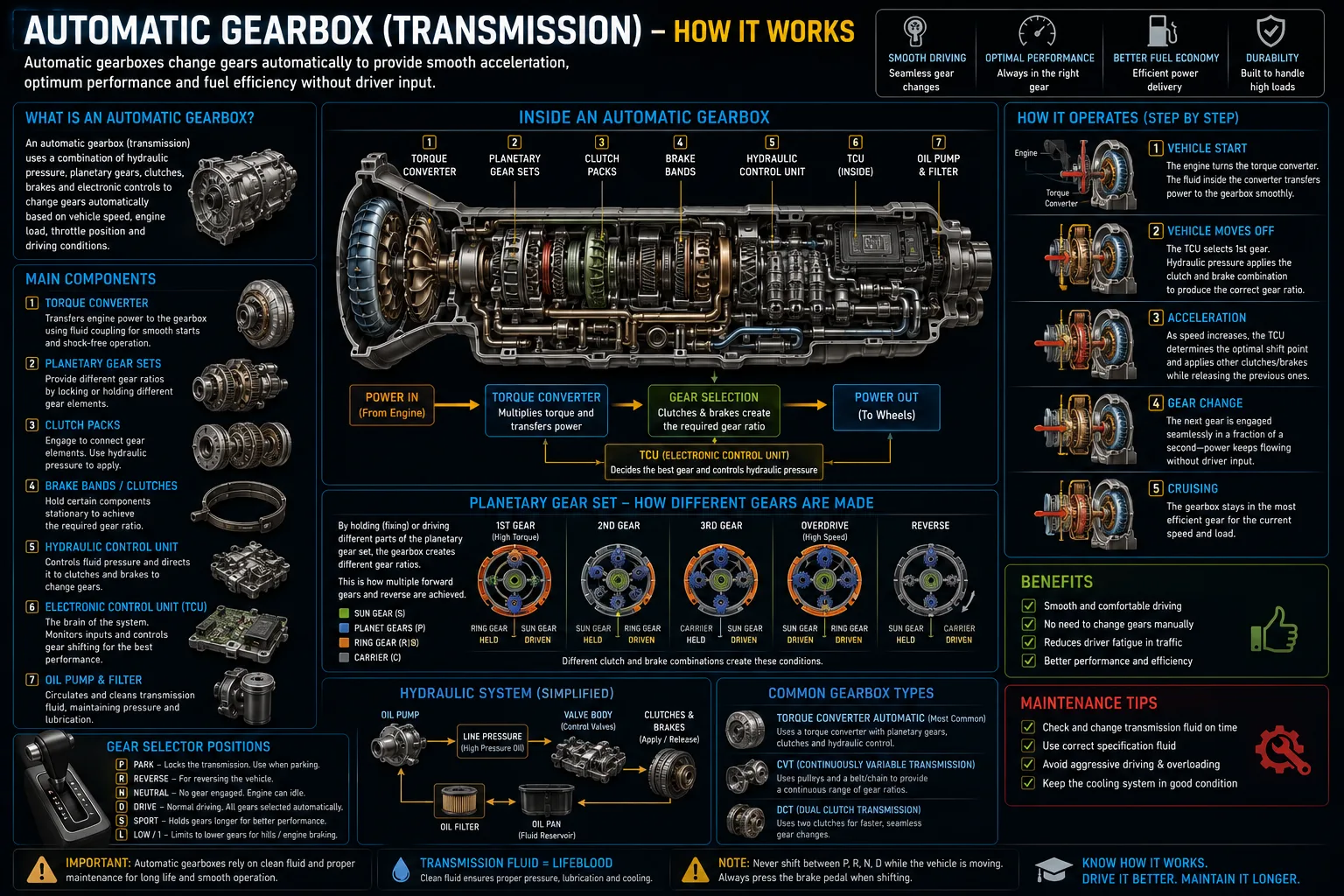
A gearbox — whether it's a six-speed manual, a torque-converter automatic, a DSG, or a CVT — is a collection of precision metal components spinning at ludicrous speeds, constantly meshing, separating, and generally battering each other in service of getting your wheel speed to match what your right foot is demanding. The oil in there does several jobs simultaneously: it lubricates the gear teeth to prevent wear, it cools the synchronisers and bearings, it keeps seals supple, and in automatics it actually does mechanical work — transmitting pressure through a torque converter and operating hydraulic clutch packs. That's a lot to ask of a fluid that, in many cars, hasn't been touched since the factory filled it. Over time and mileage, the oil breaks down thermally (gearboxes get hot), and it accumulates fine ferrous particles from normal metal-on-metal contact. In an automatic, degraded fluid means sluggish hydraulic response, harsh shifts, and eventually solenoid contamination. In a manual, worn oil loses its extreme-pressure additive package — the chemistry that stops your gear teeth micro-welding under load. The fix is straightforward: drain the old fluid, inspect what comes out (the colour and smell tell a story), and refill with the correct specification. Correct spec is non-negotiable — putting ATF Dexron into a box that wants MTF 94 is the kind of decision people regret at MOT time, or on the M6.
“It picks up metal particles from the gear teeth every time you change ratio.”
Sound familiar?
So what's behind it?
What we do — at your door
We come to you — driveway, workplace car park, layby, supermarket — with the correct fluid for your specific gearbox already on the van. Not a generic gear oil that's broadly fine for most things, but the right spec: the GL-4 or GL-5 rated MTF your manual box actually calls for, the correct ATF for your automatic (which may be a proprietary spec that three different brands claim to meet and two of them are lying), or the specific DSG fluid if your VW Group box needs it. We drain the old oil — gravity-drain on most manuals, drain-and-fill on most automatics — inspect the fill plug magnet for metal debris (a small amount of fine grey paste is normal; chunky flakes are a warning), and refill to the correct level. Level matters: overfilling causes churning and heat, underfilling causes starvation. We don't guess; we fill to spec and check. You don't move your car. You don't book a slot two weeks out. We're already there.
What affects the price
The cost of a gearbox oil change in the UK varies more than you'd expect, and here's why it's not one flat number. First: the fluid itself. A manual gearbox in a small hatchback might take 1.5 to 2 litres of a reasonably priced MTF; a large automatic might require 5 to 8 litres of a proprietary ATF that costs considerably more per litre. DSG fluid and CVT fluid occupy their own pricing tier, which is best described as "more than you'd like." Second: accessibility. Some gearbox drain plugs are reached in three minutes flat; on others, they're buried behind undertray panels, exhaust components, or the apparent engineering spite of whoever designed the subframe. Third: whether a full flush is warranted over a drain-and-fill — a full flush exchanges more fluid but requires additional time and equipment. Labour time is generally an hour or less for most standard drains. We'll quote you upfront based on your actual vehicle and gearbox type — no surprises when the invoice arrives, because that's not how we operate.
Random knowledge you didn't ask for
Questions you're probably asking
My car's handbook says the gearbox is 'sealed for life' — do I really need to change the oil?
Yes, and the manufacturer knows it too — they just won't be footing the bill when the gearbox fails at 110,000 miles. 'Sealed for life' means sealed from the factory, not serviced for the lifetime of the vehicle. Most independent engineers recommend a gearbox oil change between 40,000 and 60,000 miles for manuals, and roughly every 40,000 miles for automatics, with DSGs often having official service intervals of around 40,000 miles regardless of what the headline marketing says.
My manual gearbox is notchy when cold but fine once warmed up — is that a fluid problem or something worse?
It's often a fluid problem, and it's the most optimistic diagnosis available, so take it. Degraded gearbox oil loses viscosity and its extreme-pressure additive package, which makes cold shifts feel like you're engaging gears in a tractor. Fresh oil of the correct specification can transform the feel of an older box. If the notchiness persists when warm as well, that's when worn synchro rings enter the conversation, which is a different and considerably more expensive discussion.
What's the difference between a drain-and-fill and a full gearbox flush?
A drain-and-fill removes the old fluid via the sump plug and refills — typically exchanging 70–80% of the total oil volume, which is adequate for routine maintenance on a box that's been serviced within a sensible interval. A full flush uses a machine to circulate new fluid through the system and exchange closer to 95–100%, which is more appropriate for badly neglected fluid or when addressing a known contamination issue. We'll tell you which is appropriate for your situation rather than defaulting to whichever costs more.
Does it matter which gearbox oil I use, or is gear oil just gear oil?
It matters enormously and gear oil is emphatically not just gear oil. Manual gearboxes may specify GL-4 or GL-5 rated oil, and they're not interchangeable without checking — GL-5's additive chemistry can damage brass synchro rings in some boxes. Automatics may require a specific ATF spec from the manufacturer (ZF Lifeguard, Honda ATF-DW1, and so on) and using a generic substitute risks shift quality issues and solenoid damage over time. DSGs and CVTs are equally fussy. Fitting the right fluid is the entire point of the job.
Can a gearbox oil change fix a slipping automatic or a crunching manual gear?
Sometimes, yes — and it's always the right first step before anyone starts talking about gearbox rebuilds. Degraded ATF causes slip and harsh changes in automatics; fresh fluid at the correct spec can restore clean hydraulic pressure and smooth shifting. A crunchy manual gear is often a worn synchro ring, which oil won't fix, but degraded oil accelerates synchro wear — so changing it stops things getting worse even if it can't undo existing damage. We'll give you an honest assessment of what the fluid condition suggests before anyone quotes you for a rebuild.
How often should manual gearbox oil be changed?
Every 30,000–50,000 miles is a sensible rule of thumb, though your manufacturer will insist it's "sealed for life" — which really means sealed for the warranty period, after which it's your problem. Manual gearbox oil picks up metal particles from normal gear contact, degrades thermally, and loses its extreme-pressure additive package over time. The result is that notchy, cold-morning resistance you're probably already noticing. If yours hasn't been touched in over 40,000 miles, it's overdue — worth getting it done before it becomes a gearbox rebuild.
Gearbox Oil Change — sorted at your door
Stop procrastinating. Get a transparent quote and we'll come to you.