The Fuel Pump: When Your Car Decides Petrol Is Optional
Somewhere deep inside your fuel tank — submerged in petrol like a tiny industrious submarine — sits a pump that has exactly one job: keep pressurised fuel flowing to your engine at all times. It doesn't get days off. It doesn't get recognition. It just spins, relentlessly, every time the ignition is on. And when it starts to fail, the car doesn't give you a gentle nudge. It gives you a motorway at 70mph, a splutter, a silence, and a very long wait for the RAC. Or worse: it gives you a driveway full of hope and an engine that cranks, and cranks, and cranks, and absolutely refuses to start. SOSCarFix diagnoses fuel pump problems with a pressure gauge and some sense, then replaces the unit at your door — no tow truck, no garage waiting list, no being fobbed off with a spark plug change that fixes nothing.
See our upfront pricingCranks but won't start? Cutting out on the motorway? Your fuel pump is telling you something. SOSCarFix comes to you — no garage, no faff. Get a quote.
How it actually works
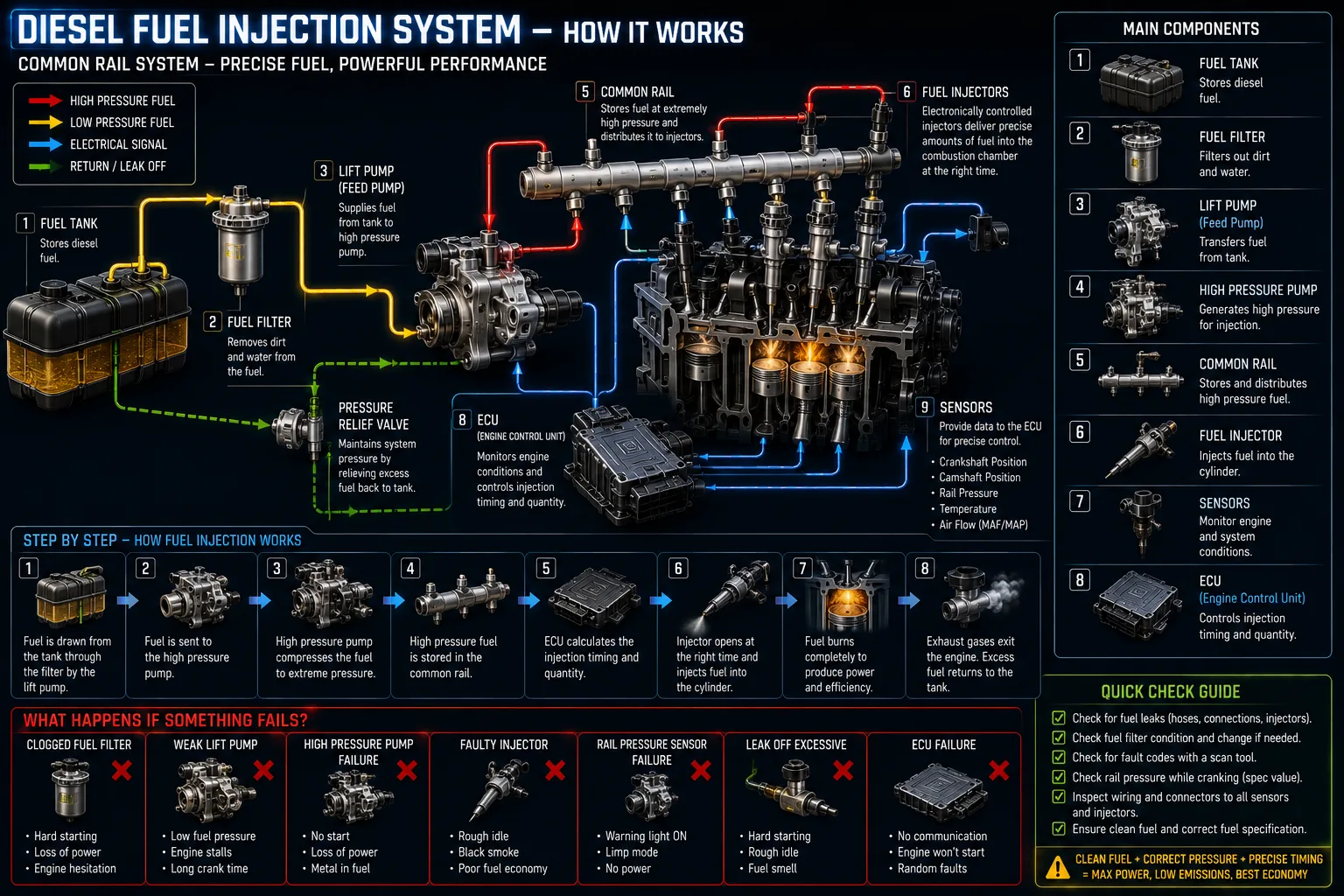
Modern petrol and diesel cars typically run a two-stage fuel delivery system, and understanding which half has given up the ghost matters enormously — because they are not the same job. The in-tank lift pump (also called the low-pressure pump on some diesels) sits inside the fuel tank, often integrated with the fuel level sender and a swirl pot. It draws fuel from the tank and pushes it toward the engine at low pressure. On most modern petrol cars, this same in-tank unit also does the high-pressure work — typically running at 3 to 5 bar — pushing fuel through the filter and up to the fuel rail where the injectors live. Diesels with high-pressure common rail systems are a different beast: the in-tank pump primes the system, while a separate high-pressure pump (mechanically driven off the camshaft or timing belt) generates the 1,500 to 2,000+ bar that common rail injection demands. That high-pressure pump failing is a different, more expensive conversation. When we talk about fuel pump replacement in the context of a car that cranks-but-won't-start, cuts out at speed, or whines from the tank, we're almost always talking about the in-tank electric pump — the one that has quietly been running on borrowed time, possibly made worse by you treating the fuel gauge as a dare.
“It gives you a motorway at 70mph, a splutter, a silence, and a very long wait for the RAC.”
Sound familiar?
So what's behind it?
What we do — at your door
We turn up to wherever you and the car have ground to an uneasy standstill — driveway, office car park, or the layby you are currently pretending was a planned stop — and we actually diagnose before we start pulling things apart. Fuel pump failure is often misdiagnosed as a crank sensor fault, a cam sensor issue, or — SOSCarFix's personal favourite — an expensive ECU problem that the last garage was very excited to replace. We connect a fuel pressure gauge to confirm what the system is or isn't producing, check the pump relay and fuse, test voltage at the pump connector, and establish whether you have a genuinely dead pump, a blocked filter restricting pressure, or something upstream in the wiring that's preventing a perfectly good pump from doing its job. Once we know what we're dealing with, we fit a quality replacement pump — typically an OEM-specification unit or a reputable branded equivalent — drop the tank or access through the boot floor depending on the vehicle, reseal everything correctly, and recheck pressure before we leave. No guessing. No part-swapping on the basis of hope.
What affects the price
What you pay for fuel pump replacement in the UK varies enough to be genuinely annoying, but the variables are real rather than invented. The biggest driver is the car itself: a fuel pump on a common Ford Focus or Vauxhall Astra is a well-supplied, competitively priced part that takes a reasonable amount of time to access. The same job on a German executive saloon, a Land Rover, or anything with a saddle-shaped tank split across two halves involves a more complex removal, a more expensive OEM-adjacent part, and proportionally more labour. Whether your car requires dropping the tank completely or allows access through a hatch cut into the boot floor is a significant labour variable — the former is more involved. Parts quality matters too: a budget pump from an unbranded source may cost a third of a reputable alternative and last a fifth as long. For most mainstream UK cars, total cost runs somewhere in the range of a premium service to a minor repair, rather than a major mechanical overhaul — but get a proper quote for your specific vehicle rather than guessing off an average that wasn't calculated for your car.
Random knowledge you didn't ask for
Questions you're probably asking
My car cranks but won't start — how do I know it's the fuel pump and not something else?
Honestly, you don't — not without testing. Cranks-but-won't-start is one of the more diagnostic-resistant symptoms in the book, because it implicates fuel, spark, and compression simultaneously. A proper fuel pressure test will confirm within minutes whether the pump is delivering anything. If pressure is zero or far below spec, the pump is the prime suspect. If pressure is normal, the fault lives elsewhere — and a garage that quotes you a pump without testing it first is guessing on your money.
Can I drive the car with a failing fuel pump?
Briefly and reluctantly, possibly — but cutting out at 70mph on a dual carriageway because the pump finally gave up mid-journey is not a risk worth taking for the sake of avoiding a call-out. A pump that's whining and struggling may hold on for days or may pack in entirely on the next cold start. There is no reliable way to know which it will be, and neither outcome is improved by delay.
Is it worth fitting an aftermarket pump or should I insist on OEM?
It depends on the car and your tolerance for doing the job twice. For most mainstream vehicles, a quality aftermarket pump from a reputable brand — Delphi, Bosch, Pierburg, and Walbro are well-regarded in the UK market — will perform correctly and last a reasonable service life. What you want to avoid is unbranded budget parts from the cheapest shelf, which have a well-documented tendency to fail within two years and leave you exactly where you started.
My pump whines more on a near-empty tank. Does that mean it's definitely failing?
It means your pump is unhappy and you should stop treating the fuel gauge as a game of chicken. The whine increases on low fuel because the pump is no longer fully submerged — it's working harder, running hotter, and drawing in air which the impeller is not designed to handle. Whether it's already damaged or just telling you off depends on how long you've been playing this game. Stop running it low, see if the noise reduces. If it persists on a full tank, the pump is already compromised.
What's the difference between a fuel pump and a fuel pressure regulator failing?
They produce overlapping symptoms — poor starting, hesitation, lean running — but a pressure regulator failure tends to cause fuel pressure that's consistently too high or too low rather than intermittently absent. A regulator fault also usually shows up as black smoke and rich running (stuck open) or lean stumbling (stuck closed) rather than complete cut-out at speed. A fuel pressure test distinguishes them quickly: stable but wrong pressure suggests the regulator; fluctuating or absent pressure under load points at the pump.
The Fuel Pump — sorted at your door
Stop procrastinating. Get a transparent quote and we'll come to you.