Your Fuel Rail Pressure Sensor Is Gaslighting Your ECU: Hard Starting, Limp Mode, and Cutting Out — Diagnosed and Fixed at Your Door
The fuel rail pressure sensor is one of those components that sits quietly on your engine doing something absolutely critical while nobody gives it a second thought — right up until it goes wrong. On a modern common-rail diesel or a GDI (Gasoline Direct Injection) petrol, the fuel system operates at pressures that would make your garden hose weep: common-rail diesels run anywhere from 300 to 2,000 bar depending on load, and the ECU is managing that pressure in real time, adjusting the high-pressure pump and fuel pressure regulator hundreds of times a second to keep combustion clean, efficient, and legal. The fuel rail pressure sensor is the only thing telling the ECU what pressure is actually in the rail. When it starts lying — sending voltages that don't match reality, going intermittent, or dying outright — the ECU either panics and throws the engine into limp mode, or worse, keeps believing the sensor and makes catastrophically wrong fuelling decisions. Either way, you notice. SOSCarFix comes to your driveway, plugs into the proper live data, and sorts it without you spending a week at a garage wondering what the courtesy car smells of.
See our upfront pricingHard starting, limp mode, engine cutting out? Your fuel rail pressure sensor is lying to your ECU. SOSCarFix diagnoses and fixes it at your door. Get a quote.
How it actually works
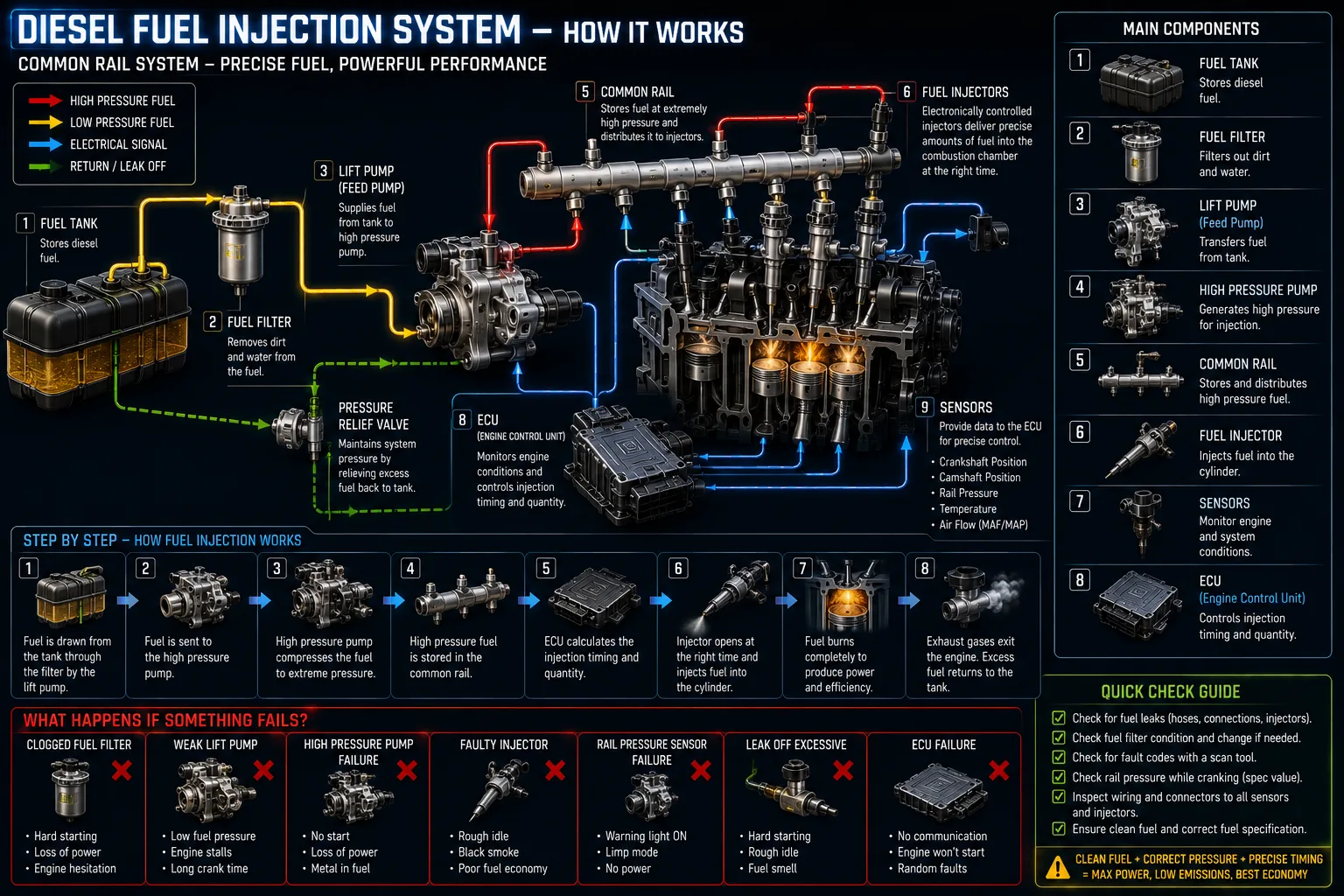
The fuel rail pressure sensor is a piezoresistive pressure transducer — which is a very dignified way of saying it's a device that changes its electrical resistance in proportion to the mechanical pressure applied to it. It's typically threaded directly into the fuel rail (the metal manifold that distributes high-pressure fuel to the injectors), with a small sensing element exposed to the fuel on one side and the wiring connector on the other. As fuel pressure rises and falls, the sensor outputs a corresponding voltage — usually in the 0.5–4.5V range — which the ECU reads and compares against the target pressure it's trying to achieve. On a common-rail diesel, the ECU uses this reading to control two things simultaneously: the high-pressure fuel pump (which generates the rail pressure in the first place) and the fuel pressure regulator or metering valve, which bleeds off excess pressure. It's a closed-loop system — the ECU sets a target, the sensor reports reality, and the ECU trims accordingly, many times per second. At idle you might be running at 300–400 bar; under hard acceleration on a modern diesel, the rail pressure can exceed 1,800 bar. The sensor has to track all of this accurately. On a GDI petrol engine the pressures are lower — typically 50–200 bar — but the principle is identical, and the ECU's dependency on accurate pressure data is just as absolute. Get the signal wrong and the ECU either over-fuels (rich running, smoke, catalyst damage) or under-fuels (misfires, loss of power, rough running). It then stores a fault code, switches on the engine management light, and if it decides things are bad enough, restricts engine output to protect itself. That's limp mode. You'll know it when you hit it.
“The fuel rail pressure sensor is the only thing telling the ECU what pressure is actually in the rail.”
Sound familiar?
So what's behind it?
What we do — at your door
When you book SOSCarFix, a mobile mechanic arrives at your address — driveway, office car park, roadside — with a proper diagnostic tool capable of reading live fuel rail pressure data in real time, not just pulling a fault code and shrugging. Live data is everything on a fuel pressure fault. We watch the rail pressure from cold start through warm-up, at idle, under snap acceleration, and at steady load. A sensor that's drifting will show a voltage signal that doesn't track the expected pressure curve; one that's failing intermittently will flatline or spike on the live graph at precisely the moment you'd see a symptom. More importantly, a real pressure shortfall caused by a worn high-pressure pump or a leaking regulator will also show up — as a system that can't reach target pressure even with a correctly-reading sensor, which is a very different diagnosis and a very different repair. We don't condemn parts based on fault codes alone. Once we've confirmed the sensor is the actual culprit, we fit a quality OE-specification replacement, clear the codes, and run a live data verification to confirm the new sensor is tracking correctly across the pressure range. On common-rail diesels we also verify the high-pressure pump output and regulator operation, because there's no point replacing a sensor on a fuel system that has another fault waiting to take over. All of this at your car, with no garage, no recovery truck, and no waiting.
What affects the price
Fuel rail pressure sensor replacement cost in the UK varies more than you might expect for what looks like a small bolt-in component. The sensor itself ranges from modestly priced on high-volume common-rail platforms — think Ford TDCi, Vauxhall CDTI, VW TDI — where aftermarket sensors are well-established and competitively priced, to considerably more on lower-volume diesels, premium German machinery, or anything with a rail and injector setup that isn't shared across half of Europe. GDI petrol pressure sensors tend to sit at the higher end of the parts cost range. On some vehicles the sensor is threaded directly into an end of the fuel rail and accessible in ten minutes; on others it's buried under the inlet manifold, EGR pipework, or an assortment of ancillary components that need to come off first, which adds labour time in direct proportion to how much the manufacturer wanted to annoy mechanics. If the sensor threads are corroded or the sensor body has seized into the rail (common on higher-mileage diesels), removal needs care and time — a sensor snapped in a fuel rail turns a modest job into a significantly larger one. Diagnosis time is separate but well worth it, because the cost of diagnosing correctly before replacing anything is considerably less than replacing a perfectly good sensor when the actual problem is a high-pressure pump.
Random knowledge you didn't ask for
Questions you're probably asking
My car is showing a P0190 fault code — does that definitely mean I need a new fuel pressure sensor?
Not necessarily, no. P0190 means the ECU detected a fuel rail pressure sensor circuit signal outside its expected range — but that could be a failing sensor, a corroded connector introducing resistance into the signal wire, a real fuel pressure shortfall caused by a worn high-pressure pump, or a leaking fuel pressure regulator that's allowing the rail to bleed down. Replacing the sensor on a fuel system that has a genuine pressure problem won't fix anything. Live data diagnosis is the only way to tell the difference, and it matters because the alternatives are considerably more expensive repairs.
Can I drive with a fuel rail pressure sensor fault?
In limp mode, technically yes — the ECU is deliberately restricting you to protect the engine, and it's designed to be driveable at reduced power. But limp mode exists because the ECU has lost confidence in its ability to manage fuelling correctly, and driving for extended periods under those conditions risks over-fuelling (which destroys the catalytic converter and DPF) or under-fuelling (which causes misfires and potentially damages injectors). Intermittent cutting-out faults are more immediately dangerous — an engine that switches off at a motorway junction is not a problem to defer. Sort it promptly.
How is a fuel pressure sensor different from a fuel pressure regulator?
They're related but distinct. The fuel pressure sensor is the measurement device — it reads the pressure in the rail and reports it to the ECU. The fuel pressure regulator (or pressure control valve) is an actuator — the ECU uses it to actively control the pressure in the rail by varying how much fuel is returned or bled off. A faulty regulator causes real pressure problems; a faulty sensor causes the ECU to believe there are pressure problems when there may not be. Both result in similar fault codes and symptoms, which is exactly why live data diagnosis distinguishes between them before anyone orders parts.
My diesel cuts out intermittently and then restarts after a few minutes — could this be the fuel pressure sensor?
It could be, yes. An intermittent fuel pressure sensor fault — particularly one that worsens with heat — can cause the ECU to temporarily switch off fuelling when it receives an implausible signal, with the engine recovering once the signal returns to a plausible range or the ECU resets. The same symptom can also be caused by a high-pressure pump that loses output when hot, a sticking fuel pressure regulator, or a low-pressure lift pump struggling to feed the high-pressure circuit. A live data capture during a fault event is the diagnostic gold standard here — a snapshot of what the sensor reported at the moment of cut-out is worth considerably more than a fault code read after the event.
Is it worth fitting an aftermarket fuel pressure sensor or should I insist on OEM?
For a high-precision, safety-critical signal like fuel rail pressure, quality of the replacement part matters more than it does for, say, a cabin filter. From established manufacturers — Bosch, Delphi, Denso, Continental — quality aftermarket sensors meet OE specification and carry a warranty; these are often the same companies that made the original part anyway. The budget end of the online marketplace is a different matter: a sensor with slightly drifted output characteristics won't throw a fault code immediately, it'll just cause the ECU to run slightly wrong fuelling until it does, which is a slow and difficult problem to diagnose. SOSCarFix fits quality parts with a warranty, because a sensor that fails in three months means we have to come back and do the job again, which suits nobody.
Your Fuel Rail Pressure Sensor Is Gaslighting Your ECU — sorted at your door
Stop procrastinating. Get a transparent quote and we'll come to you.