ESP / Traction Control Warning Light: What Your Dashboard Is Actually Telling You
There's a little car-with-squiggly-lines symbol on your dashboard that means one of two very different things. If it's flashing, something clever just happened — your car caught a skid, did the maths faster than you could blink, and quietly saved you from a hedge. Flashing is fine. Flashing is the system doing its job. Steady, though? Steady means your car has looked at the evidence, decided something is broken, and is now logging a fault. It has also, in all likelihood, switched the whole system off. So if you do hit a patch of ice or a wet roundabout, you're now very much on your own. SOSCarFix comes to you, plugs in proper diagnostic kit, reads the live data and tells you exactly which sensor or switch has taken early retirement — before you find out the hard way on the A21.
See our upfront pricingESP or traction control light on? Could be nothing. Could be a wheel-speed sensor quietly lying to your car. We come to you and find out. Get a quote.
How it actually works
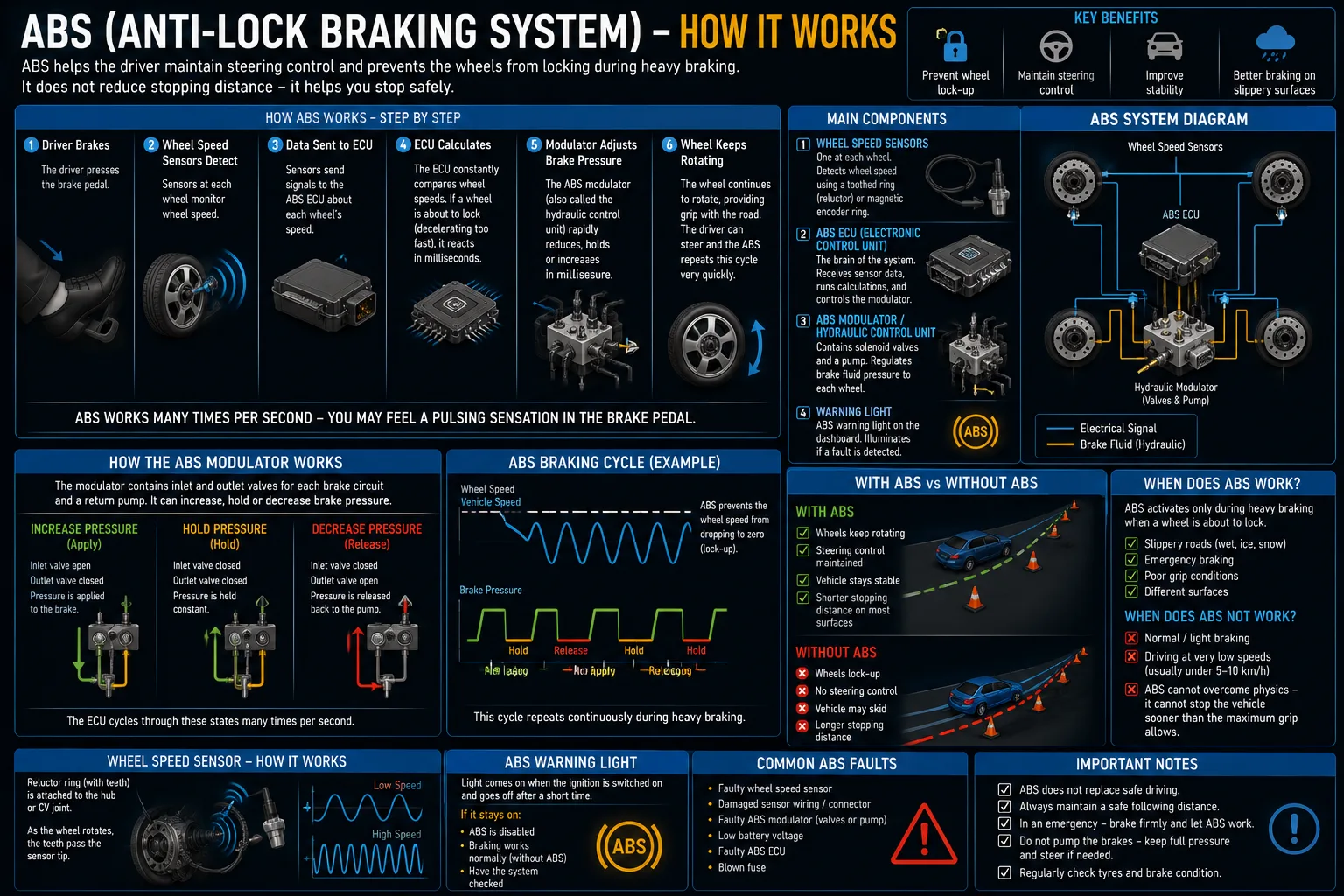
ESP (Electronic Stability Programme), ESC (Electronic Stability Control) and traction control are, broadly, the same family. Manufacturers give them different names — Bosch's ESP, Toyota's VSC, Ford's AdvanceTrac — but they all work on the same principle: compare what the driver is asking the car to do with what the car is actually doing, and quietly correct the discrepancy before it becomes a horror story. To do this, the system stitches together data from several sensors simultaneously. Wheel-speed sensors at each corner tell it how fast each wheel is turning. A yaw-rate sensor detects rotation around the car's vertical axis (spinning, in plain English). A lateral-acceleration sensor measures sideways forces. A steering-angle sensor knows where you're pointing the wheel. And a brake-pressure sensor knows how hard you're pushing. If the car detects a wheel spinning up (loss of traction) or the rear stepping out (oversteer) or the front washing wide (understeer), it selectively brakes individual wheels and may reduce engine torque — all in milliseconds, all without you doing anything. When a sensor in this chain fails, lies, or simply loses its connection, the system can no longer trust the picture. So it turns itself off and lights the warning. The fault is rarely the ESP unit itself — it's almost always a sensor feeding it bad data. That's actually good news: sensors are considerably cheaper than stability-control modules.
“There's a little car-with-squiggly-lines symbol on your dashboard that means one of two very different things.”
Sound familiar?
So what's behind it?
What we do — at your door
We come to you — driveway, car park, office, wherever the car is sitting — and plug in professional-grade diagnostic equipment, not the £25 Bluetooth dongle your neighbour swears by. We read the stored fault codes and, crucially, go into live data mode: watching each wheel-speed sensor's output in real time as we spin the wheels by hand, so we can see exactly which sensor is lying, skipping or flatlining. We check the steering-angle sensor calibration, test the brake-light switch signal, inspect the sensor reluctor rings and loom connectors at each corner for corrosion, and assess brake fluid level. That means by the time we quote you a repair, we know precisely what's wrong — not a shortlist of three possibilities. No parts are fitted until we've confirmed the actual fault.
What affects the price
Wheel-speed sensors are the most frequent fix and are generally modest parts — though price varies meaningfully between a basic Vauxhall Astra sensor and an OEM BMW or Mercedes unit. Labour is also straightforward on most cars (the sensor is usually one bolt and a connector), though rear sensors on some models require more dismantling. Steering-angle sensor resets or calibrations are typically done in software and add minimal time. A brake-light switch is one of the cheapest parts in the car — the labour to access it (on some VAG models, it's buried behind the pedal box) is usually more than the switch itself. If the fault turns out to be a damaged wiring loom, repair time depends on how extensive the damage is. An ABS/ESP module replacement is the priciest scenario and also requires programming — but it's genuinely uncommon. We always confirm the exact fault before quoting, and we'll tell you honestly if it's a cheap fix or a bigger one.
Random knowledge you didn't ask for
Questions you're probably asking
Is it safe to drive with the ESP warning light on?
It depends. If the light is flashing rhythmically — it's working, you're fine, carry on. If it's steady, the system has switched itself off. The car still drives and brakes normally in dry conditions, but you've lost your electronic safety net. On wet roads, icy roundabouts or emergency manoeuvres, that net matters considerably. We'd say: get it sorted within a few days rather than months.
Will a steady ESP light fail my MOT?
Yes, it will. A warning light that's on when it shouldn't be is an MOT failure under the 'warning lamp' category — the tester isn't required to diagnose it, just record that it's lit. If your MOT is coming up, get the fault read and fixed beforehand, not after. You'd be surprised how often a £30 wheel-speed sensor is the entire reason.
My ABS light and ESP light came on at the same time — is that one problem or two?
Almost certainly one problem. Wheel-speed sensors are shared between the ABS and ESP systems — the same sensors feed data to both control units. When one sensor fails, both systems lose confidence in the wheel-speed data and both warn you simultaneously. One diagnosis, one fix, two lights go out. It's one of the more satisfying faults to clear.
The ESP light came on after my tyres were changed — is that related?
Very possibly. Wheel-speed sensors and their wiring connectors are right next to the wheel hub — a careless tyre fit can knock a sensor, partially unseat a connector, or damage the reluctor ring on the hub. It's also possible the new tyres are a different size and have confused the system, though modern cars are usually tolerant of minor size changes. We'll check the sensors and connectors at each corner first.
Can I reset the ESP light myself with a cheap OBD reader?
You can clear the code, yes — but if the underlying fault is still there, the light will be back within a mile or two. Worse, some faults (a steering-angle sensor that needs recalibrating, or an intermittent sensor losing signal at speed) won't show on a basic OBD reader at all — you need live data and manufacturer-level access to the ABS/ESP module to actually see what's happening. Clearing codes without diagnosing the cause is just paying to feel better for a few minutes.
ESP / Traction Control Warning Light — sorted at your door
Stop procrastinating. Get a transparent quote and we'll come to you.