Engine Misfire: When Your Engine Decides Three Cylinders Are Quite Enough, Thank You
There is a very specific feeling when your engine decides it fancies a four-cylinder experience despite being born with five. A lumpy, lolloping idle. A vibration you feel in your fillings. The faint sense that your car has developed a personality disorder. That, right there, is an engine misfire — and it is not a mood your engine should be allowed to stay in. One cylinder is skipping its combustion cycle entirely, sending raw unburned fuel straight down into the exhaust. Which brings us to the flashing orange light on your dashboard. A solid engine management light is your car raising an eyebrow. A flashing one is your car waving its arms above its head, because that raw fuel is currently cooking your catalytic converter from the inside. Stop driving. Call us.
See our upfront pricingEngine running like it's had one too many? Lumpy idle, stuttering, flashing EML? SOSCarFix mobile mechanics diagnose and fix engine misfires at your door across the UK.
How it actually works
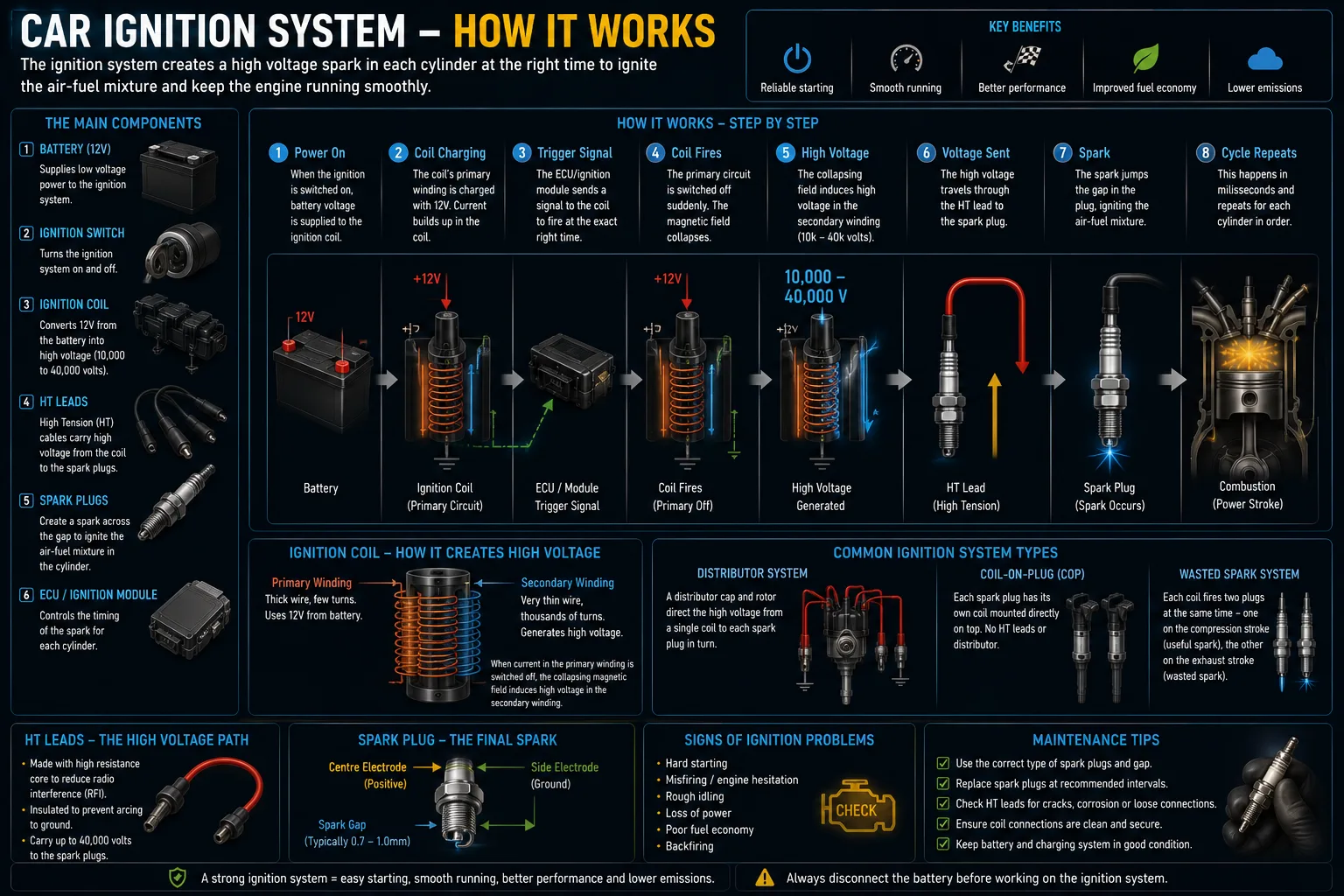
A four-stroke engine runs on a very precise pub round: intake, compression, combustion, exhaust. Every cylinder gets its turn, bang on time, every revolution. A misfire happens when one cylinder drops the ball on the combustion stroke — no spark, wrong fuel mix, or not enough compression to bother. The other cylinders carry on valiantly, which is why the engine still runs but feels like it is doing so through treacle. The crank sensor detects the slight rotational hiccup as that cylinder contributes nothing, and your ECU logs a misfire fault code — P0300 for a general lottery of misfires, P0301 through P0308 for when it knows exactly which cylinder is shirking. Now here is the bit that makes a flashing EML genuinely urgent: the raw, unburned fuel-air mixture that should have ignited in that cylinder gets pushed out into the exhaust. It hits your catalytic converter, which runs at around 500°C on a good day, and ignites there instead. Within seconds the converter can spike past 1,300°C — hot enough to melt the ceramic honeycomb structure inside it. You go from a relatively cheap ignition fix to a very expensive exhaust repair in the time it takes to drive to the end of your road. A flashing EML during a misfire is not a suggestion. It is a hard stop.
“There is a very specific feeling when your engine decides it fancies a four-cylinder experience despite being born with five.”
Sound familiar?
So what's behind it?
What we do — at your door
We come to you — your driveway, your workplace, the car park where it gave up — and we bring the diagnostic kit with us. We plug in and read the fault codes, which tell us which cylinder is misbehaving and give us a solid starting point rather than a guessing game. From there we work through the likely culprits in logical order: ignition system first, fuel delivery second, compression if we need to go further. We carry the common parts — plugs, coil packs, leads — so in many cases we can diagnose and fix on the same visit. If the misfire turns out to point toward something more involved, like a compression issue or a sensor fault, we will tell you straight what is needed and what it means for the car, without dressing it up. No garage, no booking weeks out, no courtesy car faff. Just a mechanic who turns up, sorts it, and does not leave you guessing.
What affects the price
What you end up paying depends almost entirely on what is actually causing the miss. A set of spark plugs is a very different conversation from a fuel injector strip-down or a compression test pointing toward worn rings. Engine type matters too — a straightforward four-cylinder with coil-on-plug ignition is far more accessible than a turbocharged six where half the components are buried. If the misfire has been going on long enough to damage the catalytic converter, that obviously changes the scope of the job significantly, which is one very good reason not to drive on a flashing EML. Age of the vehicle, severity of the fault, and how many cylinders are affected all feed into it. We give bespoke quotes based on an actual diagnosis of your actual car, not a ballpark pulled from thin air.
Random knowledge you didn't ask for
Questions you're probably asking
Can I drive with an engine misfire?
If the engine management light is flashing, the short answer is no. A flashing EML during a misfire means unburned fuel is actively reaching your catalytic converter, and driving on it risks turning a relatively contained ignition or fuelling fault into a ruined exhaust system. If the light is solid rather than flashing and the misfire is mild, you can drive carefully to get it sorted — but it should be diagnosed promptly, not filed under 'deal with it later'.
Why is my engine management light flashing and not just on?
A solid EML means the car has logged a fault and wants you to book it in. A flashing EML is a different category of urgency altogether — it specifically indicates an active, severe misfire. The engineers programmed it to flash rather than glow steady because the catalytic converter damage that follows a prolonged misfire is both expensive and quick. Think of it as the car going from a raised eyebrow to an actual shout.
Will fixing a misfire also fix my poor fuel economy?
Almost certainly yes, at least partially. When a cylinder is not firing properly the engine management system compensates by enriching the fuel mixture and working the remaining cylinders harder. Fix the root cause and combustion efficiency returns to normal. If fuel economy was already declining before the misfire symptoms showed up it is worth checking whether the misfire was actually the first symptom of the same underlying fault.
How do you know which cylinder is misfiring?
Your car already knows — the ECU logs individual cylinder misfire counts as fault codes. A P0301, for example, points straight at cylinder one. We read those codes with a diagnostic tool, which tells us where to look rather than requiring us to work through every component on every cylinder. From there, a few targeted tests usually confirm whether it is a spark, fuel, or mechanical issue.
Engine Misfire — sorted at your door
Stop procrastinating. Get a transparent quote and we'll come to you.