EGT Sensor Replacement: Because Your Exhaust Is Running Hotter Than Your Temper
The exhaust gas temperature sensor is one of those components your car absolutely depends on and that nobody has ever heard of — right up until it fails and your diesel van enters limp mode on the M6 at 7am with a full load on board. Its job is unglamorous but critical: measure exactly how hot the gases leaving your engine are, so the ECU can protect the DPF and turbo from being cooked alive. Get that data wrong — or lose it entirely — and the ECU does the only sensible thing it can: assume the worst, clamp the power, and park you somewhere between "furious" and "late for everything." SOSCarFix comes to you — driveway, lay-by, or the car park of whatever client you're already embarrassingly late to — diagnoses the fault with live scan data, and fits the right sensor on the spot. No garage. No tow truck. No drama.
See our upfront pricingEGT sensor fault killing your diesel's power and clogging your DPF? SOSCarFix diagnoses and replaces it at your door — no garage, no faff. Get a quote.
How it actually works
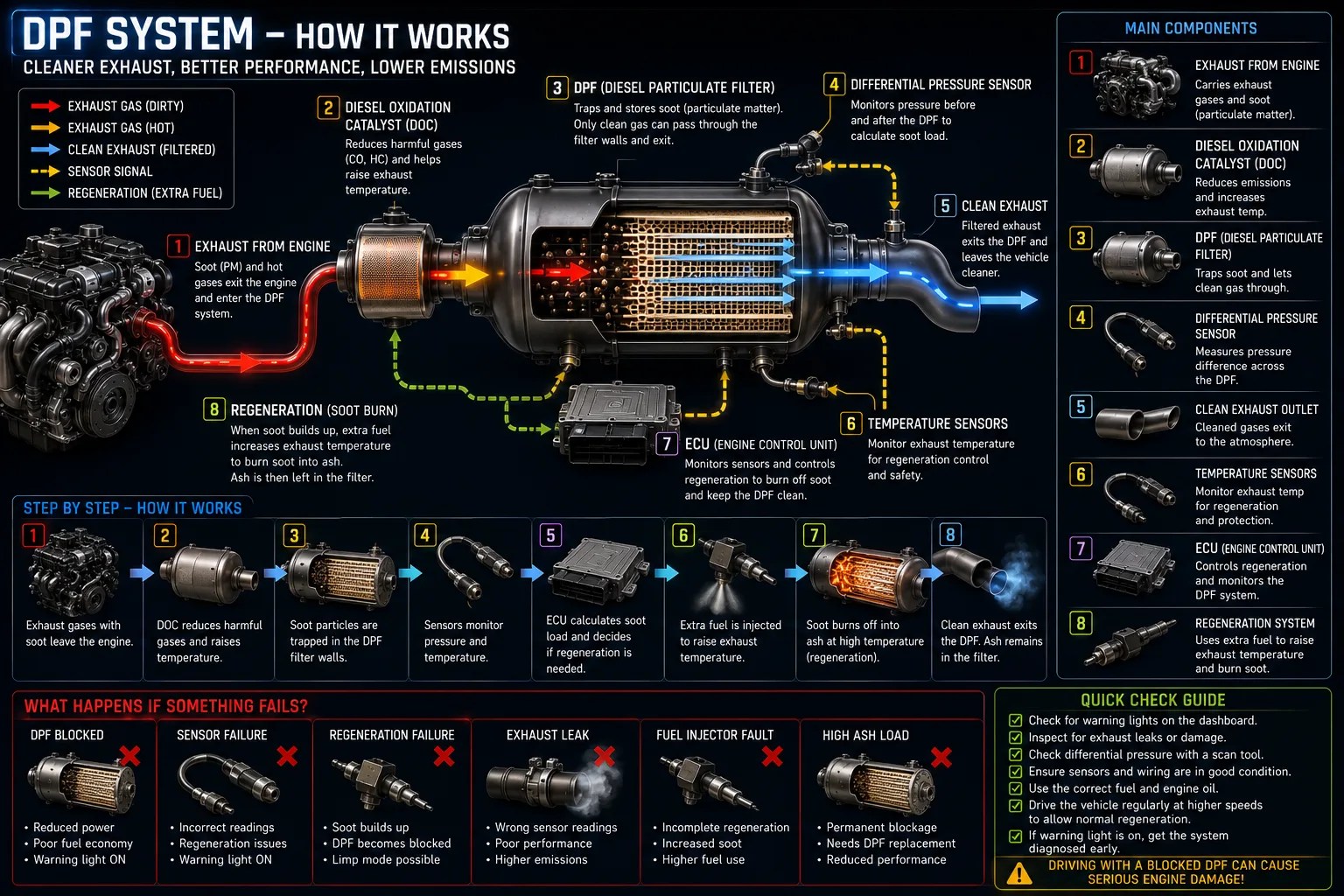
Your diesel engine burns fuel and produces exhaust gases at temperatures that can comfortably exceed 700°C under hard load. The EGT (exhaust gas temperature) sensor — usually a thermocouple or NTC thermistor screwed into the exhaust manifold or DPF housing — sends a continuous live voltage signal to the ECU representing exactly how hot those gases are at that point in the exhaust stream. Most modern diesels have multiple EGT sensors: one pre-turbo, one post-turbo, one pre-DPF, and one post-DPF, each doing a slightly different job. The ECU uses this data for two things above all else. First, turbo protection: if exhaust temperatures climb dangerously high under sustained load, the ECU can enrich the fuel mixture or reduce boost to bring temperatures back down before the turbine housing warps or the blades shed. Second, and more visibly relevant to most diesel owners, DPF regeneration management. Active regeneration — where the ECU injects a late post-combustion fuel squirt to raise exhaust temps and burn off the accumulated soot in your DPF — only works if the ECU can confirm that temperatures are actually hitting the required window (typically around 550–650°C). If the EGT sensor is lying, stuck low, or dead entirely, the ECU either cannot initiate regeneration at all, or cannot confirm it completed successfully. Your DPF fills up. Your car sulks. You get a light.
Sound familiar?
So what's behind it?
What we do — at your door
We turn up wherever your car has staged its protest — driveway, car park, roadside — with a proper diagnostic scan tool that reads live EGT sensor data, not just stored fault codes. That distinction matters: a code tells you the ECU is unhappy; live data tells you whether the sensor is dead, reading low, reading high, or producing an intermittent signal every time the loom flexes. We confirm the fault before we quote you a part, because replacing a perfectly functional sensor because the wiring connector is corroded is exactly the kind of thing a bored main dealer does to pass the time. Once we know the sensor is genuinely at fault, we fit a quality replacement — using penetrating release where needed and the correct torque on reinstallation, so the thread survives — clear the codes, and verify the ECU is reading live temperature data correctly before we leave. If the DPF has accumulated enough soot during the sensor's absence that it needs a forced regeneration cycle, we can discuss that too rather than leaving you to discover it the hard way.
What affects the price
EGT sensor replacement cost in the UK varies more than you might expect for what sounds like a small job. The sensor itself ranges considerably depending on whether it is a pre-turbo or post-DPF position, which vehicle it is fitted to, and whether you use OE-specification or budget aftermarket parts — and on a diesel where EGT accuracy genuinely matters, the budget sensors that read five percent out of spec are a false economy. Labour is where the real variation comes in: a sensor that unscrews cleanly in ten minutes is a different world from one that has been heat-seized into an exhaust manifold for eight years and requires careful heat application, extraction tools, and thread repair before a new one can go in. Vehicles with multiple EGT sensors (most modern Euro 5 and Euro 6 diesels have two to four) may have one failed and one borderline, so it is worth discussing whether it makes sense to address more than one position while access is open. There are no call-out charges or ramp fees with SOSCarFix — what you are quoted is what you pay.
Random knowledge you didn't ask for
Questions you're probably asking
Can I drive with a faulty EGT sensor?
In limp mode, technically yes — the car will move. But the ECU has clamped your power precisely because it cannot confirm exhaust temperatures are safe, and your DPF regeneration will have stopped working entirely. Drive long enough and you go from a sensor fault to a blocked DPF, and from there to a forced regen or DPF replacement that costs considerably more. It is the automotive equivalent of ignoring a small roof leak until the ceiling comes down.
Will clearing the fault code fix it?
For about forty seconds, yes. Then the ECU reads the sensor again, sees the same rubbish data, and puts the light straight back on. Clearing codes without fixing the underlying fault is a technique beloved of people who want to sell you a car, not people who want to fix one. You need the sensor replaced or the wiring fault repaired — the code is the symptom, not the disease.
How do I know if it is the sensor or the wiring?
This is exactly why live data diagnosis beats guessing. A dead sensor gives a fixed open-circuit reading; a faulty connector gives an intermittent signal that drops out when the loom flexes; a sensor drifting out of calibration gives a plausible but wrong reading that never quite matches expected values at idle or under load. A scan tool showing live EGT data in real time tells you which you are dealing with. Replacing the sensor when the connector is corroded wastes your money and your afternoon.
My diesel has multiple EGT sensors — how do I know which one failed?
The fault code will typically reference a specific sensor position — pre-catalyst, post-DPF, and so on — and the code number itself (P0544, P2033, etc.) maps to a specific sensor in the circuit. A proper diagnostic session reads all sensor positions in live data simultaneously, so you can see which one is reading implausibly and which ones are behaving themselves. We check all positions, not just the one that threw the code.
Can a failed EGT sensor damage my turbo or DPF?
Yes, and this is not scaremongering. Without accurate temperature feedback, the ECU loses its ability to protect the turbo from sustained overheating under load, and loses its ability to manage DPF regeneration safely. A DPF that never regenerates fills with soot until it blocks completely — at which point you are looking at a forced regen or a new DPF rather than a sensor. Fix the cheap thing before it becomes the expensive thing.
EGT Sensor Replacement — sorted at your door
Stop procrastinating. Get a transparent quote and we'll come to you.