Your EGR Position Sensor Is Gaslighting Your ECU: What It Does, Why It Fails, and Why Guessing Gets Expensive
The EGR valve position sensor has one job: tell the ECU how far the EGR valve has opened. That's it. One job. And yet when it starts sending the wrong signal — or no signal at all — it triggers a chain reaction that the ECU, quite reasonably, interprets as a catastrophe. Rough idle that feels like the engine is trying to dislodge itself. Hesitation when you press the accelerator and the car thinks about it for an unsettling moment. Limp mode that limits you to a sad, apologetic fifty miles an hour on the dual carriageway. An engine management light that glows on the dashboard like a tiny orange accusation. The cruel joke is that the valve itself might be perfectly fine — it's the sensor that's feeding garbage data, and the ECU, not being psychic, has no way to know the difference. SOSCarFix comes to your driveway, car park, or office, plugs in a proper scan tool, pulls live data, and tells you exactly what's lying to what. No guessing. No unnecessary parts. No bus home.
See our upfront pricingEML on, rough idle, hesitation, or limp mode? Your EGR position sensor is probably lying to the ECU. SOSCarFix diagnoses it at your door. Get a quote.
How it actually works
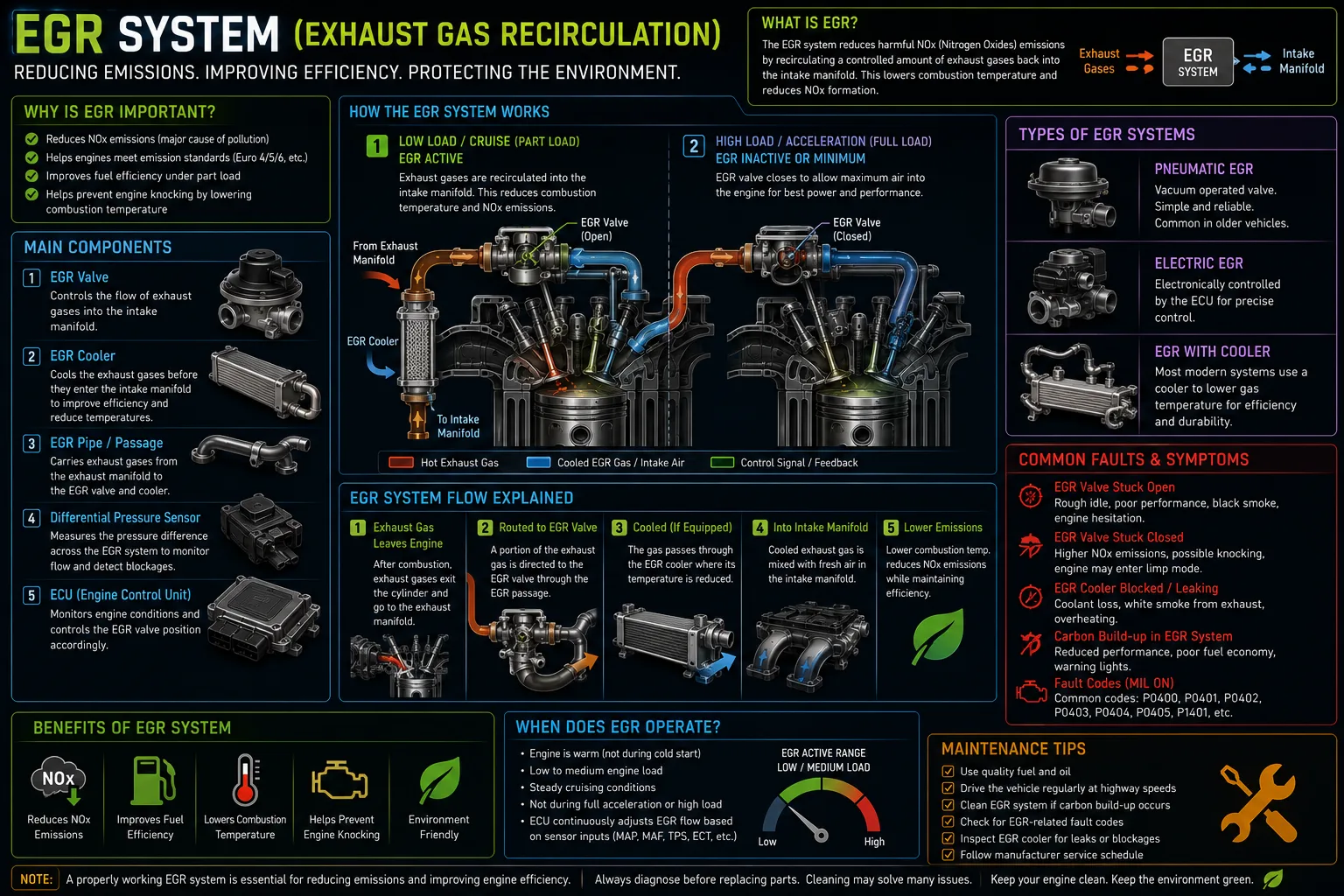
The EGR system — Exhaust Gas Recirculation — exists because combustion engineers discovered that reintroducing a controlled amount of inert exhaust gas back into the intake reduces the peak combustion temperature, which in turn reduces the formation of nitrogen oxides (NOx). NOx is what makes urban air genuinely unpleasant and what emissions legislation exists to limit, so your car is legally obliged to have this system functioning. The ECU controls the EGR valve's opening position based on engine load, RPM, coolant temperature, and throttle position — it's a precise, dynamic calculation that changes second by second. But to make those calculations work in a feedback loop, the ECU needs to know not just how far it told the valve to open, but how far it actually opened. That's the EGR position sensor's contribution: a potentiometer or Hall-effect sensor mounted on the valve body that continuously reports actual valve position back to the ECU as a variable voltage signal. When the sensor is working correctly, the ECU can compare commanded position against actual position and adjust accordingly. When the sensor drifts, sticks, develops an intermittent open circuit, or simply lies about the valve's position with cheerful consistency, the ECU sees a discrepancy it cannot explain and responds accordingly — logging a fault code, illuminating the engine management light, and often pulling the engine back into a safe but miserable operating mode. The key diagnostic insight here is that the fault code tells you a signal is wrong; it does not automatically tell you whether the sensor, the valve, or the wiring is to blame. That's what live data is for.
“Hesitation when you press the accelerator and the car thinks about it for an unsettling moment.”
Sound familiar?
So what's behind it?
What we do — at your door
We come to you — driveway, car park, office, layby, wherever the car has stopped being cooperative — and we start with a proper scan rather than a parts lottery. Our diagnostic equipment reads the full fault code memory and, more importantly, pulls live data from the EGR position sensor in real time: we can see the voltage signal the sensor is producing versus the position the ECU is commanding, watch how the signal behaves across the rev range, and observe whether the discrepancy is in the sensor, the valve mechanism, or the wiring between them. This matters because an EGR valve that's coked solid with carbon deposits will produce exactly the same fault codes as a failed position sensor, and the fix is completely different — one needs a sensor, the other needs a thorough clean or a new valve assembly, and confusing the two is expensive. Once live data confirms the actual fault, we carry quality replacement sensors for common UK vehicles and can fit the correct part on the spot. Where the valve itself is carboned up and restricting movement, we'll advise on whether a clean or a full valve replacement is the more sensible route based on the vehicle's age, mileage, and the severity of the deposits. No guessing. No parts-cannon approach. Just the right diagnosis, the right fix, done at your location.
What affects the price
EGR position sensor replacement cost in the UK depends on several things that vary enough to make any flat-price quote you see online essentially fictional until someone actually checks your registration. The sensor itself ranges from a modest outlay on a mainstream Ford, Vauxhall, or Volkswagen Group diesel to considerably more on prestige brands where parts pricing appears to have been set by someone who assumed you could afford it. Some manufacturers supply the position sensor as a standalone component; others sell it only as part of the complete EGR valve assembly, which is a larger parts cost for what might have been a smaller problem. Labour time is generally straightforward on accessible engines but can increase significantly where the EGR valve is buried under intake manifolding that needs to come off first — a situation depressingly common on some popular diesel engines. If the valve itself needs cleaning or replacing in addition to the sensor, that adds both parts cost and time. A proper diagnostic check before any parts are ordered is worth factoring in — it's the difference between fixing the right thing first time and buying a sensor that doesn't solve a carbon fouling problem.
Random knowledge you didn't ask for
Questions you're probably asking
Can I just unplug the EGR position sensor to get rid of the fault?
You can, and the car will probably still run — but the ECU will immediately detect an open circuit where it expected a signal, log a fault, and in most cases keep the engine management light on or put the car into limp mode anyway. You haven't fixed anything; you've just changed which fault code is stored. On a car that needs to pass an MOT emissions test, a disconnected EGR system will likely mean a fail. Unplugging sensors to avoid fixing them is a strategy with a poor long-term record.
My scan tool shows an EGR fault code. Does that definitely mean the position sensor has failed?
Not necessarily — and this is exactly why fault codes are a starting point, not a diagnosis. P0400-series and EGR position codes can be triggered by a failed sensor, a valve that's coked solid and mechanically stuck, a cracked vacuum hose on older systems, a wiring fault in the sensor circuit, a failing EGR cooler, or occasionally a software issue. Reading live data — watching what the sensor actually reports versus what the ECU commands in real time — is what tells you which of those is the actual problem. Codes narrow the area; live data confirms the culprit.
Is this an MOT failure?
An active engine management light is a direct MOT failure, full stop — it doesn't matter whether the underlying fault is EGR-related or something else. Beyond that, if the EGR system is disabled or malfunctioning in a way that causes elevated NOx emissions, the emissions test can fail independently on the tailpipe analysis, even if the light isn't currently illuminated. EGR faults have a way of affecting MOT outcomes from more than one direction simultaneously.
The fault is intermittent — it disappears on its own sometimes. Can I leave it?
Intermittent faults are typically sensors or connectors in the process of failing rather than faults that have decided to fix themselves. The signal gets worse with heat, vibration, and time, and 'sometimes fine' usually has a finite lifespan before it becomes 'consistently wrong.' The intermittent phase is actually the best time to diagnose it — a scan tool monitoring live data while the fault is active gives you real information, whereas once the connector has failed completely you're sometimes left chasing a more ambiguous picture. Intermittent does not mean ignorable.
How long does the replacement take?
On most common UK diesel engines where the EGR valve is reasonably accessible — your VW Group 2.0 TDIs, Ford 1.5 and 2.0 EcoBlues, Vauxhall CDTis and similar — fitting a standalone position sensor typically takes under an hour once we know that's definitively what needs doing. Where the valve assembly needs to come out completely, or where access requires removing intake ducting or heat shielding, add time accordingly. If there's significant carbon fouling to deal with as well, allow more again. We'll give you a realistic estimate once we've confirmed what the job actually involves.
Your EGR Position Sensor Is Gaslighting Your ECU — sorted at your door
Stop procrastinating. Get a transparent quote and we'll come to you.