Dual Mass Flywheel: The Most Expensive Part You've Never Heard Of
There is a component sitting between your engine and gearbox that does something remarkable: it absorbs the brutal, uneven firing pulses of your engine and delivers smooth, civilised power to your clutch. It is, in essence, the peacekeeper in a very angry metal sandwich. It also costs considerably more than a regular flywheel, wears out over time like any other friction-related component, and announces its demise with a distinctive rattle — often most noticeable when you switch the engine off and the whole drivetrain shudders to a stop like a dog shaking off water. That's your dual mass flywheel (DMF) telling you its spring-damper internals are knackered, and it is not a problem that gets better on its own. SOSCarFix comes to you — driveway, office car park, or the layby where you've been Googling "DMF replacement cost" in a growing sense of dread — diagnoses the situation properly, and replaces it without you ever having to visit a garage.
See our upfront pricingThat rattle when you switch the engine off? That's your DMF dying. SOSCarFix replaces dual mass flywheels at your home or workplace — no garage faff. Get a quote.
How it actually works
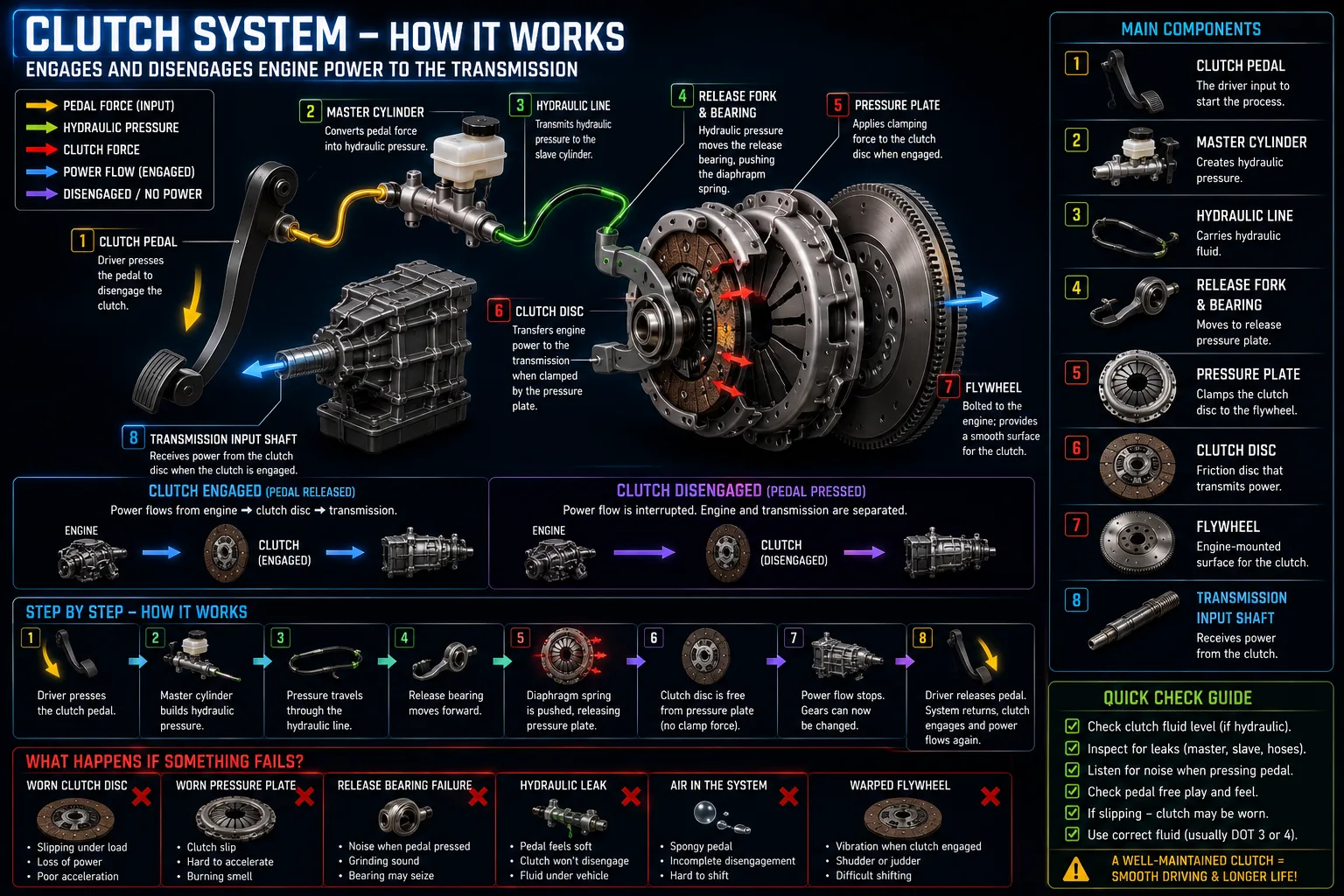
A dual mass flywheel does the same basic job as a regular flywheel — it's a heavy spinning disc that stores rotational energy and gives the clutch something solid to grip against — but with a crucial twist. Inside the DMF are arc-shaped coil springs and a set of friction dampers arranged between two separate flywheel masses that can rotate relative to each other. This spring-damper system absorbs the rotational shock of the engine's firing pulses before they reach the gearbox, which is why diesel engines and high-torque petrols use them almost universally: without the DMF, those firing pulses travel straight through the drivetrain, causing vibration, noise, and accelerated wear on every component downstream including the gearbox. Over time — typically somewhere between 80,000 and 150,000 miles, though aggressive driving and lots of stop-start work shortens that considerably — the internal springs fatigue and the friction material wears down. The two flywheel masses develop excessive play, which is what makes that characteristic rattle and shudder. Because a DMF is almost always removed during a clutch replacement anyway, it makes overwhelming sense to change both at the same time. Sending a tired, worn flywheel back in with a brand new clutch kit is an expensive false economy — you'll be doing the labour again in short order.
“It is, in essence, the peacekeeper in a very angry metal sandwich.”
Sound familiar?
So what's behind it?
What we do — at your door
We come to you — home, work, or wherever your car has staged its protest — and start with a proper diagnosis rather than just agreeing to throw parts at it. That means checking the actual freeplay and rattle in the flywheel masses, assessing the clutch condition at the same time, and identifying any oil leaks that need sorting before new parts go in. Once the quote is agreed, we drop the gearbox (yes, at your driveway — this is what we do), remove the old dual mass flywheel and clutch kit together, clean everything up properly, and fit the new DMF and clutch kit as a matched set. Fitting a new clutch without a new DMF when the DMF is worn, or vice versa, is a common false economy that we will cheerfully talk you out of. We also replace the slave cylinder and release bearing as a matter of course — they're right there and they cost very little compared to the labour of getting back in if they fail in six months. Everything is torqued to spec, the gearbox goes back in, and you drive away with a drivetrain that feels the way the engineers intended. No garage drop-off, no waiting rooms, no courtesy car nonsense.
What affects the price
DMF replacement is not a cheap job, and if anyone quotes you a suspiciously low price it's worth asking some pointed questions about what's actually being included. The part itself varies significantly by vehicle — a DMF for a Ford Transit or BMW diesel will be in a different bracket to one for a smaller family hatch, and quality matters considerably here: cheap pattern-part DMFs have a well-documented tendency to fail earlier than OEM or Sachs/LuK units. Labour is substantial because the gearbox has to come out regardless of the vehicle, and that's a multi-hour job even on straightforward cars. Most reputable mechanics will strongly recommend fitting a complete clutch kit at the same time — friction plate, pressure plate and release bearing — because the labour is already done and doing it separately later nearly doubles the total cost. Vehicles with a single-mass flywheel conversion option (fitting a solid flywheel and uprated clutch instead of another DMF) may find that a cost-effective long-term alternative, particularly on higher-mileage vans or older vehicles where the OEM DMF price is hard to justify. We'll give you an honest comparison of both options when we quote.
Random knowledge you didn't ask for
Questions you're probably asking
Can I just replace the clutch and leave the DMF if it's not too bad?
Technically yes. Practically, almost never sensible. If the DMF shows any rattle, excessive freeplay between the masses, or has done over 100,000 miles, fitting a fresh clutch against it is a gamble — you're paying the bulk of the labour cost twice when the DMF follows the clutch out in the near future. We'll tell you honestly whether yours is marginal or genuinely fine, rather than automatically upselling.
What is a single-mass flywheel conversion and should I do it?
A solid (single-mass) flywheel paired with an uprated clutch kit can replace the DMF entirely. You lose some refinement at low revs — slightly more vibration at idle, a firmer clutch — but gain a more durable, simpler setup that many diesel van drivers prefer. It's often cheaper long-term on high-mileage vehicles. We'll quote both options honestly.
How long does DMF and clutch replacement take at my home?
On most cars, budget a full day — typically five to eight hours depending on access and whether the car fights back. Gearbox removal is the majority of that time. We'll confirm the estimate when we quote, and we'll tell you upfront if your particular model is notably awkward. We try not to start jobs we can't finish in one visit.
My car is rattling at idle but the clutch feels fine — could it still be the DMF?
Absolutely. A DMF can make all the classic rattle and shudder noises while the clutch itself still bites cleanly — the two wear independently. The idle rattle is the giveaway: that's the worn spring-damper internals knocking as the engine fires, and it won't improve. A proper physical check of the flywheel freeplay tells us more than guesswork.
Does a new DMF need any running-in period?
The DMF itself doesn't, but the new clutch friction plate does. For the first 500 miles or so, avoid aggressive clutch take-up, sustained slip on hills, and heavy towing. Gentle, progressive use beds the friction material evenly and significantly extends the life of the new components. After that, drive normally — you've earned it.
Dual Mass Flywheel — sorted at your door
Stop procrastinating. Get a transparent quote and we'll come to you.