Clutch Slave Cylinder Replacement: When the Hydraulics Give Up Before You Do
Your clutch pedal used to have resistance. A reassuring firmness that said "I am a properly functioning piece of hydraulic engineering and I have everything under control." Now it goes straight to the floor like a wet sponge dropped on a trampoline, and you cannot for the life of you select first gear without a grinding noise that makes bystanders wince. Congratulations: your clutch slave cylinder has failed. It is a small component. It does one very specific job. And when it stops doing that job, your car becomes a rather expensive ornament that cannot move. SOSCarFix comes to you — driveway, car park, or the lay-by where you've been sitting in quiet desperation — diagnoses the fault on the spot, and gets your clutch hydraulics working again without you needing to abandon the car at a garage for four days.
See our upfront pricingPedal to the floor, gears won't select, fluid all over the floor? Your clutch slave cylinder's quit. SOSCarFix comes to you — get a quote today.
How it actually works
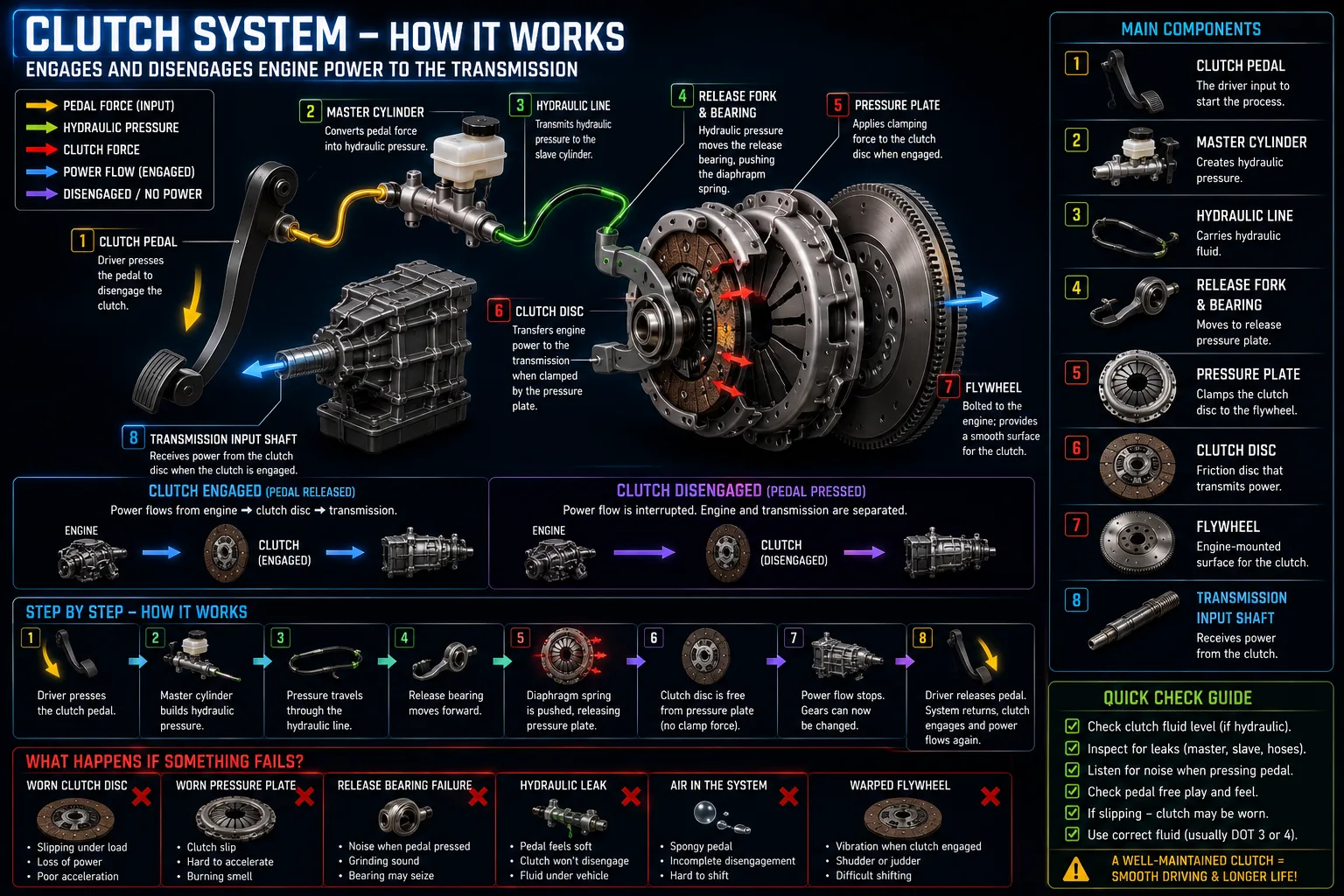
Your clutch hydraulic system works on the same principle as your brake hydraulics: fluid under pressure transmits the force from your foot to the mechanical bits that actually release the clutch. The master cylinder (at the pedal end) generates that pressure. The slave cylinder (at the gearbox end) receives it and pushes the release bearing or fork to disengage the clutch. There are two main designs in UK cars. The external slave cylinder sits on the outside of the gearbox bell housing and operates a clutch fork — older design, accessible, relatively straightforward to replace without removing the gearbox. The concentric slave cylinder (CSC), increasingly common on modern vehicles including most Ford, Vauxhall, Volkswagen Group, and BMW models from the 2000s onwards, lives inside the bell housing, mounted concentrically around the gearbox input shaft. It is elegant engineering. It is compact. It is also utterly inaccessible without removing the gearbox. When either design fails — through a split seal, a cracked body, or corrosion on the bore — hydraulic pressure drops. The pedal goes soft or falls straight to the floor. The clutch stops disengaging properly. You cannot select gears cleanly, or at all. Fluid either leaks externally (external slave) or disappears into the bell housing area (CSC). Some CSC failures are "dry" — the seals fail internally and the cylinder simply stops generating force with no visible puddle. Sneaky.
“A reassuring firmness that said "I am a properly functioning piece of hydraulic engineering and I have everything under control.”
Sound familiar?
So what's behind it?
What we do — at your door
SOSCarFix comes to your location — home, workplace, wherever the car is sitting looking sorry for itself. We do not need a ramp for diagnosis, and for external slave cylinder replacement we may not need one at all. On arrival, we check the clutch fluid reservoir level and condition first (dark, murky fluid is doing no one any favours). We pump and test the pedal feel, checking for travel, sponginess, and whether pressure returns after pumping. If there is an external slave cylinder, we inspect it directly for visible leaks, seal condition, and pushrod engagement with the clutch fork. For suspected CSC failures on modern vehicles, we connect our diagnostic equipment to check for any related fault codes (some cars log hydraulic clutch faults), then perform a pressure hold test on the hydraulic circuit to confirm whether the slave cylinder is bleeding down internally. We will tell you clearly whether it is an external slave (often a half-day job we can complete on your driveway) or a CSC (which requires gearbox removal — a bigger undertaking but absolutely achievable as a mobile job with the right equipment). We quote before we touch anything. If we recommend replacing the clutch kit at the same time as a CSC — because pulling the gearbox anyway makes that sensible — we will explain exactly why, not just say "while we're in there" and add £400 to the invoice without justification.
What affects the price
Cost varies considerably depending on which type of slave cylinder your car has and whether the clutch itself needs attention at the same time. External slave cylinders are the affordable end of this repair — the part is typically £15–£80 depending on vehicle, labour is modest because access is reasonable, and a complete hydraulic bleed is included. If you just need the external slave replaced and bled, you are looking at a sensible repair bill. Concentric slave cylinders are a different conversation. The part itself is typically £40–£200 (OEM units from main dealers cost significantly more), but the labour is substantial because the gearbox must come out. On most front-wheel-drive hatchbacks and saloons this is a 4–7 hour job. Because the gearbox is already out for a CSC, a full clutch kit replacement (friction plate, pressure plate, release bearing — now redundant on CSC cars, but any worn clutch components should be done now) adds parts cost but very little extra labour. Doing the CSC but leaving a worn clutch is the automotive equivalent of decorating your living room but leaving the damp. You will regret it within 18 months. Dual mass flywheels, if worn (common on higher-mileage diesel vehicles), add the most significant cost to any CSC job — but again, the flywheel is right there, and replacing it separately later means paying for gearbox removal twice. We provide an honest, itemised quote before starting. No invented labour hours, no padding.
Random knowledge you didn't ask for
Questions you're probably asking
My clutch pedal went to the floor this morning. Can I still drive the car to save you coming out?
Short answer: no. A clutch pedal with no pressure means you cannot disengage the clutch properly, which means gear changes are at best grinding and at worst impossible. Forcing gear changes on a failed clutch hydraulic system risks damaging your synchromesh, which is a significantly more expensive conversation than the slave cylinder. Some people manage to limp home by matching revs and changing without the clutch — impressive, unnecessary, and still not recommended on a daily basis. Call us instead.
How do I know if it is the master cylinder or the slave cylinder that has failed?
The master cylinder is at the pedal end; the slave is at the gearbox end. A master cylinder failure typically means total pedal loss with no resistance from the very beginning of travel. A slave cylinder failure more often presents as a pedal that has pressure initially but fades or sinks under sustained hold. Visible leaks at the pedal box area suggest master; leaks near the gearbox suggest slave. In practice, diagnosis requires a pressure hold test and inspection — we do this on arrival before quoting anything.
Do I need a full clutch replacement at the same time as the concentric slave cylinder?
Not automatically, but it is worth a serious conversation. Because a CSC replacement requires gearbox removal, the clutch components are fully accessible at no additional labour cost. If your clutch has over 60,000 miles on it, is showing any symptoms of wear, or if you simply do not know its history, replacing the clutch kit at the same time is strongly advisable. Paying gearbox removal labour twice — once now for the CSC and once in 18 months for the clutch — is not clever economy.
Can you bleed a clutch hydraulic system without replacing anything if there is just air in it?
Yes, absolutely. If the spongy pedal is caused by air introduced during previous work rather than an actual component failure, a proper hydraulic bleed of the clutch circuit can restore normal pedal feel without replacing any parts. We check this before recommending component replacement. Many cars respond well to a vacuum or pressure bleed using fresh DOT 4 fluid. If bleeding restores firm pedal and it holds, you are done. If it bleeds fine but the pedal fades again within a day or two, the slave cylinder seal is passing fluid and needs replacing.
How long does a clutch slave cylinder replacement take?
An external slave cylinder on most cars is a 1–2 hour job including hydraulic bleed, and we can typically complete it on your driveway without requiring a ramp. A concentric slave cylinder is a 4–8 hour job depending on the vehicle, because the gearbox must be removed and refitted. We will confirm the expected time when we book, so you know whether to plan around us for the morning or the full day.
Clutch Slave Cylinder Replacement — sorted at your door
Stop procrastinating. Get a transparent quote and we'll come to you.