Clutch Replacement: The Long, Slow Goodbye
You know exactly how this story ends. Six months ago the biting point was somewhere sensible — mid-pedal, maybe slightly above. Unremarkable. Then it started its slow migration north. A centimetre here, a centimetre there, like a retiree packing up the car for Bognor Regis with absolutely no intention of coming back. Now you're catching it with your knee practically level with the steering wheel and telling yourself it's fine. It is not fine. Your clutch is waving you off from the platform and the train has already left. The good news: this is fixable, we can come to wherever you are, and we've seen far worse — usually from people who had exactly this conversation with themselves six months earlier.
See our upfront pricingYour clutch biting point has migrated north and the end is near. SOSCarFix replaces clutches at your home or work — no garage, no drama, bespoke quote. Book today.
How it actually works
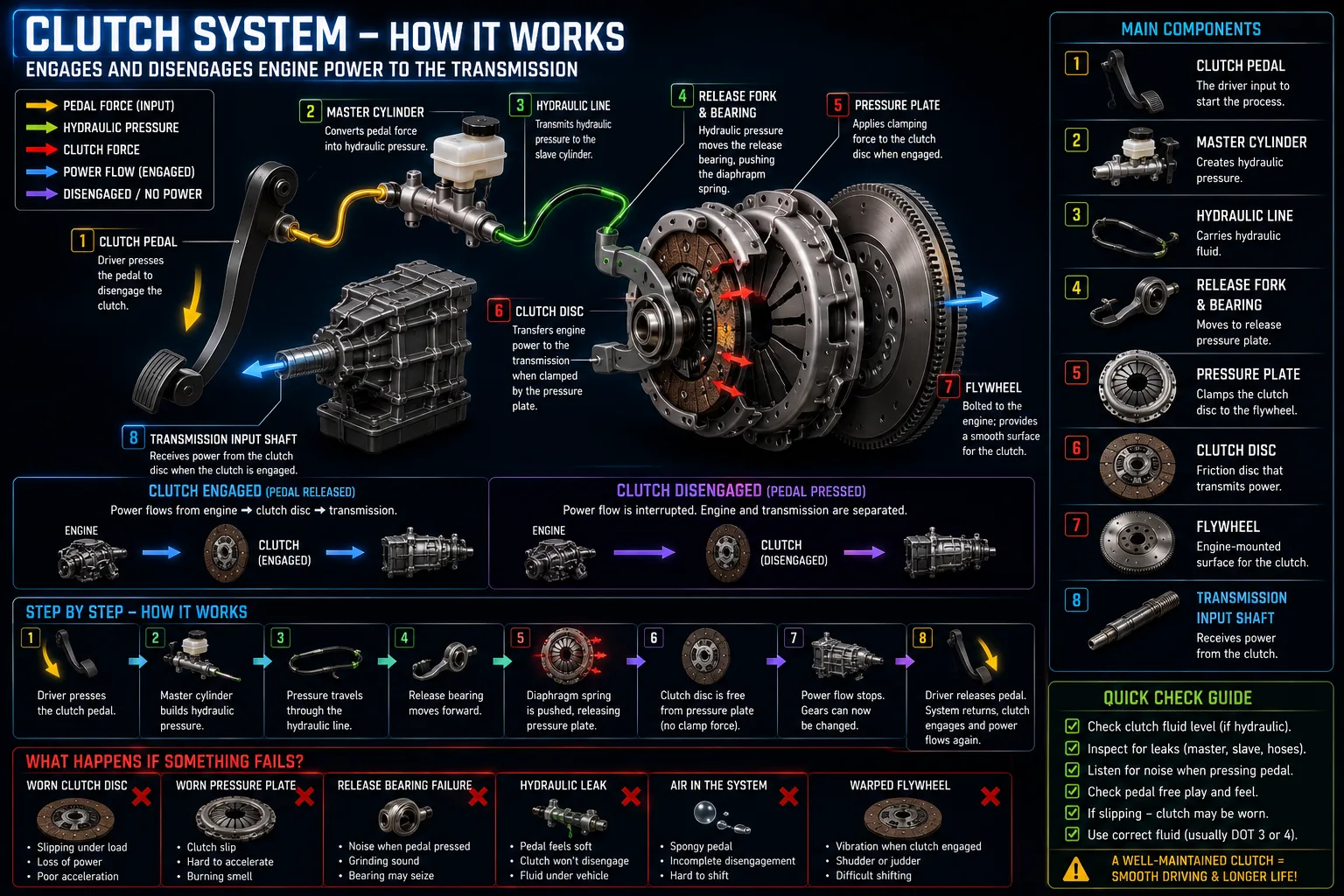
A clutch is a beautifully simple piece of kit doing a frankly exhausting job. Every time you move off, change gear, or sit in queuing traffic on the M25 contemplating your life choices, the clutch is working. Here is the mechanics of it, without the condescension. Your engine is always spinning. Your wheels, mercifully, are not always spinning. The clutch is what brokers peace between the two. At the heart of it sits a friction disc — a plate covered in hard-wearing material, sandwiched between the flywheel (bolted to the engine, spinning constantly) and the pressure plate (spring-loaded, clamping everything together). When you lift your foot off the clutch pedal, those springs force the friction disc hard against the flywheel and the drive is on: engine torque flows through to the gearbox and off you go. Press the pedal and the pressure plate releases its grip, the friction disc spins free, engine and gearbox are decoupled, and you can select whatever gear the situation demands without the car launching itself at the vehicle in front. The problem is the friction material on that disc has a finite number of engagements in it — like a very patient pub quiz host who, one day, simply will not take any more. As it wears down, the pressure plate has to clamp further and further inward to find the remaining material. From the driver's seat, that manifests as the biting point marching steadily toward your knee. Eventually, the plate runs out of road: it slips rather than grips, and the game is up. A clutch replacement means fitting a new friction disc, pressure plate, and release bearing as a kit — because if one is worn, the others are close behind and doing half the job is how you end up doing it twice. On many modern cars we also inspect (and sometimes replace) the dual-mass flywheel, which is a more complex beast that absorbs vibration from the drivetrain — and one that has a habit of developing its own expensive opinions once the clutch has gone.
“Now you're catching it with your knee practically level with the steering wheel and telling yourself it's fine.”
Sound familiar?
So what's behind it?
What we do — at your door
We come to your house, your workplace, a car park — wherever the car has chosen to finally stage its protest. No recovery truck, no courtesy car rigmarole, no sitting in a waiting room next to a man reading a three-year-old copy of Top Gear magazine. We carry a full clutch kit — friction disc, pressure plate, release bearing — and the tooling to do the job properly at your location. The gearbox comes out, the worn components come off, fresh parts go on, everything gets torqued and reassembled correctly. We inspect the flywheel while we have got access to it, because if it is scored, glazed, or exhibiting the hot spots that come from a slipping clutch, addressing it now costs considerably less than finding out later. Hydraulic clutch systems get the fluid checked and replaced if needed while the system is open. Cable systems get adjustment or replacement if the cable has stretched beyond useful service. We do not guess. We quote based on what your car actually needs, not a blanket number plucked from a website. Because a clutch job on a front-wheel-drive hatchback and a clutch job on a heavy four-wheel-drive with a dual-mass flywheel are not the same conversation.
What affects the price
A few things determine what your clutch replacement quote looks like, and being upfront about them is how we avoid unpleasant surprises on either side. The car itself is the biggest variable. A front-wheel-drive hatchback is relatively straightforward — the gearbox is accessible, the job is well-understood. A four-wheel-drive, a rear-wheel-drive, or anything with a particularly deep-buried drivetrain layout requires considerably more labour to get in and out. Some performance cars and vans have clutch kits that cost significantly more in parts alone. The flywheel question is the one that changes quotes the most. Solid flywheels can often be machined and reused if they are in decent condition; dual-mass flywheels, which are more complex and expensive components, may need replacing alongside the clutch if they have developed noise, play, or heat damage. We assess this on the car, not on assumption. Hydraulic versus cable clutch systems is another variable — hydraulic systems with worn or contaminated fluid, or failing slave cylinders, need additional work that a simple cable setup does not. Oil contamination changes things too: finding and repairing the leak that soaked the old clutch is a necessary step before fitting new components, otherwise history repeats itself at your expense. We will tell you what we find and what it means before we proceed. That is the job.
Random knowledge you didn't ask for
Questions you're probably asking
How long does a clutch replacement take?
For most common cars it is a three-to-five hour job. The gearbox has to come out to access the clutch assembly, which is where the bulk of the time goes. Some vehicles — particularly those with complex four-wheel-drive systems or awkward engine layouts — take longer. We will give you a realistic timeframe when we quote, not an optimistic one designed to sound appealing.
Can I keep driving with a high biting point?
Technically, yes — for a while. Practically, it is one of those situations where the longer you leave it, the worse the outcome. A slipping clutch generates heat that can score or warp the flywheel; if the flywheel goes, it joins the bill. Clutches also tend to fail suddenly once the friction material runs out, which is a much more disruptive event than booking a replacement on your own terms. Catch it before the cliff.
Do you always have to replace the flywheel at the same time?
Not always. Solid flywheels in good condition can be reused or, if lightly marked, machined back to spec. Dual-mass flywheels are more of a judgement call — they can last through multiple clutch replacements or they can fail alongside the clutch, and the only way to know is to inspect the vehicle. We assess it properly and tell you what we find, rather than automatically adding it to every quote or pretending it does not exist.
What is the difference between clutch slip and clutch drag?
Slip is when the clutch fails to grip fully — revs rise, the car does not accelerate to match, and you often get a burning smell. Drag is the opposite problem: the clutch fails to release fully when the pedal is depressed, so the car creeps with the clutch in or you cannot select gears cleanly. Different failures, different diagnoses, both firmly in the 'do not ignore this' category.
Clutch Replacement — sorted at your door
Stop procrastinating. Get a transparent quote and we'll come to you.