Clutch Master Cylinder Replacement: When Your Pedal Gives Up Before You Do
Your clutch pedal has one job. One. You press it, it disengages the clutch, you change gear, life continues in an orderly fashion. When the clutch master cylinder starts failing, that elegant simplicity collapses into an embarrassing farce — the pedal sinks slowly to the floor like a sulky teenager collapsing onto a sofa, gears refuse to select without a grinding protest, and you find yourself sitting at a roundabout doing a very convincing impression of someone who has never driven a manual car before. The clutch master cylinder is the hydraulic heart of your clutch system; when it goes, nothing downstream works properly. SOSCarFix cuts out the garage middleman entirely — we come to your driveway, car park, or roadside predicament, diagnose whether it's the master cylinder, slave cylinder, or just air in the system, and sort it on the spot while you get on with your day.
See our upfront pricingSpongy clutch pedal, floor-diver, gear-selection drama? Clutch master or slave cylinder failing. SOSCarFix comes to you, fixes it, no garage required. Get a quote.
How it actually works
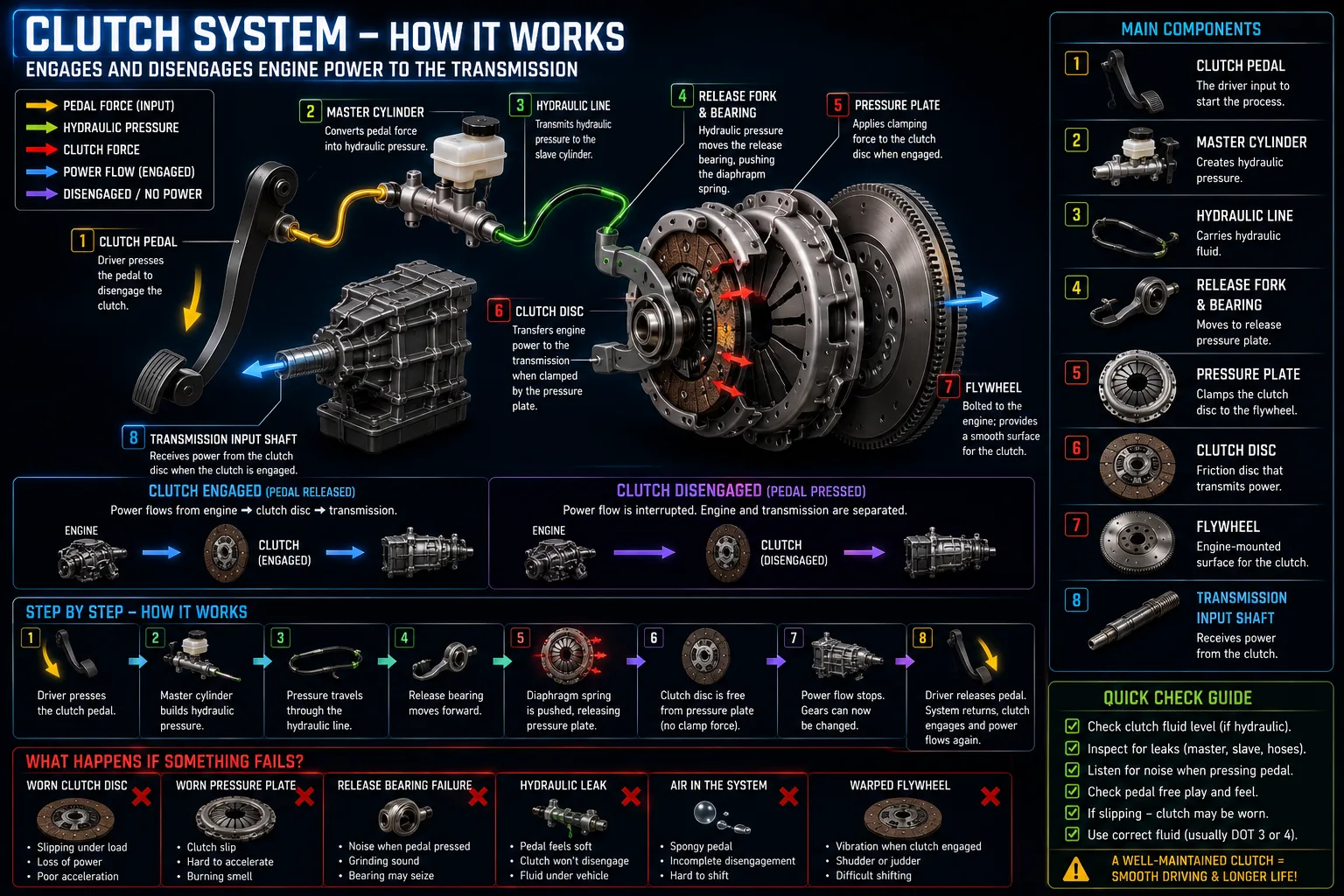
The hydraulic clutch system works on the same principle as your brakes — fluid under pressure transmitting force. When you press the clutch pedal, the clutch master cylinder (mounted near the bulkhead, inside the engine bay) converts that mechanical pedal effort into hydraulic pressure, sending pressurised fluid through a pipe to the clutch slave cylinder. The slave cylinder then either pushes on a fork or acts directly on the clutch release bearing (if it's a concentric slave cylinder buried inside the bellhousing) to disengage the clutch plate from the flywheel. That's the theory. The practice, when seals start weeping or the bore wears unevenly, is a hydraulic system that can no longer hold or transmit pressure properly. Replacing a clutch master cylinder means draining the hydraulic fluid, unbolting the old unit from the bulkhead (and disconnecting the pushrod from the pedal), fitting the new master cylinder, reconnecting the hydraulic line, refilling with the correct clutch fluid (usually DOT 4, though always confirm for your specific vehicle), and bleeding the system to remove every last bubble of air. Air in a hydraulic clutch line is the enemy — even a small pocket of compressible air will give you a spongy, unpredictable pedal. The slave cylinder is often replaced at the same time, particularly the concentric type, because if one seal is failing the other usually isn't far behind, and the labour is already on the clock.
“The clutch master cylinder is the hydraulic heart of your clutch system; when it goes, nothing downstream works properly.”
Sound familiar?
So what's behind it?
What we do — at your door
Rather than tow your car to a garage where it will sit in a queue for two days while someone's apprentice gets around to it, SOSCarFix sends a qualified mobile mechanic directly to wherever your car happens to be. We carry the diagnostic kit to confirm it's actually the master or slave cylinder at fault rather than something simpler, and we carry the parts or source them rapidly so we're not making you wait on a courier. We drain the hydraulic fluid properly, fit a quality replacement cylinder, reconnect everything, refill with fresh DOT 4 (or whatever your vehicle specifies), and bleed the system until the pedal is firm and the bite point is exactly where it should be — not somewhere around your ankle. If the concentric slave cylinder is also looking sus or we find evidence of fluid contamination on the clutch plate itself, we'll tell you honestly what that means for your budget rather than surprising you with a bigger bill at the end. No garage visit, no waiting room, no mysterious additional charges that materialise at collection time.
What affects the price
What you'll pay for a clutch master cylinder replacement in the UK depends on a handful of genuinely variable factors rather than a figure we've plucked from the air. The part itself ranges considerably — a clutch master cylinder for a common Ford or Vauxhall is substantially cheaper than an equivalent for a BMW or Mercedes, where German engineering pride is baked into the part price. Labour time varies too: on some cars the master cylinder is a thirty-minute job once you're set up; on others it's tucked behind a bulkhead bracket that requires half the engine bay to move first. If the slave cylinder is also being replaced (often wise, particularly on concentric units that require gearbox removal to access), that adds both parts and time to the bill. Fresh hydraulic fluid and a proper bleed are included in any decent quote — if someone's quoting you a master cylinder job without mentioning fluid replacement, ask why. The type of fluid your car needs can also vary slightly in cost. Get a quote from us with your registration number and we'll give you a straight answer rather than a range so broad it's functionally useless.
Random knowledge you didn't ask for
Questions you're probably asking
Can I drive with a spongy or sinking clutch pedal?
For a very short distance in an emergency, possibly — but it's genuinely dangerous and gets worse fast. A sinking pedal means you may not be able to fully disengage the clutch, which makes gear changes unreliable, particularly for reverse and first. On a concentric slave that's weeping fluid internally, continued driving can contaminate the clutch plate itself, turning what was a cylinder job into a full clutch replacement. The sensible answer is: don't.
Is it the master cylinder or the slave cylinder that's failed on my car?
Sometimes it's one, sometimes the other, occasionally both. A master cylinder failure often shows as fluid leaking inside the car near the pedal box, or a gradual pressure loss in the system. A slave cylinder failure (particularly concentric units) may show no external leak at all until it's quite far gone. Proper diagnosis — pressure testing and inspection — is needed rather than guessing, which is why we assess before we just start fitting parts.
How long does a clutch master cylinder replacement take?
On a straightforward application with accessible components, typically one to two hours including bleeding the system properly. If the slave cylinder is also being replaced and it's an external type (fork-actuated), add another hour or so. A concentric slave is a bigger job because the gearbox has to come out — that's a half-day minimum. We'll give you an honest time estimate when you book, not an optimistic one designed to get you to commit.
Why does my clutch pedal feel fine when cold but gets worse as the engine warms up?
Classic symptom of a seal that's right on the edge — heat causes the hydraulic fluid to expand and internal seals that are borderline can cope at cold temperatures but fail to hold pressure once everything's warmed through. It's the system's way of giving you a small preview of the total failure that's coming shortly. The cylinder needs replacing; the warm-up reprieve is not a cure.
Can you just bleed the clutch system rather than replacing anything?
If air has entered the system due to a loose bleed nipple or during a previous job, bleeding alone might fix a spongy pedal and be entirely legitimate. But if the air keeps returning — or if there's any sign of fluid loss — bleeding is treating the symptom while ignoring the cause. We won't charge you for bleeding if bleeding isn't the actual fix; we'll tell you what is.
Clutch Master Cylinder Replacement — sorted at your door
Stop procrastinating. Get a transparent quote and we'll come to you.