Clutch Judder When Pulling Away: Why Your Car Thinks It's a Mechanical Bull
You ease up the clutch, give it a bit of throttle, and instead of gliding smoothly into motion your car shakes like it's been personally offended. That rhythmic shudder — sometimes violent enough to rattle the mirrors — is clutch judder, and it is emphatically not your driving technique. Well. Probably not. Clutch judder happens when the clutch disc is intermittently gripping and releasing instead of engaging smoothly, and there are several reasons it does that, ranging from a slow oil leak quietly ruining your clutch to a dual-mass flywheel that has quietly given up the ghost. The good news: it is diagnosable, it is fixable, and SOSCarFix can do it on your driveway without the rigmarole of booking a garage, arranging a courtesy car, and waiting three days to find out what they've decided you need.
See our upfront pricingCar shuddering like a nervous horse every time you pull away? Clutch judder is diagnosable. SOSCarFix comes to you — get a quote.
How it actually works
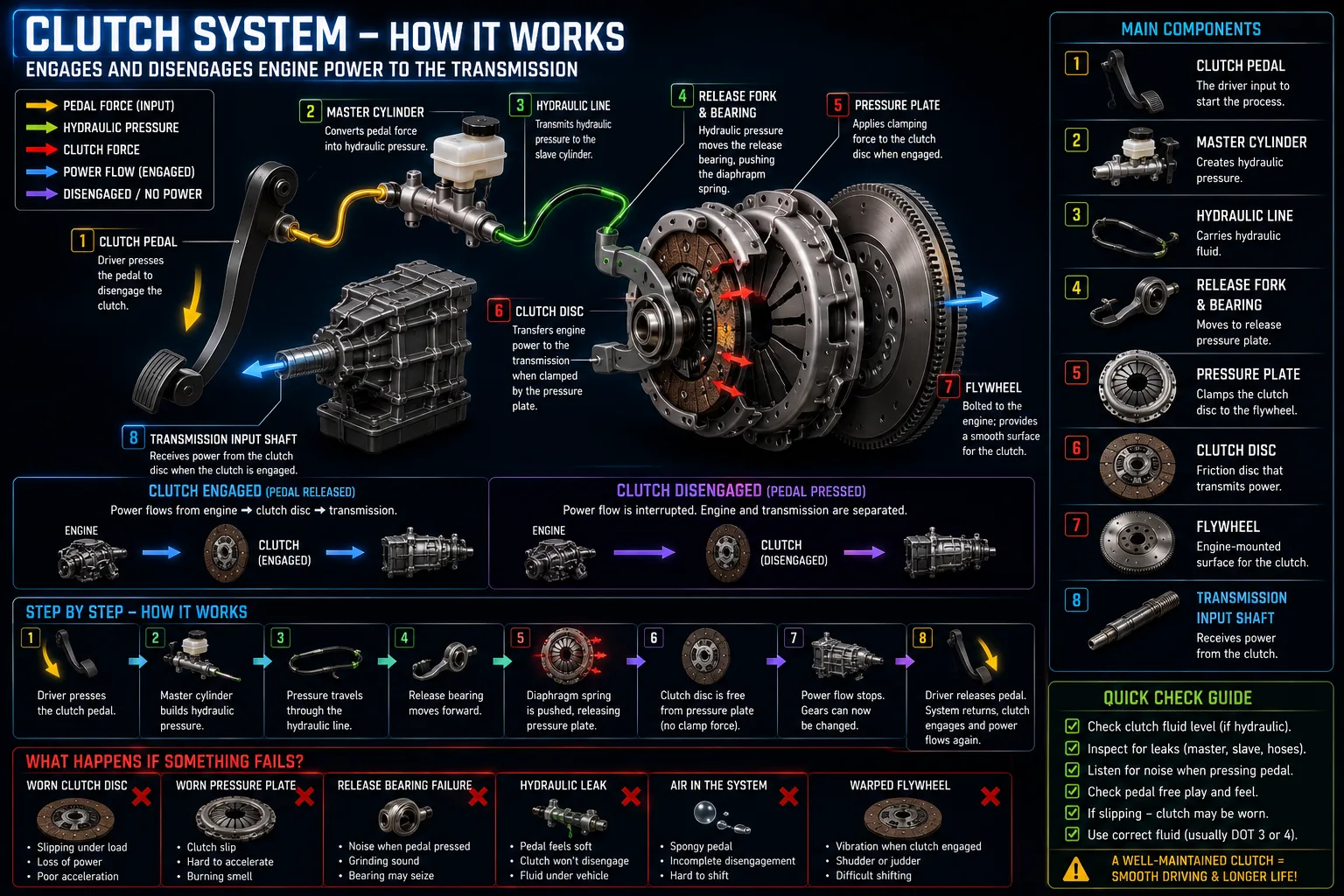
The clutch lives between your engine and gearbox — its entire job is to briefly disconnect the two so you can change gear or pull away without grinding the drivetrain to powder. It has three main components that work together: the clutch disc (covered in friction material, sandwiched between the flywheel and pressure plate), the pressure plate (which clamps everything together using spring pressure), and the flywheel (bolted to the crankshaft, spinning with the engine). When you lift the clutch pedal, the springs in the pressure plate clamp the friction disc against the flywheel, and drive is transmitted. In a healthy clutch this engagement is smooth and progressive. Judder occurs when that engagement is uneven — the clutch grabs, releases slightly, grabs again, several times a second. It is most noticeable at low speed when pulling away because that is when the clutch is only partially engaged; at higher road speeds it usually disappears. The fix depends entirely on the cause. A glazed clutch disc may sometimes be temporarily coaxed back to life; a contaminated or worn one cannot. A dual-mass flywheel (DMF) — the two-piece flywheel used on most modern cars to absorb vibration — cannot be resurfaced; when it fails it gets replaced. Engine or gearbox mounts that have collapsed let the drivetrain rock around enough to introduce judder without the clutch itself being at fault at all.
Sound familiar?
So what's behind it?
What we do — at your door
We come to you — home, work, wherever the car is sitting misbehaving — and the first thing we do before quoting you a penny is diagnose it properly. We'll rock the engine with the brakes on to check mount condition, inspect underneath for oil leaks around the rear of the engine and bellhousing, and if the car is safe to move we'll perform clutch engagement tests to feel the character of the judder ourselves. On modern cars with CAN bus access we'll pull live data to check for any drivetrain-related fault codes that might point toward mounts or ancillaries. Only once we know whether you're looking at a contaminated clutch, a tired DMF, failed mounts, or a combination, do we give you a clear itemised quote. If mounts are the cause, that's a far cheaper job than a full clutch replacement — and we'll tell you that honestly rather than selling you a clutch you don't need. If it is the clutch, we carry out the full replacement on-site: clutch kit (disc, pressure plate, release bearing), DMF if needed, and we inspect and address any oil leaks before fitting new parts so you're not back here in 10,000 miles doing it again.
What affects the price
Clutch judder costs vary enormously based on what's actually causing it, which is exactly why diagnosing first matters. Engine or gearbox mounts are the cheap win — typically a fraction of a clutch job, and often overlooked. If it is the clutch, the big variable is the flywheel: cars with a dual-mass flywheel (DMF) require a new DMF alongside the clutch kit, and DMFs for some German or French cars can cost more than the entire clutch kit on a simpler vehicle. Labour is substantial regardless because getting to the clutch means separating the gearbox from the engine — on some front-wheel-drive cars that's a relatively contained job; on others it's an all-day operation. Any oil leaks must be addressed at the same time (rear crankshaft seal, gearbox input seal) because fitting a clean clutch over an active oil leak just buys you a contaminated clutch again at considerable extra cost. Parts quality matters too: budget friction kits can glaze and judder within 20,000 miles; OEM-equivalent or branded kits (LuK, Sachs, Valeo) are the default for a reason.
Random knowledge you didn't ask for
Questions you're probably asking
Can I keep driving with clutch judder?
For a short while, possibly — it depends on severity and cause. Light judder from early DMF wear is more an irritant than an immediate danger. But if the judder is caused by oil contamination, the clutch is deteriorating every time you use it, and it can fail to disengage cleanly, making gear changes unpredictable. Driving with collapsed engine mounts risks the engine moving far enough to damage hoses, wiring or the driveshafts. Get it diagnosed sooner rather than later.
Is clutch judder always the clutch's fault?
No, and this is the important bit. Engine mounts and gearbox mounts that have collapsed let the entire drivetrain rock when the clutch engages, producing judder that feels identical to a worn clutch. A proper diagnosis — rocking the engine, checking for leaks, feeling the engagement — separates the two. Fitting a new clutch when the actual fault is a £80 mount is an expensive mistake we'd rather you didn't make.
My car only judders when the engine is cold. Is that a clue?
It is, and it's a fairly strong pointer toward the dual-mass flywheel. DMFs use grease-packed internal springs and dampers that stiffen when cold and loosen as everything warms up — so a failing DMF often judders noticeably from a cold start and eases (though rarely disappears) once at operating temperature. If you're also hearing a rattle when you dip the clutch on a cold morning, that clinches it.
Do I need to replace the flywheel when I replace the clutch?
On cars with a dual-mass flywheel, almost always yes if the DMF is showing any wear — fitting a new clutch kit against a dying DMF wastes the labour. On cars with a single-mass (solid) flywheel, the flywheel should be inspected and ideally skimmed flat; if it's too thin to skim or heavily scored, it gets replaced. We check it and tell you; we don't replace it 'just in case' to inflate the bill.
Can you fix clutch judder at my home or workplace?
Yes — that's exactly what we do. We need reasonable flat ground and access to both sides of the car. A clutch replacement is a substantial job, so we'll confirm the time needed when we quote, but there's no reason it can't be done on a driveway. We come with our own tools, ramps and parts — you supply the kettle.
Clutch Judder When Pulling Away — sorted at your door
Stop procrastinating. Get a transparent quote and we'll come to you.