Slipping Clutch: All That Revving and Going Absolutely Nowhere
You put your foot down. The engine obliges — it screams, it strains, it sounds absolutely committed to the cause. The car, however, has other plans. You're doing 40mph in spirit and 28mph in reality, accompanied by a smell that can only be described as toast that's deeply reconsidered its life choices. Welcome to the slipping clutch: where the engine works overtime and the wheels barely get the memo. It's one of the more demoralising faults a manual car can develop, and it only gets worse the longer you ignore it. The good news? We're mobile mechanics. We come to you, fix the clutch, and leave before your neighbours have finished staring.
See our upfront pricingYour revs are screaming, your speed isn't. That burnt-toast smell confirms it: your clutch is slipping. SOSCarFix mobile mechanics fix it at your door, across the UK.
How it actually works
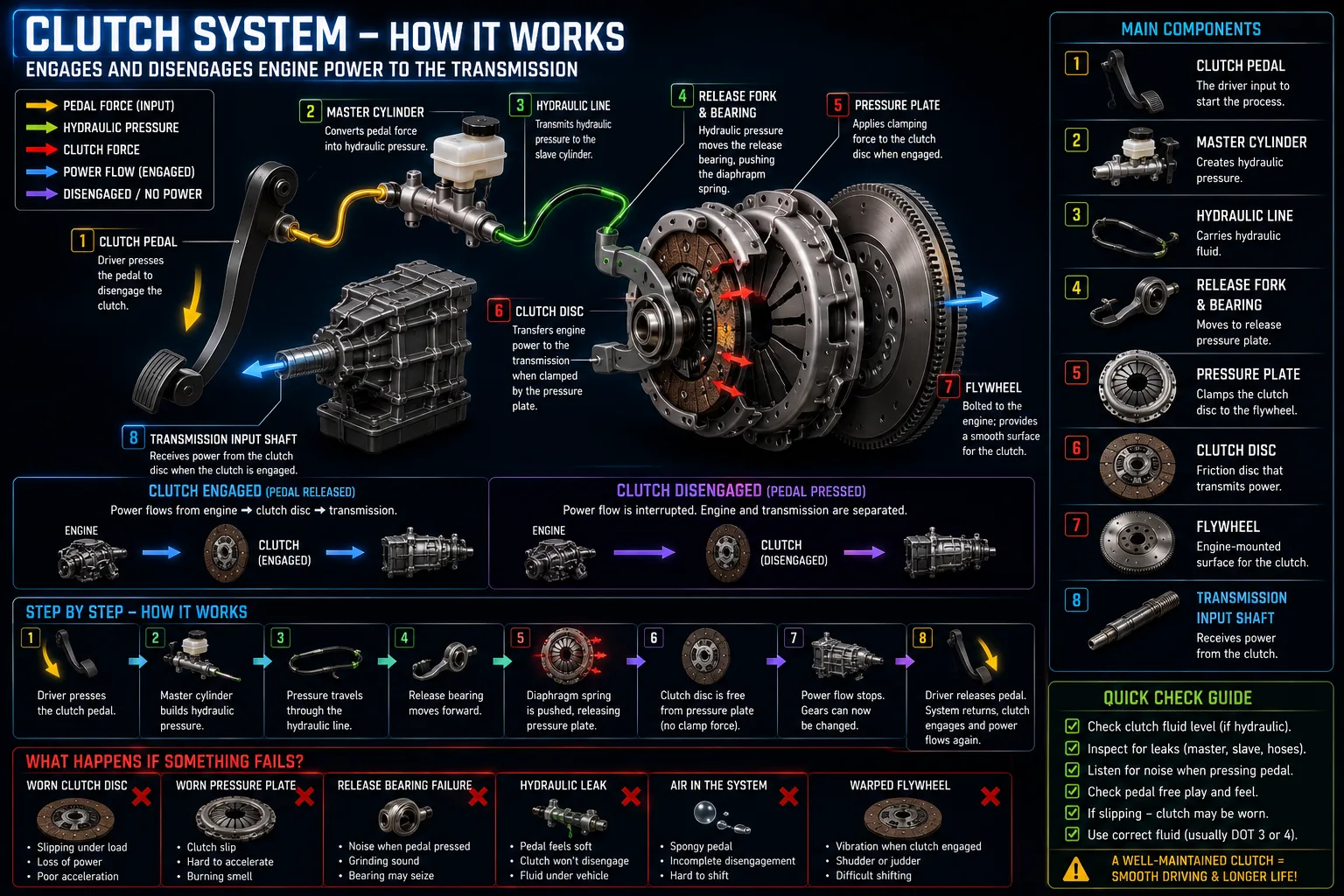
Your clutch is the diplomat between your engine and your gearbox — without it, every gear change would be a grinding act of violence. At the heart of it sits a friction disc, clamped between a pressure plate and the flywheel. When you're driving, those three are locked together, spinning as one, transmitting engine torque straight to the wheels. Press the pedal and you release the clamp, disconnect the engine, and change gear in peace. The problem with friction discs is in the name: they work by friction, which means they wear. When the friction material thins out enough — or gets contaminated with oil, or the pressure plate springs weaken — the disc starts to slip against the flywheel instead of gripping it. The engine revs climb dutifully as if something is happening. The car accelerates as if it is entirely unconvinced. The heat generated by all that slipping has to go somewhere, and it goes into the air around you as that unmistakable acrid, scorched smell. The more it slips, the more it wears, the more it slips. It is, in mechanical terms, a situation that does not resolve itself.
“It's one of the more demoralising faults a manual car can develop, and it only gets worse the longer you ignore it.”
Sound familiar?
So what's behind it?
What we do — at your door
When you call us out for a slipping clutch, we start with a proper diagnosis before we start unbolting things — confirming it is indeed the clutch rather than a gearbox or driveline issue wearing a clutch-shaped disguise. Once confirmed, clutch replacement means dropping the gearbox to access the clutch assembly. We replace the friction disc, pressure plate, and release bearing as a set — because if one has had a hard life, the others were right there alongside it. The flywheel gets inspected and resurfaced or replaced if it has been overheated and scored. Everything is torqued to specification, the biting point is set correctly, and we test it properly before calling it done. All of this happens on your driveway, in your street, or wherever the car gave up on you. We bring the tools, the parts, and the competence. You supply the parking space and optionally a cup of tea.
What affects the price
Clutch jobs vary considerably in cost, and the main reasons come down to three things. First, the car itself — accessing the clutch on a front-wheel-drive hatchback is a very different afternoon to the same job on an all-wheel-drive estate or a vehicle with an engine that appears to have been installed by someone who hates mechanics. Some gearboxes practically fall out; others require half the front end to come with them. Second, parts quality — there is a spectrum between budget friction material and OEM-spec components, and that spectrum directly affects how long the replacement lasts. We will always tell you what the options are. Third, condition of related components — if the flywheel is scored or the release bearing is obviously on its way out, replacing those at the same time is significantly cheaper than doing the job twice. We give bespoke quotes once we know what car you have, and we do not add drama to the price.
Random knowledge you didn't ask for
Questions you're probably asking
Can I keep driving with a slipping clutch?
For a very short time, probably. For any meaningful distance, we would not recommend it. A slipping clutch worsens progressively — each slip generates heat, heat accelerates wear, wear increases slip. What starts as occasional hesitation on hills tends to become a car that cannot climb a multi-storey car park ramp. More importantly, if it goes completely, you lose drive. That is a breakdown waiting to name its moment, and it will pick a good one.
How do I know it is definitely the clutch and not something else?
The classic test: find a quiet road, engage third gear at low speed, and gently accelerate. If the revs rise while the speed does not keep up, the clutch is slipping. The burnt smell under load is also fairly conclusive. That said, some gearbox and driveline faults can behave similarly, which is why we diagnose before we start dismantling things.
How long does a clutch replacement take?
On most common cars, a clutch replacement is a solid half-day job — typically three to five hours depending on the vehicle and what we find once we are in there. We carry common parts and aim to complete the job in a single visit, though for less common vehicles we may need to confirm parts availability first.
Does the flywheel always need replacing too?
Not always, but often it needs at minimum a proper inspection. A clutch that has been slipping generates significant heat at the flywheel surface. If it is scored, blued from overheating, or has developed hard spots, resurfacing or replacement is the right call — fitting a new friction disc against a damaged flywheel is a reliable way to be doing this job again much sooner than you would like.
Slipping Clutch — sorted at your door
Stop procrastinating. Get a transparent quote and we'll come to you.