DPF Pressure Sensor Fault: When Your Car Panics About a Filter That's Probably Fine
Your diesel's DPF pressure sensor has one job: tell the ECU how clogged the particulate filter is, so it knows when to burn off the soot and when to leave well alone. It's not glamorous. It's not expensive. It's a small sensor connected to two thin pipes either side of the DPF — and when it fails, your car immediately loses all sense of proportion. It convinces itself the filter is either completely blocked or perpetually clean, launches into regenerations at entirely the wrong moment, shoves itself into limp mode, and illuminates the engine management light with the self-righteous confidence of someone who is absolutely certain they're right and absolutely isn't. Meanwhile, your actual DPF may be perfectly healthy. The sensor's just lying. We diagnose the real picture with live data — no guessing, no throwing a new DPF at a sensor problem.
See our upfront pricingDPF pressure sensor fault? Limp mode, false blocked-DPF warnings and bungled regens — all from one tiny sensor. Mobile diagnosis and replacement. Get a quote.
How it actually works
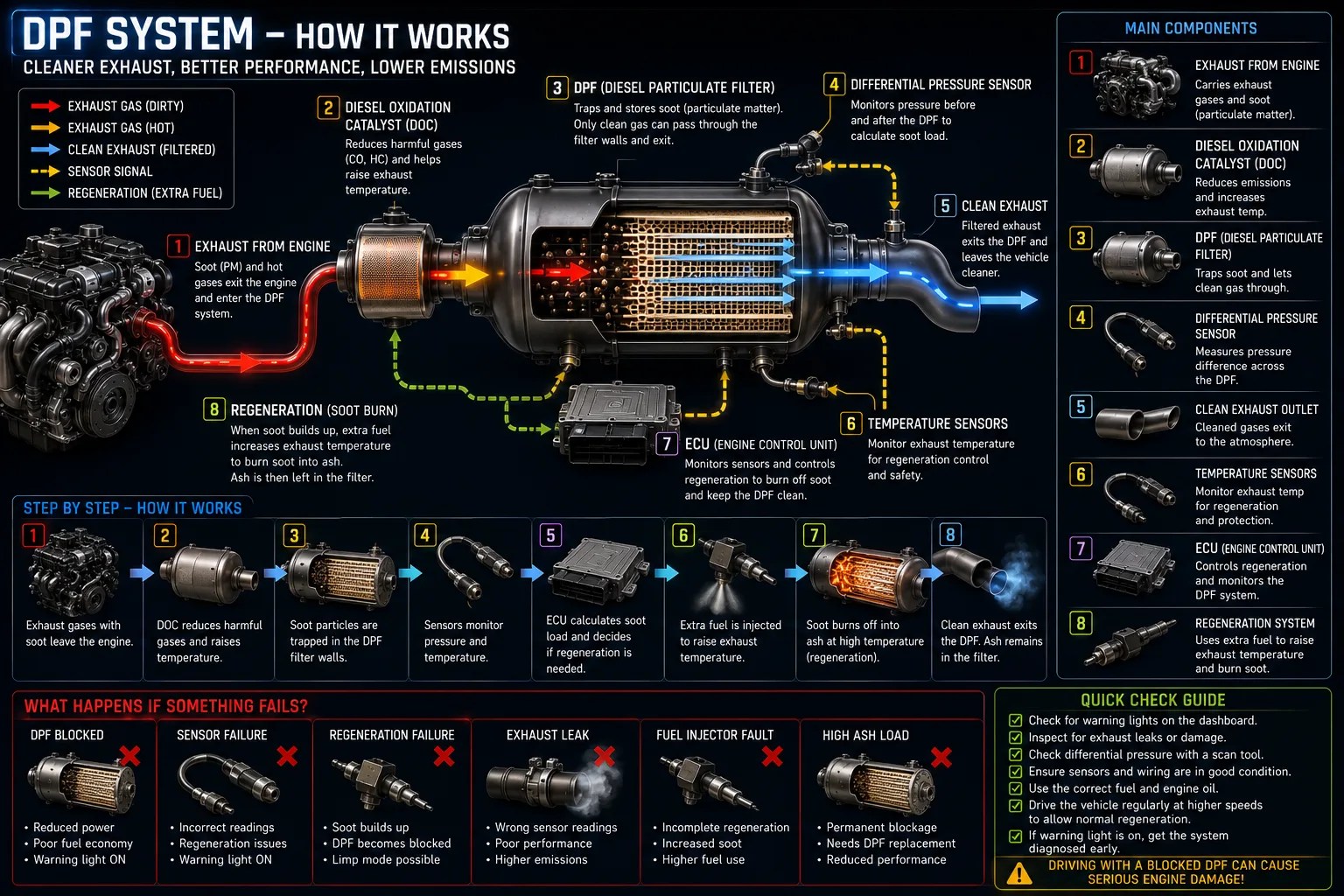
The diesel particulate filter is a ceramic honeycomb trap in your exhaust that catches soot particles before they escape into the atmosphere. Over time it fills up, and the ECU has to decide when to initiate a regeneration — essentially baking the soot away at high exhaust temperatures, usually during a motorway run. To make that decision intelligently, it needs to know the pressure drop across the filter: a clean DPF passes exhaust gas with minimal resistance; a clogged one creates a measurable back-pressure difference. That's what the differential pressure sensor measures. It has two pressure ports — one upstream (before the DPF) and one downstream (after) — connected by thin hoses to the sensor body, which converts the pressure difference into a voltage signal the ECU reads continuously. Low differential pressure means the filter is clear; rising pressure means soot is accumulating; high pressure means regeneration is needed. The ECU uses this signal alongside exhaust temperature readings, engine load and vehicle speed to calculate the actual soot load and time regenerations correctly. Lose the sensor signal — through a dead sensor, blocked sample pipes or a split hose — and the ECU is essentially flying blind. It'll either regenerate constantly (wasting fuel and cooking the filter), refuse to regenerate at all (genuinely blocking the DPF), or flag a fault and drop the car into limp mode until a human with a scan tool sorts it out.
“We diagnose the real picture with live data — no guessing, no throwing a new DPF at a sensor problem.”
Sound familiar?
So what's behind it?
What we do — at your door
We come to you — driveway, car park, office, or the layby where it just went into limp mode — and start with a proper diagnostic scan across all modules, not a quick code-read that points at the DPF and calls it a day. We pull the live data from the pressure sensor in real time: we can see what differential pressure it's actually reporting versus what the ECU expects given current engine conditions, exhaust temperatures, and calculated soot load. That live-data picture tells us immediately whether the sensor is lying, whether the sample pipes are blocked or split, or whether the DPF itself is genuinely in trouble. We physically inspect the sensor and both hoses — they're often the overlooked culprit and a fraction of the cost. If the sensor needs replacing, we fit a quality replacement, clear the fault codes, and verify the ECU is reading correctly before we pack up. No parts cannon, no assumptions, no recommending a £1,500 DPF replacement when the actual fault is a £90 sensor and a pair of clear hoses.
What affects the price
Several things affect what you'll spend on a DPF pressure sensor job in the UK, and it's worth understanding them before anyone quotes you. The sensor itself varies considerably by make and model — a sensor for a common Ford Transit or Volkswagen Passat diesel sits in a different price bracket to one for a BMW or Mercedes with a more complex DPF system. Labour is generally modest because the sensor is usually accessible without removing half the exhaust, though some manufacturer packaging is creative enough to test that optimism. The sample hoses are inexpensive but labour-intensive to clear or replace properly, especially if they've melted onto the DPF ports. On top of the sensor job, if a diagnostic scan reveals the DPF genuinely is blocked beyond regeneration — not just misreported — that's a separate conversation involving professional DPF cleaning or, in worst cases, replacement. That's why getting an accurate diagnosis first is not optional: confusing a sensor fault for a DPF fault, or a DPF fault for a sensor fault, is how people end up spending serious money solving the wrong problem.
Random knowledge you didn't ask for
Questions you're probably asking
My scan tool says 'DPF blocked' — does that mean I need a new DPF?
Not necessarily, no. A 'DPF blocked' code is the ECU reporting what the pressure sensor told it. If the sensor is faulty, reading falsely high, or the sample hoses are blocked, you get exactly that code with a perfectly healthy DPF behind it. Proper diagnosis with live data — watching what the sensor actually reports against real engine conditions — is the only way to tell the difference between a lying sensor and a genuinely blocked filter. Don't spend DPF money until you've confirmed that.
Can I drive in limp mode with a DPF pressure sensor fault?
You can, in the way that you can also walk to work in the rain. Limp mode exists to protect the engine and emissions system from damage — it limits power and usually caps revs around 3,000 RPM. Short, careful trips to get the car sorted are generally tolerable, but extended motorway driving in limp mode isn't recommended, and ignoring a genuine DPF fault long enough can turn a sensor job into an actual DPF replacement. Sort it promptly.
The sample hoses were cleared before but the fault came back — why?
Blocked sample hoses tend to be a symptom of a DPF that's running slightly too rich or seeing excessive soot for the driving cycle. Clear the hoses, the sensor works, the fault goes. But if the underlying cause — too many short journeys preventing proper regeneration, an EGR issue, a fuelling fault — isn't addressed, the hoses block again. We look at the whole picture rather than just clearing and sending you on your way.
Is the DPF pressure sensor the same as the DPF temperature sensor?
No — they do completely different things. The pressure sensor measures soot load via differential pressure across the filter. Temperature sensors (there are usually two or more: pre and post DPF) monitor exhaust temperature to manage regeneration heat. Both can cause DPF-related fault codes and both are worth checking during diagnosis, but they're separate components with distinct failure modes. A scan tool showing live data from both tells you which one is the problem.
My DPF was replaced six months ago but the pressure sensor light is back — is the new DPF faulty?
Probably not. A new DPF fitted without replacing or checking the pressure sensor and sample hoses inherits the old sensor — which may have been marginal before and is now failing properly. It's a very common sequence: DPF replaced, car fine for a few months, then the sensor that should have been checked at the same time decides to give up. Diagnosis usually shows a straightforward sensor fault with a healthy (and expensive) new filter behind it.
DPF Pressure Sensor Fault — sorted at your door
Stop procrastinating. Get a transparent quote and we'll come to you.