Diesel Injectors: The Tiny Parts Costing You a Fortune in Fuel and Embarrassment
Diesel injectors are the precision instruments your engine absolutely depends on — and the ones most drivers never think about until the car sounds like a bag of spanners rolling downhill. Each injector fires at pressures somewhere north of 1,500 bar (that's roughly 22,000 psi for the metrically challenged), multiple times per combustion cycle, every time you drive anywhere. So when one starts to fail — dribbling fuel instead of atomising it, firing late, or not firing at all — your engine knows immediately. You'll know too, because your MPG will fall off a cliff, your exhaust will start generating its own weather system, and your idle will vibrate with the kind of righteous indignation usually reserved for someone who's been given the wrong order at a drive-through. SOSCarFix diagnoses and replaces diesel injectors at your door — no garage, no three-week wait, no "while we're in there" upselling. Just the job done properly, on your driveway.
See our upfront pricingKnocking, smoking, or misfiring diesel? Faulty injectors diagnosed and replaced at your door. No garage faff, no upsell theatre. Get a quote from SOSCarFix.
How it actually works
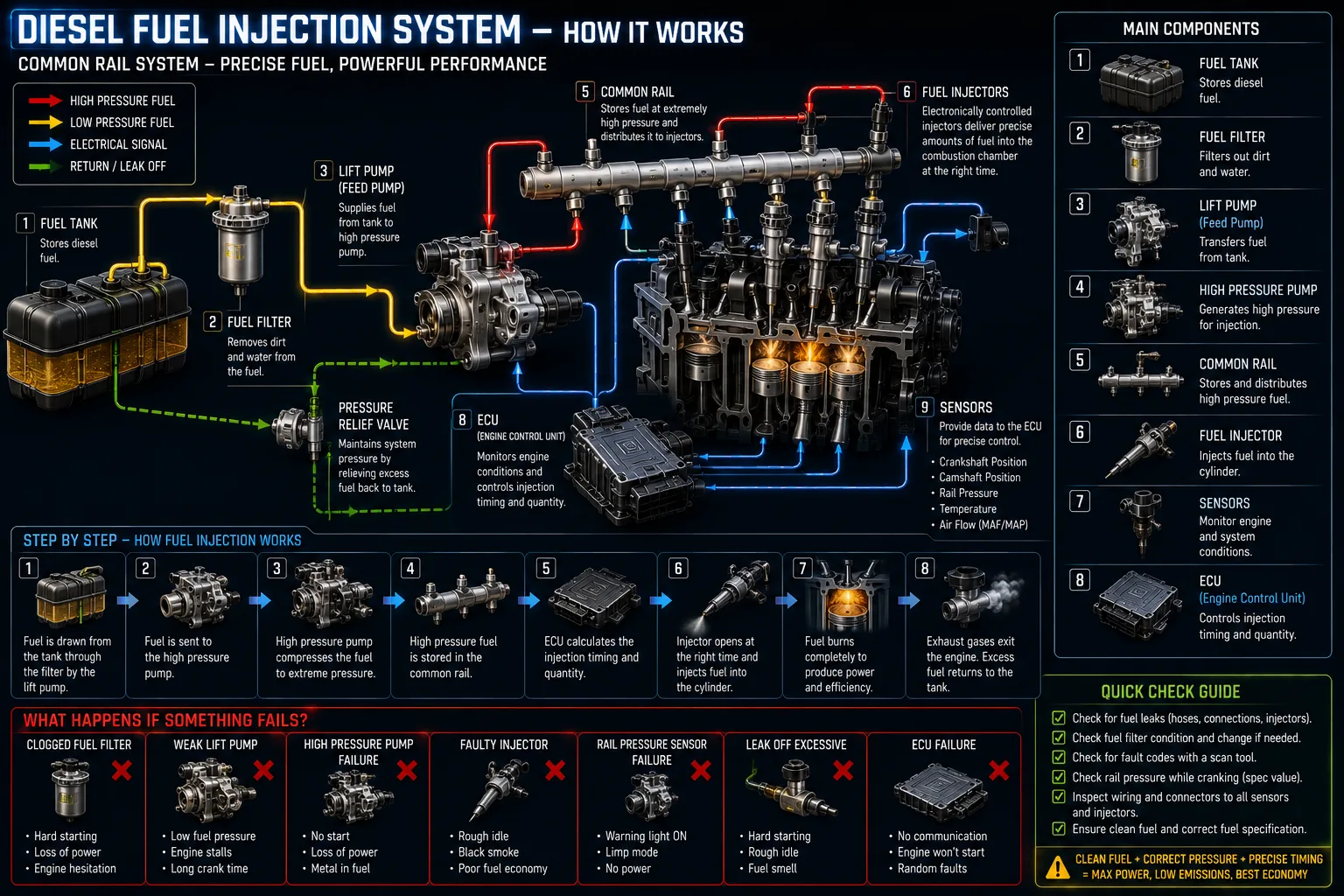
A modern diesel common-rail injector is a solenoid- or piezo-actuated needle valve that opens for a precisely calculated window — sometimes as brief as a millisecond — to spray atomised fuel directly into the combustion chamber. The ECU calculates exactly how long to hold the injector open based on engine load, rpm, temperature, and about forty other variables it finds more interesting than you do. When an injector wears, the spray pattern degrades, the needle seat leaks internally (allowing fuel to dribble into the cylinder rather than arrive as a fine mist), or the electrical control circuitry develops a fault. Any of those failures throws off the combustion event for that cylinder — producing unburnt fuel, misfires, incomplete combustion, or excessive black or white smoke depending on which way the failure goes. Diagnosing injectors properly requires more than plugging in a code reader and squinting at a freeze-frame. A leak-off test — measuring how much fuel each injector returns to the tank rather than using in combustion — identifies lazy or worn injectors before they become catastrophically failed ones. After replacement, most modern diesel ECUs require injector coding: a unique alphanumeric IMA (Injection Measuring Adjustment) code printed on each new injector has to be programmed in so the ECU knows exactly how to compensate for that individual injector's manufacturing tolerances. Skip the coding and you'll still run badly despite fitting brand-new parts. SOSCarFix brings the diagnostic equipment to handle all of that on your driveway.
“Just the job done properly, on your driveway.”
Sound familiar?
So what's behind it?
What we do — at your door
SOSCarFix comes to wherever your car happens to be sitting — your driveway, your workplace car park, a lay-by, or the forecourt of somewhere you've limped into on three cylinders and a prayer. We start with a proper diagnostic scan to pull fault codes and live injector data, then carry out a leak-off test if warranted, comparing return-flow volumes across all injectors to identify any that are underperforming or leaking internally. If replacement is the verdict, we fit the correct injectors for your engine — using OE-quality or OEM-equivalent parts depending on what the application calls for — torque them to spec with new copper seating washers, and then programme the injector IMA codes into your ECU using professional coding equipment. We clear faults, road-test (or run-up if you're parked somewhere awkward), and make sure the engine is running cleanly before we leave. No garage. No courtesy car nonsense. No three-day wait while it sits in a queue behind someone's annual service. Just the repair, on your ground, done right.
What affects the price
Diesel injector replacement is one of those jobs where the cost range is wide enough to be genuinely unhelpful if you just want a number, so here's an honest breakdown of what moves it. The number of injectors being replaced matters enormously — replacing all four (or six, if your engine has six cylinders and a sense of occasion) at once costs more in parts but can save on labour if the car is already stripped out. Injector type plays a huge role: older solenoid-type injectors are considerably cheaper than modern piezo injectors, which are precision components that can run to several hundred pounds each before fitting. Your vehicle make matters too — injectors for a common Ford or Vauxhall diesel are far easier and cheaper to source than those for a Land Rover, BMW, or anything with a French engine that seems to have been designed specifically to be difficult. Professional injector coding equipment time adds a modest but non-trivial amount to the total. What you won't pay for with SOSCarFix is a garage's overhead, a courtesy car levy baked into the labour rate, or the quiet "extras" that appear on some bills like magic.
Random knowledge you didn't ask for
Questions you're probably asking
How do I know if it's the injectors or something else causing my diesel to knock and misfire?
Honest answer: you need a proper diagnostic. Diesel knock and misfires can come from injectors, but also from glow plug failure, low compression in a worn cylinder, EGR issues, or a failing fuel pump. A leak-off test and live data scan will distinguish between them. Guessing and replacing injectors when the actual problem is a glow plug is an expensive lesson. We diagnose before we recommend, every time.
Can I just clean diesel injectors rather than replace them?
Sometimes, yes — ultrasonic cleaning and flow-bench testing of removed injectors is legitimate if the spray pattern has degraded due to deposits rather than mechanical wear. Some garages also offer in-situ fuel system cleaners, which have limited but real benefit for mild deposit build-up. If the injector needle seat is worn or the solenoid is failing electrically, no amount of cleaning rescues it. We'll tell you which situation you're in rather than recommend the more expensive option by default.
What's injector coding and do I really need it?
Yes, you really do — on any modern common-rail diesel that requires it. Each replacement injector has a unique alphanumeric IMA code that defines its precise flow characteristics. That code must be programmed into the ECU so it can calibrate fuelling for that specific injector. Without coding, the ECU is guessing. The engine will run — probably — but not cleanly or efficiently. Some older diesel applications don't require coding, but we check this as part of the job.
How long does mobile diesel injector replacement take?
For a four-cylinder engine with one or two injectors being replaced, typically two to four hours at your vehicle. A full set of injectors on a larger engine, or a job with complicating factors like seized injectors (a real and deeply unpleasant possibility on high-mileage engines), will take longer. We'll give you a realistic time estimate before we start rather than a wildly optimistic one that turns into an awkward conversation halfway through.
My diesel has high mileage — is it worth replacing the injectors or should I scrap it?
Depends heavily on the rest of the car and what the injectors actually cost for your application. On some common diesels, a set of injectors is a sensible investment on a high-mileage car that's otherwise sound. On others, the injector cost alone starts to approach the car's value. We'll give you an honest parts and labour estimate and let you make that call with the real numbers rather than nudging you toward the most profitable option for us.
Why is my diesel knocking or making a ticking noise?
That distinctive knock or tick — especially on a cold start that never quite settles — is classic diesel knock, and worn injectors are a leading suspect. Instead of atomising fuel into a fine mist at the right moment, a failing injector dribbles fuel early; it accumulates, then ignites all at once in a pressure spike rather than a controlled burn. The bang you hear is that spike. It can also be a glow plug issue or low compression, which is why a proper diagnostic — not a parts lottery — is the right first move.
Diesel Injectors — sorted at your door
Stop procrastinating. Get a transparent quote and we'll come to you.