Dashboard Warning Lights: What the Colours Actually Mean (and When to Panic)
Your dashboard just lit up like a fruit machine at closing time. Congratulations — your car is communicating with you. The question is whether it's a polite heads-up, a firm nudge, or a full-blown emergency. The colour system is actually quite sensible, borrowed from the highway code: red means stop, amber means think carefully, green and blue mean something is on. The problems start because manufacturers squeeze dozens of different symbols into those three (or four) colours, and the little pictogram glowing at you could mean anything from "your fog light is on" to "your engine is about to become a very expensive paperweight." This guide cuts through the hieroglyphics, tells you what each colour tier means, which symbols are genuinely urgent, and — when you need a proper diagnosis — how SOSCarFix comes to you with the right tools to find out exactly what's wrong.
See our upfront pricingRed, amber or green — your dashboard is trying to tell you something. Learn what warning light colours mean & when to act. SOSCarFix comes to you.
How it actually works
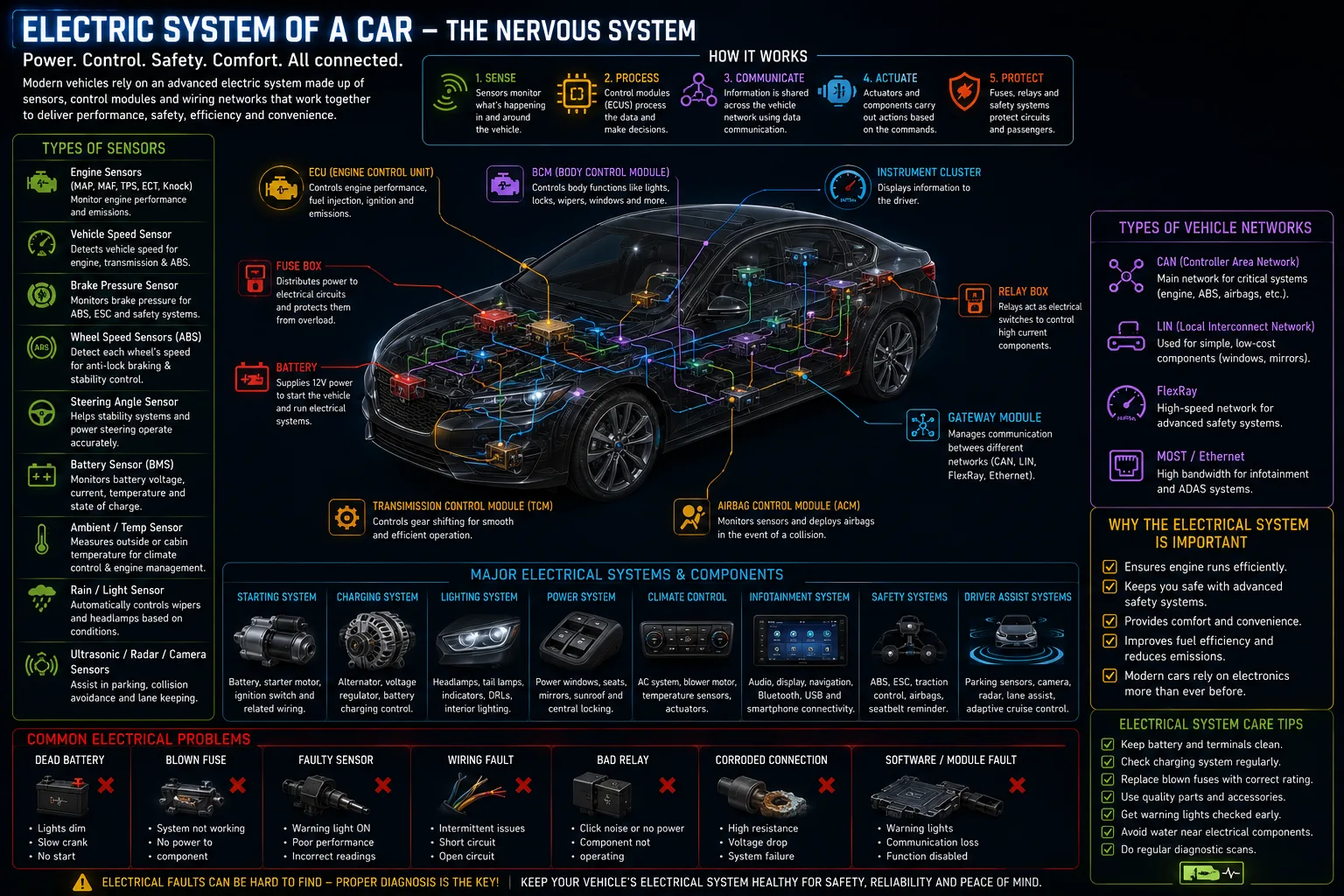
Your car is constantly talking to itself. Sensors all over the engine, brakes, transmission, steering, emissions system and body feed live data into a network of electronic control units (ECUs) running on something called the CAN bus. When any reading falls outside its expected range — coolant temperature too high, oil pressure too low, a wheel spinning faster than the others — the relevant ECU logs a Diagnostic Trouble Code (DTC) and illuminates a warning light on your instrument cluster. The colour hierarchy works like this: **Red** lights demand immediate attention — these signal conditions that can cause instant engine or safety damage if ignored. **Amber or orange** lights are the "see to this soon" category — something is wrong or wearing out, but you're not necessarily in danger right now. **Yellow** lights can sit in either camp depending on the symbol. **Green and blue** lights are purely informational — they confirm a system is active (high beam, fog light, cruise control, lane assist). They are not warnings; they are status updates. What the colour system cannot tell you is *why* the light is on. An amber engine management light could be a loose fuel cap, a failing oxygen sensor, a blocked DPF, or a misfire destroying your catalytic converter as you read this. That's where a proper diagnostic scan — reading the stored codes, live sensor data and freeze-frame — turns a vague dashboard alarm into a specific, actionable fault.
“The question is whether it's a polite heads-up, a firm nudge, or a full-blown emergency.”
Sound familiar?
So what's behind it?
What we do — at your door
We come to you — driveway, car park, or the layby where you've very wisely pulled over — with a professional-grade scan tool that reads codes across every module on the car, not just the engine. We pull the stored DTCs, check the live sensor data and the freeze-frame snapshot the ECU captured at the moment the fault triggered, and we compare all of that against known fault patterns before recommending a single penny of work. You get a plain-English explanation of what the light actually means for your specific car, which faults are urgent and which can wait, and a clear quote for any repair — not a printout of codes and a shrug. If the fault needs further physical testing (compression test, fuel pressure, wiring trace) we carry out the relevant checks on the spot. No garage drop-off, no waiting room, no upsell on work you don't need.
What affects the price
The diagnostic scan itself is a fixed call-out charge — that covers the full multi-module scan, code interpretation and a verbal report on what we found. Any repair work beyond that is quoted separately and clearly before we start. Cost factors for the underlying repair vary enormously by fault: a loose fuel cap costs nothing to fix, a failing DPF or a replacement ECU will be considerably more. Labour on a mobile visit is generally competitive with a main dealer (and often cheaper, with less faff), and we carry common parts. Where specialist parts are needed we quote a return visit. What you are not paying for here is a reel of diagnostic guesswork — buying parts on the strength of a code number alone, without testing, is how a £40 sensor replacement turns into a £400 misadventure.
Random knowledge you didn't ask for
Questions you're probably asking
Is it safe to drive with an amber warning light on?
Usually yes, for a short while — amber is the 'investigate soon' tier, not the 'pull over now' tier. The exception is a flashing engine light (active misfire) or an amber oil pressure or temperature light, which can sit at the more urgent end. If you're unsure which symbol it is or what it means for your car, get a diagnostic scan before doing lots more miles on it.
My engine light came on but the car feels completely normal — can I ignore it?
No, but you don't need to panic. Many engine management faults — failed oxygen sensors, EGR issues, loose fuel caps — produce no driveable symptom at all, yet can slowly damage other components (and will cause an MOT emissions failure). A steady engine light with no performance change is 'soon', not 'tomorrow'; a flashing one is 'now'.
I cleared the warning light myself — has the problem gone away?
Almost certainly not. Clearing the code turns the light off but leaves whatever caused it exactly where it was. If the fault is still present, the light comes back within a few drive cycles — and clearing it also erases the freeze-frame data that makes diagnosis faster and cheaper. Find the fault first, clear the light second.
Can a warning light cause an MOT failure?
Yes. Any illuminated MIL (engine management light) is an automatic MOT failure — the test specifically checks for it. ABS and brake warning lights also cause an automatic fail. Other lights may result in an advisory or failure depending on what system they relate to. Getting the fault properly diagnosed and fixed before your MOT is considerably cheaper than a retest.
Why does my car show a different warning light from what I see described online?
Manufacturers are not obliged to use identical symbols for every warning — while there is a set of standardised icons, some makers tweak the look or use their own for non-standard systems. Always cross-reference your owner's manual for the exact symbol, then get a diagnostic scan if you're unsure; the car's own fault codes will tell us which system triggered it regardless of what the icon looks like.
Dashboard Warning Lights — sorted at your door
Stop procrastinating. Get a transparent quote and we'll come to you.