Your Car Won't Start in Cold Weather: Winter Is Just a Battery Test With Ice on Top
Your car spent all summer pretending to be fine. The battery was borderline, the glow plugs were tired, and the starter motor had been phoning it in since roughly March. Nobody noticed, because summer is forgiving. Then November arrived, the temperature dropped to three degrees, and the car finally told the truth. Cold weather doesn't break cars — it exposes the ones that were already quietly failing. SOSCarFix comes to you, plugs in proper diagnostic equipment, battery-tests on site, and tells you exactly what gave up and why — before you've spent a penny on parts that weren't the problem.
See our upfront pricingCar dead on a cold morning? Weak battery, dodgy glow plugs or waxed diesel fuel — we come to you, diagnose it on the spot and get you moving. Get a quote.
How it actually works
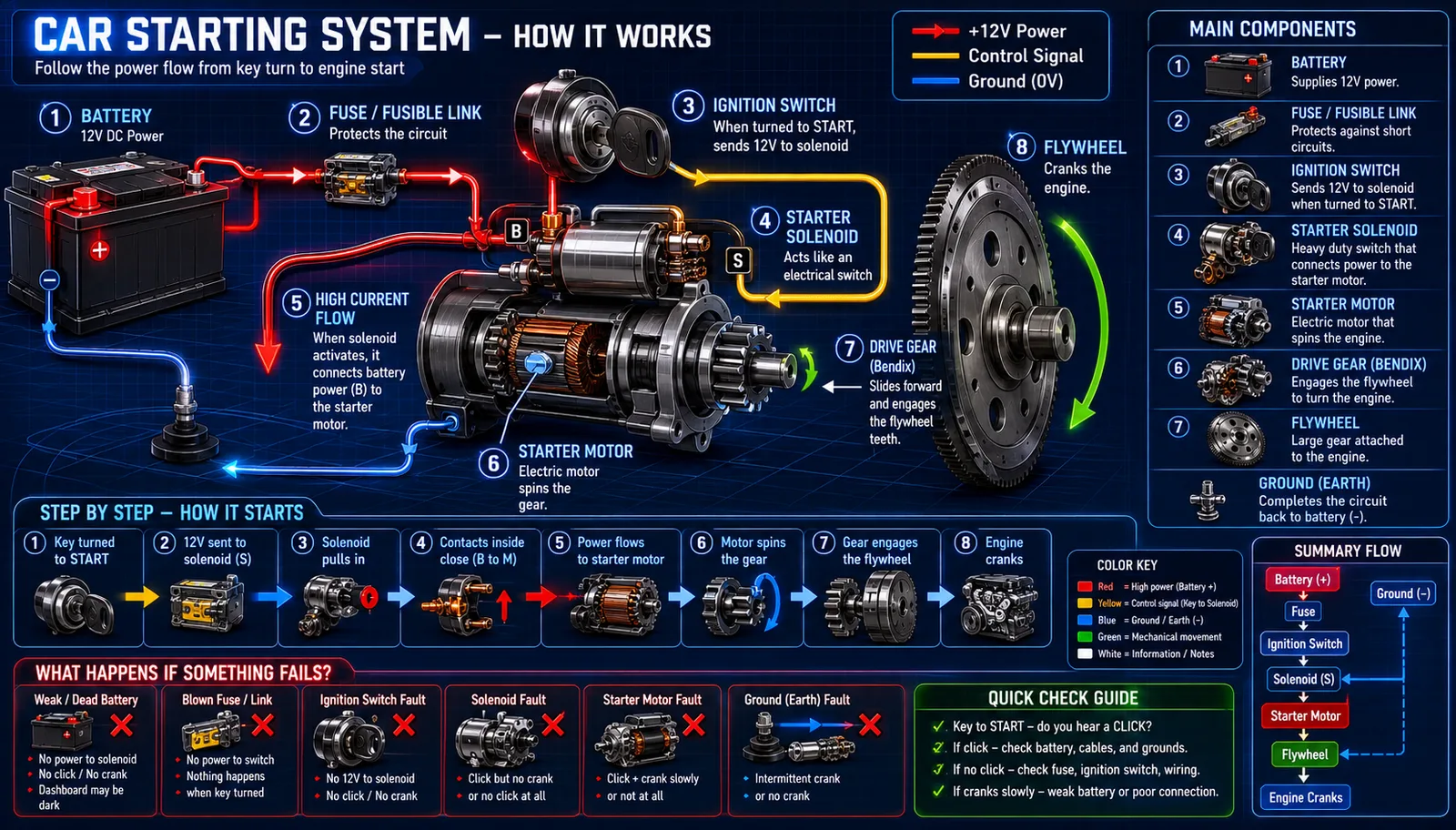
Starting a cold engine is genuinely one of the hardest things it has to do all day. The battery has to spin the starter motor fast enough to crank the engine — and cold temperatures kill a battery's available power. A 12V lead-acid battery loses roughly 20% of its cranking power at 0°C and closer to 50% at -10°C. Meanwhile the engine oil has thickened overnight into something resembling treacle, so the starter has to work harder against more resistance just to turn the thing over. On a petrol engine, the ECU richens the fuel mixture and holds the idle higher until things warm up — if sensors are playing up, that balance goes wrong. On a diesel, the glow plugs pre-heat the combustion chambers before cranking; worn plugs fail to do that, and cold diesel simply won't ignite. Diesel fuel itself can start to cloud and wax in very cold conditions if it's summer-grade fuel still sitting in the tank. So the cold morning non-start is almost never one single dramatic failure — it's usually a marginal component that was just about getting away with it all summer, finally meeting conditions it can't handle. That's why plugging in a diagnostic tool and running a proper battery load test tells you far more than staring at the engine does.
“The battery was borderline, the glow plugs were tired, and the starter motor had been phoning it in since roughly March.”
Sound familiar?
So what's behind it?
What we do — at your door
We come to you — driveway, car park, or roadside — with a full diagnostic kit and a proper battery load tester, not a multimeter and a prayer. A voltage reading alone won't catch a battery that's failing under load, so we apply a calibrated load test that shows actual cranking capacity against the battery's rated cold-cranking amps (CCA). We read fault codes, check live data from the relevant sensors (coolant temp, crankshaft position, fuel rail pressure on diesel), and test glow plug resistance individually. If the battery needs replacing we can do it on the spot with a correctly-specced unit. Glow plugs, starter motors and fuel filters are jobs we carry out at your location — no garage drop-off, no waiting room, no being told it'll be ready Thursday.
What affects the price
Battery replacement cost depends heavily on the battery specification — a small city car battery and a large diesel SUV battery are very different prices. AGM batteries (required by most modern stop-start cars) cost considerably more than standard lead-acid. Glow plug replacement varies by how many cylinders the engine has and how accessible the plugs are — some diesel engines make this a very straightforward job; others require partial inlet manifold removal. Starter motors range from bolt-on replacements to half-day jobs depending on where the manufacturer chose to hide them. A diagnostic call-out with a proper load test and fault code read is a fixed cost regardless of what we find — it's the step that stops you buying the wrong part first.
Random knowledge you didn't ask for
Questions you're probably asking
Can I just jump-start it and carry on, or do I need a new battery?
A jump-start gets you moving, but if the battery failed a cold-start test it will fail again — probably at a worse moment. A healthy battery that's just been deeply discharged once (lights left on) can often recover. A battery that's failed under load or is more than four years old is telling you something. We test on site so you get an actual answer, not a guess.
My diesel starts fine in summer but struggles every winter — is that normal?
Struggling is not the same as normal. A diesel with healthy glow plugs and a good battery should start reliably down to well below freezing. Repeated cold-start difficulty is usually worn glow plugs letting the side down, or a battery that's marginal but coping in summer. Both are cheap to sort relative to what happens if the starter motor burns out trying to compensate.
How do I know if it's the battery or the starter motor?
The behaviour usually gives it away: a slow, weak crank points to battery; a single loud click (or rapid clicking) with no crank suggests battery or starter solenoid; a crank at normal speed that won't fire is almost never the battery or starter — it's fuelling or ignition. A load test and live diagnostic data separate them quickly without guessing.
My car has stop-start — does it need a special battery?
Yes, and this matters a lot. Stop-start systems use AGM (Absorbent Glass Mat) or EFB (Enhanced Flooded Battery) batteries that can handle hundreds of partial charge cycles. Fitting a standard lead-acid battery in a stop-start car will likely kill it within a year and can confuse the battery management system. We fit the correct type for your vehicle.
Can you come out if the car won't start at all — I can't drive it anywhere?
That's exactly what we're for. A car that won't start is the most inconvenient time to need a garage, and the most convenient time to have a mechanic who comes to you. We'll come to wherever the car is, diagnose it on site, and either fix it there or tell you clearly what needs doing and what it will cost.
Your Car Won't Start in Cold Weather — sorted at your door
Stop procrastinating. Get a transparent quote and we'll come to you.