Car Won't Start — Identify Your Suspect, Then Call in the Expert
Monday morning. You're already running late. You slide into the driver's seat, turn the key — and absolutely nothing happens. Or there's a click. Or the engine whirrs away cheerfully like it's fine and then completely bottoms out on actually, y'know, firing. The car has betrayed you. Specifically, it has chosen this morning, this moment, this commute. The good news is that "car won't start" almost always boils down to one of three very identifiable suspects — and once you know which one you're dealing with, you know exactly what needs doing. SOSCarFix mobile mechanics come to wherever your car has decided to stage its protest — driveway, car park, side street — diagnose the culprit, and sort it on the spot.
See our upfront pricingCar won't start? SOSCarFix mobile mechanics diagnose the silent treatment, the click of doom, or the cranks-but-won't-fire tease — and fix it at your door across the UK.
How it actually works
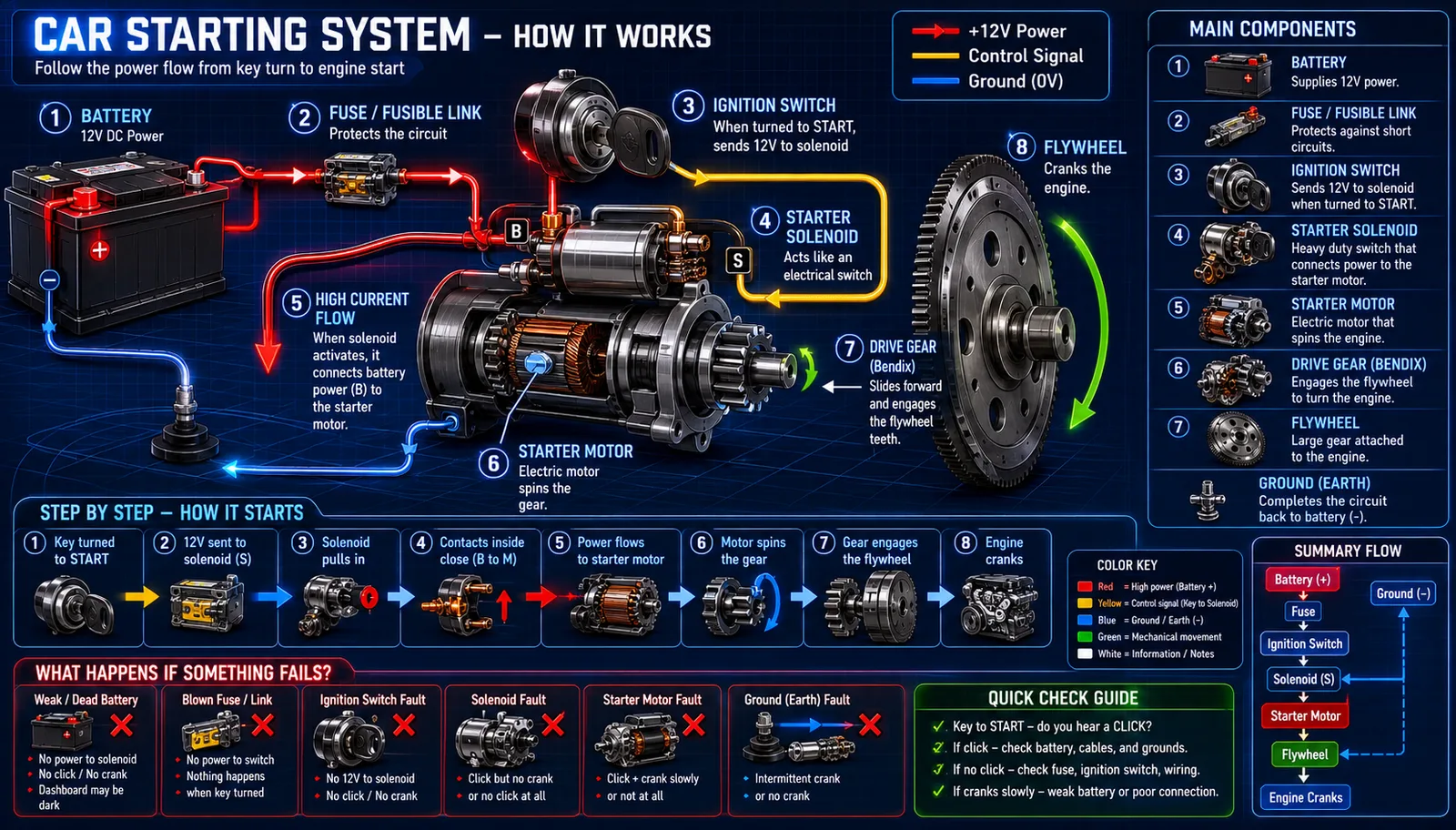
We've built our whole diagnosis around the three suspects in the Monday-morning betrayal. First, we ask you one question: what did it do when you turned the key? That single answer already points us at the guilty party before we've lifted a spanner. Suspect One — The Silent Treatment: You turn the key and get nothing. No click, no whirr, just your own disappointed sigh echoing back at you. This is usually a completely flat battery, a snapped or corroded battery terminal connection, or — less commonly — a blown main fuse. Our engineer will test your battery voltage on the spot with a load tester, check the terminals, and tell you whether it needs a jump, a new battery, or something further up the circuit. Suspect Two — The Click of Doom: You turn the key and hear a rapid machine-gun clicking, or a single heavy clunk, then silence. The rapid clicking is almost always a battery with just enough life left to wake the solenoid but not enough to actually spin the starter motor. One heavy click points more specifically at the solenoid or starter motor itself giving up the ghost. We'll test the battery under load, check the starter circuit, and replace what's actually failed rather than guessing. Suspect Three — The Cranks-But-Won't-Fire Tease: The engine spins — rrrr-rrrr-rrrr — with complete confidence and absolutely no intention of starting. This is the cruellest one, because it sounds like it almost wants to. The starter motor is fine; the problem is somewhere in fuel, spark, or signal. A failed fuel pump, clogged fuel injectors, a dead crankshaft position sensor, dodgy spark plugs, or a failed immobiliser can all produce this exact maddening routine. We carry diagnostic equipment to read fault codes, check fuel pressure, and test the ignition system before condemning any one part. Once we've identified the culprit, we carry the most common replacement parts with us. Many jobs are completed in under an hour, at whichever postcode your car has chosen to throw its tantrum.
“Or the engine whirrs away cheerfully like it's fine and then completely bottoms out on actually, y'know, firing.”
Sound familiar?
So what's behind it?
What we do — at your door
When you call SOSCarFix, a qualified mobile mechanic comes to you — no tow truck, no waiting around in a garage reception pretending to enjoy their magazines. We bring a battery load tester, a professional-grade OBD diagnostic reader, and the most commonly needed parts for exactly this kind of job. We run through the three suspects methodically: battery and charging circuit first, starter circuit second, fuel and ignition system third. We tell you clearly what we've found, what needs replacing, and why — in plain English, not in the kind of language designed to make you feel like you have no choice. If it's a battery, a starter motor, a fuel pump relay, or a set of spark plugs, there's a very good chance we can fix it the same visit. If it turns out to be something more involved, we'll tell you that too, honestly, before any work begins.
What affects the price
Several things affect what a no-start diagnosis and repair will cost. The main ones are: which of the three suspects is actually responsible (a battery swap and a fuel pump replacement are very different jobs), the make and model of your vehicle (parts costs vary enormously between a fifteen-year-old hatchback and a current German executive saloon), your location (we cover a wide area but travel distance is a factor in any mobile call-out), and whether the fault is a straightforward single-component failure or a more involved electrical gremlin that needs extended diagnostic time. We give bespoke quotes once we know what we're dealing with — contact us and we'll talk it through.
Random knowledge you didn't ask for
Questions you're probably asking
My car did start eventually after a few tries — do I still need it looked at?
Yes, and sooner rather than later. A battery or starter motor that's failing will sometimes scrape through a cold start before giving up entirely at the worst possible moment. The intermittent-but-fine stage is the warning before the stranded stage.
I got a jump start and it drove fine — is the problem solved?
Probably not. A jump start gets you going but it doesn't fix whatever went flat in the first place. It could be a failing battery that can no longer hold charge, a faulty alternator that isn't recharging the battery while you drive, or a parasitic drain pulling it flat overnight. Worth having the charging system tested before it lets you down again.
The engine cranks but won't start — could it be the immobiliser?
It could. If the car suddenly won't fire despite cranking normally, and there are no obvious fuel or spark faults, the immobiliser is absolutely on the suspect list. A flashing immobiliser light on the dashboard is a giveaway, but not all cars make it obvious. We can read the fault codes and check whether the ECU is receiving a valid key signal.
Can you fix a no-start at my home or workplace?
That's exactly the point. We come to wherever the car is sitting refusing to cooperate — your driveway, an office car park, a layby, wherever. You don't move; we do.
Why does my car start fine when it's cold but won't start once the engine's already warm?
This is a hot-start problem, and it's not your imagination — it genuinely starts worse when warm. The usual suspects are a heat-soaked fuel pump that's on its last legs (they struggle when hot), vapour lock in older or modified fuel systems, a failing coolant temperature sensor giving the ECU a completely wrong reading and over-fuelling the restart, or a crankshaft position sensor that loses its signal when the metal around it expands with heat. It needs live-data diagnostics while the engine is warm to catch it in the act — a cold test won't show anything.
Why does my car not start when it's wet or damp outside?
Moisture is brilliant at finding the gaps in an aging ignition system. The most likely culprits are a cracked or tracking distributor cap (older cars), perished HT leads letting spark leak to earth instead of the plug, or a damp coil pack. Petrol engines are far more susceptible than diesels — the high-voltage ignition circuit absolutely hates damp. If it starts fine on a dry morning but refuses after overnight rain, that's your tell. A proper ignition system inspection will find exactly which component is leaking spark before the next wet Tuesday ruins your morning.
Car Won't Start — sorted at your door
Stop procrastinating. Get a transparent quote and we'll come to you.