Puddle Under the Car With the AC On: Normal Condensation or Actual Problem?
You get back to your parking space and there's a wet patch under the front of the car. Your heart sinks. You google it. The internet immediately suggests head gasket failure, a cracked block, or possibly the apocalypse. Then someone in a forum says "relax, it's AC condensation" — and you don't know who to believe. Here's the honest answer: if it's a clear, odourless puddle roughly under the front passenger footwell area and you've had the air conditioning running, there is an extremely good chance it is entirely, boringly normal. Your AC system literally produces water as a by-product of doing its job, and that water has to go somewhere. It goes under your car. This page tells you exactly what's happening, how to tell normal condensation from an actual leak worth worrying about, and when to call us.
See our upfront pricingWater dripping under your car when the AC's on? Almost certainly fine. Here's how to tell it apart from coolant or screenwash — and when to actually worry.
How it actually works
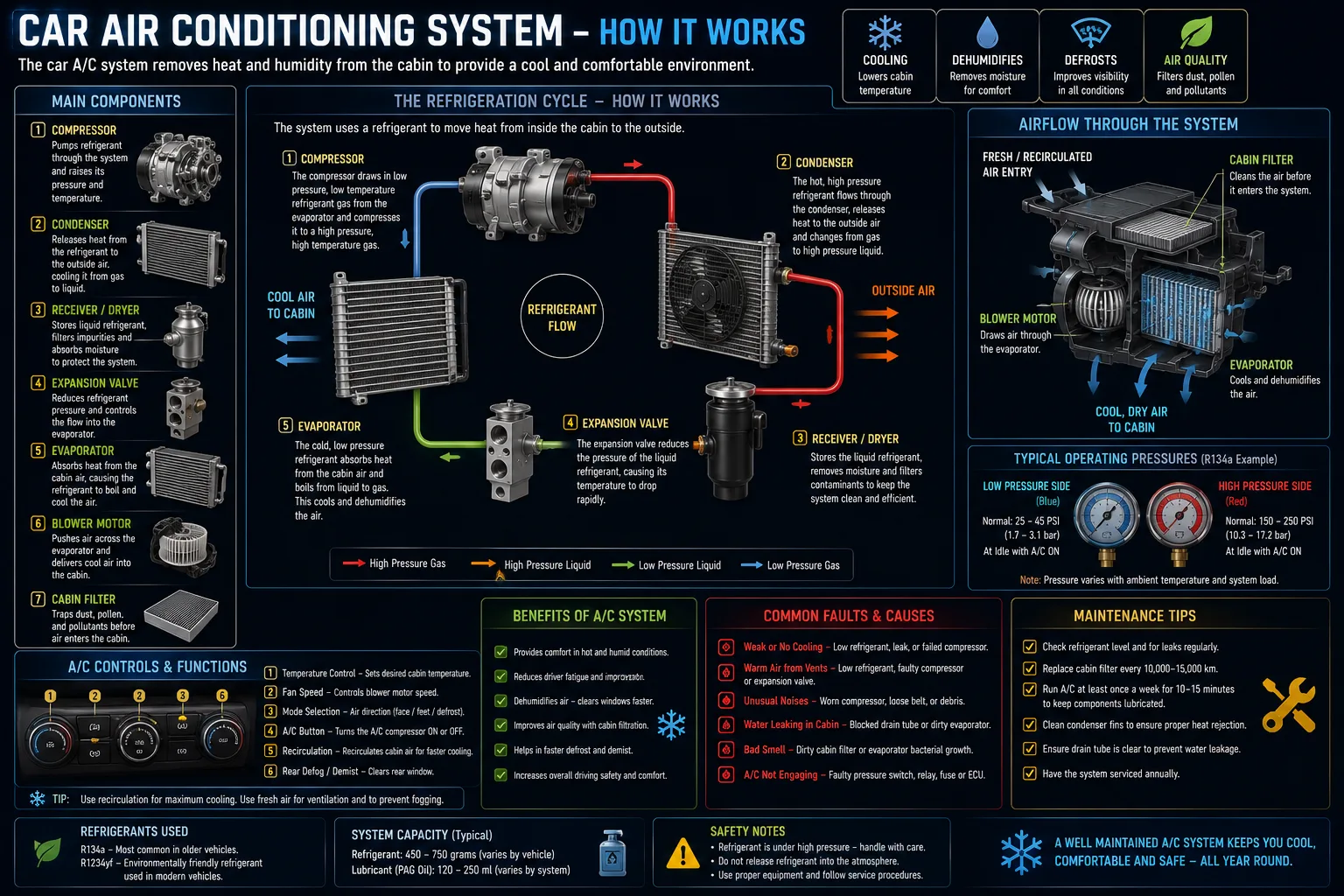
Your car's air conditioning system cools the cabin by passing warm, humid air from inside the car over a very cold component called the evaporator — a fin-and-tube heat exchanger that lives behind your dashboard, usually in the centre or slightly to the passenger side. The evaporator gets cold enough (sometimes below 5°C) that moisture from the air condenses on its surface, exactly like a cold glass of water on a warm day. That condensation collects in a shallow tray beneath the evaporator and drains away through a rubber drain pipe — called the evaporator drain or condensate drain — that exits through the bulkhead (the firewall between the engine bay and cabin) and drips harmlessly onto the road underneath the passenger side of the car. On a hot, humid British summer day (yes, both of them) with the AC working hard, you can produce a surprising amount of water — easily half a litre over a moderate journey. The system is designed to drain that water away. A puddle under the front passenger area after running the AC is the system working exactly as it should. The only time the condensate drain becomes a problem is if it gets blocked — in which case the water has nowhere to go and backs up into the cabin instead, soaking the front passenger carpet.
“Your AC system literally produces water as a by-product of doing its job, and that water has to go somewhere.”
Sound familiar?
So what's behind it?
What we do — at your door
If you're genuinely unsure whether what you're seeing is normal AC condensation or something more sinister, we'll come to you — your driveway, workplace, or wherever the car lives — and check it properly. We'll identify the source of the drip (condensate drain, coolant, screenwash, or something else entirely), inspect the evaporator drain pipe for blockages (a blocked drain means cabin flooding rather than ground draining, and causes exactly the kind of musty-smelling carpet nightmare nobody wants), and check the AC system's pressures while we're there. If your AC has also started blowing warmer than it should, we can regas the system, check for refrigerant leaks with UV dye, and inspect the compressor and condenser. No dragging your car to a garage, no waiting room with ancient magazines — we bring the tools to you and tell you plainly whether there's a problem or whether you can stop worrying.
What affects the price
Unblocking a condensate drain is a minor job and should cost very little — it is often sorted in minutes during an AC inspection. If the blocked drain has caused carpet saturation, drying that out is a separate job and the cost depends on how soaked it is and whether mould has taken hold. An AC regas (if the system is low on refrigerant separately) typically runs from around £50–£90 depending on the refrigerant type (older R134a systems are cheaper than the newer R1234yf refrigerant used on post-2017 cars, which costs significantly more per kg). Coolant leak repairs vary enormously — a loose hose clip is pennies, a weeping radiator is more, a head gasket is a whole different conversation. We quote before touching anything.
Random knowledge you didn't ask for
Questions you're probably asking
There's water dripping under my car on the passenger side — should I be worried?
Almost certainly not, if your AC has been running. The evaporator condensate drain exits on that side of the car and drips collected moisture onto the road — that is the system working correctly. Check whether the puddle is clear and odourless. If yes and the AC was on, it's condensation. If it's coloured, sweet-smelling or coming from elsewhere, that warrants a proper look.
How do I tell AC condensation apart from a coolant leak?
Coolant is almost never clear — it's dyed green, blue, orange or pink depending on the type used. It also has a distinctive sweet, slightly sickly smell. If you see a coloured puddle with an odour, or the temperature gauge is doing anything odd, that is a coolant issue and worth getting checked. Clear, scentless water that only appears after AC use? That's just condensate.
My front passenger carpet is wet but there's nothing dripping outside — what's happening?
The condensate drain pipe is almost certainly blocked. Instead of draining to the outside, the water is backing up into the drain tray and overflowing into the passenger footwell. It needs clearing before the carpet gets soaked through or mould takes hold. We can sort that on-site — it's usually a straightforward job.
The water under my car smells slightly sweet — is that still AC condensation?
No — condensation is odourless. A sweet smell strongly suggests coolant, which is toxic and should not be left dripping. Check the coolant reservoir level (cold engine only, never remove the cap hot) and get it looked at promptly. We can come to you, identify the source, and repair it without the drama of a garage recovery.
Does AC condensation mean my air conditioning is low on refrigerant?
Not at all — these are unrelated. A well-gassed, perfectly functioning AC system produces condensation as normal operation. A low-on-refrigerant system will produce less cooling (warm air, slower cool-down) and may produce less condensation as the evaporator isn't getting as cold. If your AC is blowing cold and you're seeing a water drip, the AC is doing its job.
Puddle Under the Car With the AC On — sorted at your door
Stop procrastinating. Get a transparent quote and we'll come to you.