Air Con Blowing Warm: Why Your Car Has Turned Into a Rolling Sauna
British summer lasts approximately eleven days, and your car's air conditioning has managed to stop working for at least nine of them. Classic. The moment the temperature creeps above 20°C and the nation reaches collectively for their sunglasses, the AC decides to contribute nothing but a faint wheeze of ambient-temperature air — essentially the same breeze you'd get from opening a window, except with a compressor noise to really twist the knife. The good news is that warm air from the vents is almost always diagnosable and fixable: it's usually refrigerant running low (or gone entirely), a compressor that's given up, a blocked condenser, or something electrical sulking behind the scenes. The bad news is that "just do a regas" is sometimes the beginning of a longer conversation. We come to you, diagnose the actual cause, and sort it — before the weather changes back and the whole problem becomes irrelevant until next June.
See our upfront pricingAC blowing warm air? We diagnose refrigerant leaks, failed compressors, and blocked condensers — mobile, at your driveway. Get a quote today.
How it actually works
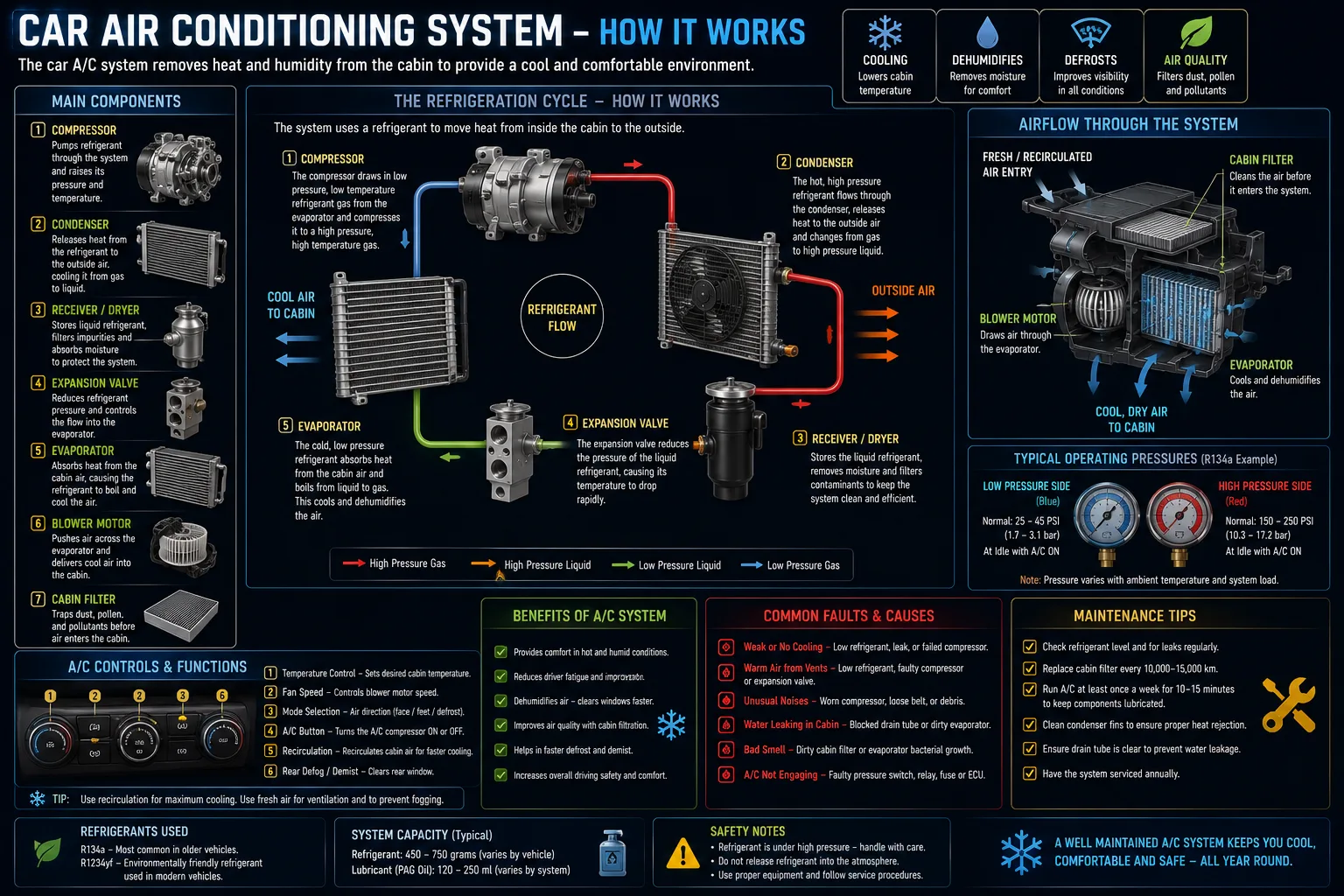
Your car's air conditioning is a sealed refrigeration loop. A compressor (driven off the engine by a belt and clutch) compresses a refrigerant gas — either R134a in older cars or the newer R1234yf in post-2017 vehicles — and pushes it under high pressure to the condenser, which sits at the front of the car and looks like a thin radiator. There, the hot compressed gas sheds its heat to the outside air and condenses into a liquid. That liquid then passes through an expansion valve, drops in pressure dramatically, and evaporates inside the evaporator — a heat exchanger tucked behind your dashboard. Evaporation pulls heat from the cabin air blown across it, and that's what you feel as cold air. Simple enough in principle; a lot of things can go wrong in practice. The most important thing to understand is that the system is sealed and the refrigerant does not get consumed — it circulates forever. If the charge is low, refrigerant has gone somewhere, usually through a slow leak at a hose joint, O-ring, or the compressor shaft seal. An annual top-up that keeps the system limping along for a year before dying again is always a slow leak in denial. Leaks need finding and fixing, not indefinitely topping over. A regas on a leaking system isn't a repair — it's a very temporary optimism.
“The bad news is that "just do a regas" is sometimes the beginning of a longer conversation.”
Sound familiar?
So what's behind it?
What we do — at your door
We come to you — driveway, work car park, wherever the car is sweating — with the equipment to actually diagnose what's going on rather than just blindly pumping refrigerant in and crossing fingers. We start with a system pressure check to establish whether refrigerant is present and at the right level, then check whether the compressor clutch is engaging, inspect the condenser for blockage or damage, and run an electrical check on the relevant fuses, relays, and pressure switches. If there's a leak, we introduce UV dye and check with a UV lamp to locate exactly where refrigerant is escaping before recommending any repair — because a regas without leak detection on a low system is money wasted. Where the system holds charge and just needs a proper regas, we recover whatever refrigerant remains, weigh in the correct quantity of R134a or R1234yf (whichever your car takes), and recheck pressures under load. If you've got a compressor, condenser, expansion valve, or electrical fault, we quote that separately and clearly before any work begins. We also carry cabin filters and can kill the bacteria on the evaporator with an anti-bacterial treatment if your car has developed that distinctive "wet dog in a gym locker" fragrance. All of it at your location, because sitting in a hot car waiting for a garage appointment is exactly the kind of suffering this service exists to prevent.
What affects the price
AC work in the UK varies significantly depending on what the actual fault is, and anyone who quotes a flat price for "air con repair" without diagnosing it first is guessing. A straightforward regas on a system that holds pressure — where refrigerant has simply leaked down over many years and no active leak is present — is the cheapest outcome. Add a UV dye leak test and you're still in relatively modest territory. The cost rises when there's an active leak requiring a new O-ring, hose, or shaft seal — prices vary by part and accessibility. A failed compressor is a more significant job: the compressor itself varies in cost by make and model considerably, and on many cars it's a meaningful labour job too; compressors should also be accompanied by a new receiver-drier and expansion valve as a matter of good practice, since debris from a failing compressor contaminates the circuit. Condenser replacement varies by vehicle — some are a thirty-minute job, others require removing half the front end. R1234yf refrigerant (found in most post-2017 cars) costs considerably more than the older R134a, which is simply the reality of the newer, lower-global-warming-potential gas. We quote the full job transparently before touching anything.
Random knowledge you didn't ask for
Questions you're probably asking
Can I just keep doing a regas every year instead of fixing the leak?
Technically yes, in the same way you can keep topping up a leaking tyre with air instead of repairing the puncture. It'll work for a while. But refrigerant that's escaping into the atmosphere is both wasteful and — in larger quantities — a legal grey area. More practically, a slow leak becomes a faster leak over time, and when the charge drops below the low-pressure switch threshold the compressor stops cycling, which can accelerate wear. Finding and fixing the leak costs more upfront but less across three years.
My AC works fine when I'm moving but blows warm at idle or in traffic — what's that?
Almost certainly a condenser airflow problem. At speed, ram air pushes through the condenser and carries the heat away. At idle, you're dependent on the electric cooling fan to do that job. A blocked condenser, a failed condenser fan, or a fan that's not being commanded on by the AC system will produce exactly this symptom — fine on a dual carriageway, useless in a traffic jam on a hot day, which is precisely when you need it most.
The AC was working and then just stopped suddenly — compressor or electrical?
A sudden stop rather than a gradual deterioration usually points to electrical: a blown fuse, a failed relay, a pressure switch cutting out because the refrigerant charge dropped to zero, or the compressor clutch coil dying. A compressor failure is more often heralded by noise first — grinding, rattling, or a seized-up feeling — before it stops working. We'll check both: measure pressure, check the clutch engagement signal, and work backwards from there.
My car has R1234yf — does it cost more to regas?
Yes, noticeably. R1234yf is the refrigerant now used in most cars built from around 2017 onwards, and it costs considerably more per kilogram than the older R134a. It also requires different handling equipment. A regas on a newer car will cost more than on an older one for this reason alone — it's the gas price, not us being creative with the invoice.
How long does an AC regas or repair take at my location?
A regas with a pressure and leak check is typically under an hour. Adding UV dye and a leak inspection adds a little time but not much. Electrical diagnosis — relay, fuse, clutch coil testing — is usually another thirty minutes to an hour depending on accessibility. A compressor or condenser replacement is a more involved job and we'll give you a realistic time estimate when we quote it, because access varies enormously by car.
Air Con Blowing Warm — sorted at your door
Stop procrastinating. Get a transparent quote and we'll come to you.