Dead Air Con Compressor: The Part That Decided Summer Was for Other People
There you are, first properly warm day of the British year — which statistically lands on a Tuesday in May and lasts until Thursday — and you jab the air con button with the confidence of someone who definitely got it serviced. Nothing. Or worse, not nothing: a horrible grinding rattle from under the bonnet, followed by a hot, stale, vaguely sock-scented breeze from the vents. The air con compressor has given up. It's the heart of your climate control system, and when it fails it doesn't fail quietly — it announces its death with the theatrical squeal of a seized clutch or the bone-dry rattle of a bearing on its way out. And unlike a lot of car faults you can quietly ignore for six months, a failed compressor has a charming side effect: it can spray metal debris through the entire refrigerant circuit, contaminating everything downstream. SOSCarFix comes to you, sorts it properly, and restores your right to not arrive at a job interview absolutely drenched.
See our upfront pricingSeized A/C compressor turning your car into a rolling greenhouse? SOSCarFix replaces it at your driveway — no garage faff, no waiting. Get a quote today.
How it actually works
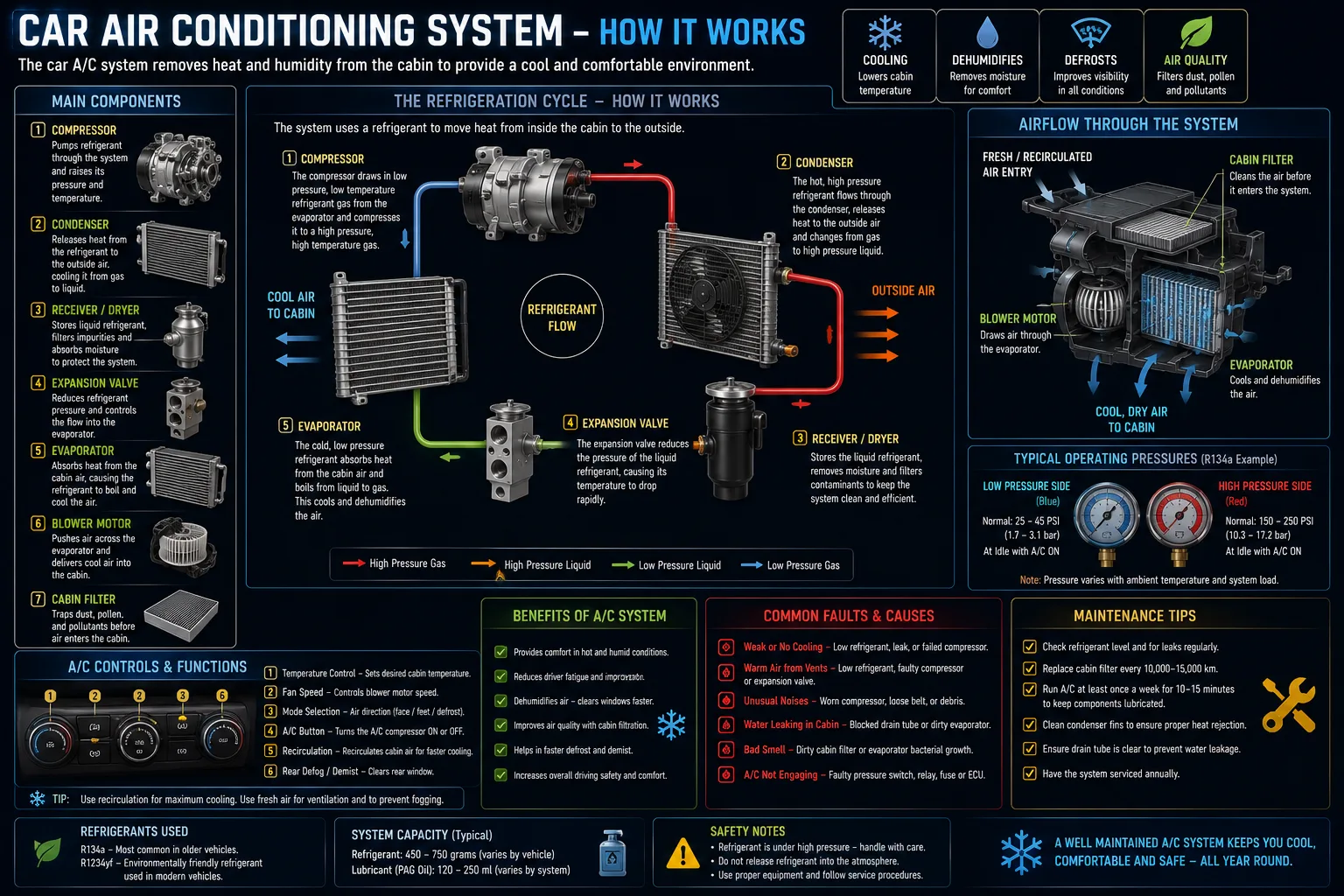
The air conditioning compressor is a belt-driven pump bolted to your engine that takes low-pressure refrigerant gas (R134a in older cars, R1234yf in anything built after roughly 2017) and compresses it into a high-pressure liquid. That liquid travels to the condenser at the front of the car — the bit that looks like a second radiator — sheds its heat, then passes through an expansion valve, drops in pressure, evaporates, and in doing so absorbs heat from your cabin air. That's the cold. The compressor makes the whole cycle happen, and it runs every time you press that A/C button (or defrost, because your car secretly uses the A/C to dehumidify). Most compressors use an electromagnetic clutch on the front pulley: when the system calls for cooling, the clutch engages and the compressor spins; when it doesn't, the pulley freewheels. That clutch is often the first thing to fail — either it seizes solid (so the belt either snaps or screams) or it stops engaging entirely (so nothing happens but the pulley spins happily and uselessly). When the internal components of the compressor itself fail, they shed metal swarf into the refrigerant circuit. At that point, a straight swap isn't enough — the system needs to be recovered, the condenser and receiver-drier replaced too, the lines flushed, the system recharged, and the whole thing pressure-tested. Anyone telling you just a compressor swap will sort contaminated-system failure is either optimistic or economical with the truth.
“SOSCarFix comes to you, sorts it properly, and restores your right to not arrive at a job interview absolutely drenched.”
Sound familiar?
So what's behind it?
What we do — at your door
SOSCarFix sends a qualified mobile mechanic to wherever your car lives — driveway, work car park, or roadside if it's got to that point — with the right equipment to do this properly, not cursorily. We recover any remaining refrigerant safely (legally required; you cannot just vent it to atmosphere, and anyone who offers to is not someone you want working on your car), remove the failed compressor, and assess what else needs attention. If the compressor has shed internal debris, we'll tell you straight: the condenser needs replacing and the system needs flushing, because fitting a new compressor into a contaminated circuit is a gift that keeps on giving (until the new compressor dies in the same way). We fit the correct refrigerant type for your vehicle — R1234yf is not a drop-in substitute for R134a, and vice versa — recharge to specification, and leak-test before handing the car back. No garage, no waiting room, no being talked into a cabin air filter you didn't ask about.
What affects the price
Air con compressor replacement is not a flat-rate job, and anyone quoting you a firm price over the phone without knowing your car is either guessing or planning to add things on. The compressor itself varies dramatically by vehicle: a unit for a mid-size family hatchback costs substantially less than one for a German executive car or anything with a variable-displacement compressor (which adjusts its own output and is correspondingly more expensive to replace). Labour time also varies — some compressors are accessible in thirty minutes, others involve removing half the front end. If the system has been contaminated by compressor debris, add the condenser, the receiver-drier (which must always be replaced on a full recharge), a system flush, the correct refrigerant by volume (R1234yf is more expensive per kilogram than R134a, full stop), and a pressure-test soak period. Geography plays a role too — parts availability and mobile call-out in central London differs from a rural postcode. Get a proper quote with your reg and an honest description of what it's doing, and be suspicious of anyone working suspiciously cheaply on a job this involved.
Random knowledge you didn't ask for
Questions you're probably asking
Can I just drive with a broken air con compressor and ignore it?
Depends on how it's broken. If the clutch simply won't engage and the compressor freewheels harmlessly, you can drive indefinitely — just without cold air, which is your problem not the car's. If the clutch has seized solid and the bearing is grinding, you're on borrowed time: that bearing will eventually fail catastrophically and could take the serpentine belt with it. At that point the engine overheats, the alternator stops, and your pleasant fault has become a breakdown. Don't ignore a grinding or squealing noise from that area.
Does the whole system need flushing when the compressor is replaced?
Only if the compressor has failed internally and shed metal debris. If it's a clean clutch failure or an electrical fault with the clutch coil, and the refrigerant circuit is uncontaminated, a straight compressor swap with a new receiver-drier and a full recharge is sufficient. If there's swarf in the system — which you'll often see as a discoloured refrigerant oil when it's recovered — skipping the flush is how you kill the new compressor within twelve months. A good mechanic will check the recovered oil before quoting you for more work.
How do I know if my car uses R134a or R1234yf refrigerant?
Check the sticker under the bonnet near the A/C service ports — it'll state the refrigerant type and the correct charge weight in grams. As a rough guide, cars first registered before 2017 are almost certainly R134a; anything registered from January 2017 onward is very likely R1234yf, with some models switching earlier. The service port fittings are physically different between the two types, so even a determined amateur can't accidentally mix them. Your reg plate lookup will confirm it if the sticker is missing.
Is it worth replacing the compressor on an older high-mileage car?
Honest answer: it depends on the rest of the car. If the vehicle is otherwise solid and you plan to keep it, a compressor replacement is a legitimate repair — it's not a sign the whole car is falling apart. If the car has significant rust, a failing gearbox, and you're already emotionally preparing for its departure, spending several hundred pounds on A/C is a harder sell. We'll give you an honest assessment rather than talk you into a repair the car doesn't justify.
Can a mobile mechanic really do air con compressor work — don't you need a ramp?
For most cars, yes — a mobile mechanic can access and remove the compressor on a level surface without a ramp. The refrigerant recovery and recharge equipment is portable professional kit, not a garage-only installation. There are exceptions: a handful of vehicles where the compressor is buried under subframes or requires lowering the engine mount benefit from a ramp, and we'll tell you upfront if your car is one of them rather than show up and pretend otherwise.
Dead Air Con Compressor — sorted at your door
Stop procrastinating. Get a transparent quote and we'll come to you.